10 Best States for Lovers of American History

10. New Jersey – There are a number of decent Revolutionary War sites here, such as the Trenton, Princeton, Monmouth and Ft. Mercer battlefields, plus Morristown, which for two years was the winter encampment site for Washington’s army. In addition, there’s a Civil War prison site, Ft. Delaware, which sits on an island in the Delaware River. Prisoners who died there are buried at Ft. Mott, on the shore. At Weehawken, you can see the monument on site of Hamilton-Burr duel, and at West Orange you can visit Thomas Edison’s home, laboratories and office. In New Jersey are the birthplace sites of James Fenimore Cooper, Grover Cleveland and the home of Walt Whitman.
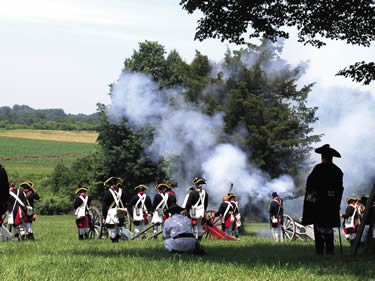
A reenactment at Monmouth

9. Missouri – The battlefields in Missouri don’t compare to the ones in the east, but there are a few, such as at Athens and Wilson Creek. In Independence you’ll find Harry Truman’s home not far from his presidential library. There’s plenty of Lewis & Clark history here (they left from St. Louis and traveled the Missouri River west), and a farm once owned by U.S. Grant, before he was important. Missouri has the homes of Mark Twain, George Washington Carver, John Pershing, Scott Joplin, Walt Disney and Thomas Hart Benton.

Harry Truman's home in Independence, Missouri

8. Texas – The Alamo (need I say more?), not to mention other Battlefields of the Texas Revolution, such as San Jacinto and Gonzales. Near Brownsville, you’ll find Mexican War battlefields. In San Antonio, in addition to the Alamo, you’ll find old 17th & 18th century Spanish missions to explore. The Texas State Cemetery in Austin is the final resting place for lots of important Texans, including Stephen F. Austin, General Albert Sidney Johnston and Governor John Connally (who was wounded in the car with Kennedy). There were dozens of Civil War skirmishes in Texas, including ones at Galveston, Corpus Christi and Sabine Pass.
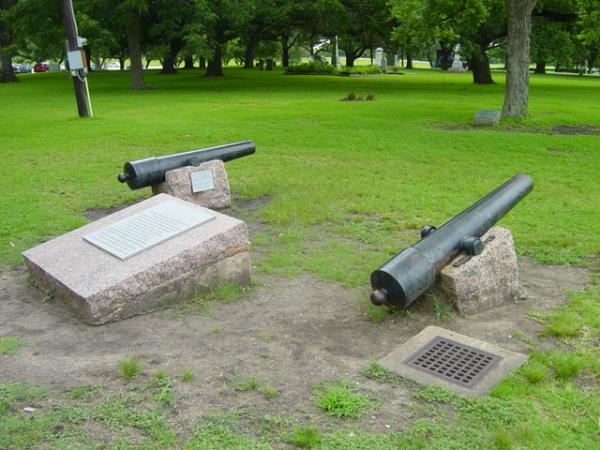
Cannon at San Jacinto

7. California – California doesn’t have the traditional battlefield-type sites that I like, but there’s still plenty of history here. In the Golden State, you’ll find Alcatraz, Death Valley, the Golden Gate Bridge, and Sutter’s Mill (Gold strike). If you like open spaces there’s the California Historic Trail, where hundreds of thousands of pioneers traversed and the Pony Express Trail. For the military buff, there’s the Presidio, which has been an army post for the Spanish, Mexicans and Americans. If you’re more into entertainment history, Hollywood and Burbank are mecca.
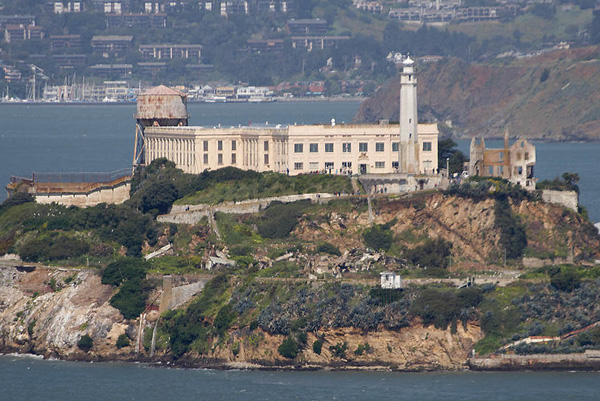
Alcatraz - Now Open for Tours!

6. Tennessee – Tennessee is second only to Virginia for sheer number of Civil War battles, including Shiloh, Chickamauga and Chattanooga, not to mention Forts Henry and Donelson. Andrew Jackson’s Hermitage is here, as well as the homes of presidents James Knox Polk (thumbs up) and Andrew Johnson (not so much).  For those who like a walk in the woods, you have Natchez Trace, a famous Indian/settler trail that is also where Meriwether Lewis met his end. Like Greek history? In 1897, Nashville rebuilt an exact replica of the Parthenon, including the statue of Athena inside. There are plenty of antebellum plantations that survived the war, if you like that sort of thing, and the Jack Daniels distillery if you get bored. The Oak Ridge National Laboratory, in the heart of Tennessee Valley Authority plants, was key to the Manhattan Project. And every American must at least once make a pilgrimage to Graceland, the home of Elvis Presley.
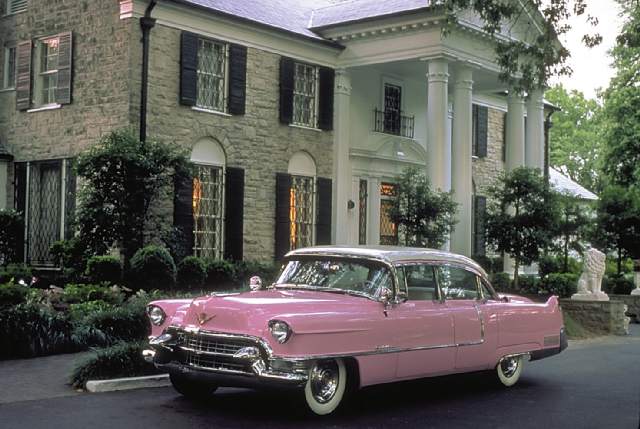
Graceland - Elvis' crib

5. New York – Home of the Bennington battlefield and Fort Ticonderoga, and Washington’s headquarters during the New York Campaign.You’ll also find plenty of War of 1812 history close to the Lakes. Sadly, almost all of the places fought over in New York City in the Revolution are now buried in asphalt, but you can still go there, just not at night, or alone. In New York City, there’s so much history that it’s impossible to list it all, so I’ll just mention the site of the Twin Towers, Trinity Church (Hamilton is buried there, along with many others), Wall Street (where Washington was sworn in as the first President), Ellis Island (I’m calling it New York, don’t even start that with me), the Statue of Liberty, and the Dakota. Lots of important people’s houses are in New York, like John Brown, Martin Van Buren, John Rockefeller, Thomas Paine (with grave), Susan B. Anthony and Millard Fillmore. Add to that the Military Academy at West Point (where a certain Benedict Arnold tried to sell us out). Oh, and the Erie Canal.

Alexander Hamilton's grave at Trinty Church

4. Massachusetts – Boston. Where do I begin? Let’s see, there’s the Old North Church, the Boston Massacre site, Boston Tea Party site, Bunker Hill, Old South Meeting House, the Paul Revere House, the USS Constitution and the JFK Presidential Library, just to mention the big targets. Getting outside of town, we get Fort Warren (where political prisoners were held during the Civil War, including the mayor of Baltimore) Lexington and Concord, John Adams and John Quincy Adams’ homes, the Lizzie Borden death house,  Waltham (Lowell’s girls), and Transcendentalist sites, like Walden Pond. And then there are the Puritan colonies, such as Plymouth (Pilgrims) and Salem (Witches), not to mention all of the Quaker and Shaker sites. For a small, state, it’s jammed packed full of history-goodness.
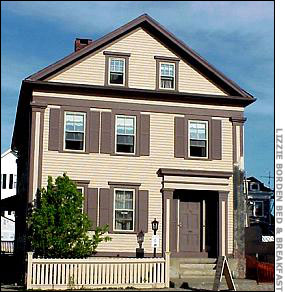
Lizzie Borden took an axe...

3. Pennsylvania – America started here (or so the Tourist Board says). Philadelphia, our nation’s capital for ten years, has Independence Hall (think Declaration of Independence, Constitution), the Liberty Bell,  the Constitution Center, the First (and Second) Banks of the United States, where Ben Franklin used to stay (and where he stays now, next to his wife, Deborah), Christ Church and Congress Hall. (I don’t mention Betsy Ross because it’s largely a myth.) You should also see Fort Mifflin, a Civil War-era fort (it’s haunted, you know). Outside of town we get the Washington Crossing site, Valley Forge, the Brandywine and Germantown battlefields, and as we move west, there’s Nirvana Gettysburg. Gettysburg is the site of the greatest battle in the history of the Western Hemisphere – I’ll just leave it at that. If this state had only Gettysburg, it would still be in the top ten. Continuing west, we get into lots of French and Indian War sites, including the Braddock battlefield, Fort Necessity and Fort Duquesne (sadly, you have to go to Pittsburgh to see this). James Buchanan’s house is in Pennsylvania, but there’s no need to stop there.
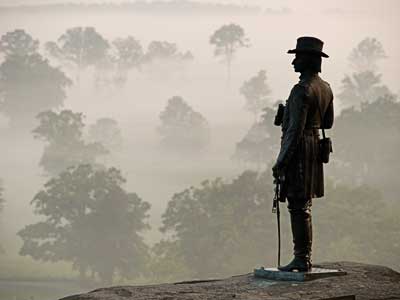
G.K. Warren's statue at Little Round Top

2. Virginia – Virginia is called the “Mother of Presidents” because so many were born there. Here’s the list: Washington, Jefferson, Madison, Monroe, W.H. Harrison, Zachary Taylor, John Tyler and Woodrow Wilson. Many of their homes are on the must see list: Mount Vernon, Monticello, Montpelier and Berkeley Plantation. Arlington National Cemetery was the home of Robert E. Lee; Virginia was also the home of Stonewall Jackson, J.E. B. Stuart, A.P. Hill and a slew of other Civil War greats. There are more Civil War battlefields in Virginia than any other state, and many of them were major, bloody engagements. Richmond, the Confederate Capital, has a ton of restored buildings and preserved artifacts. Down the Peninsula, we run into Yorktown, where the American Revolution ended, and Jamestown, where Virginia began. (Williamsburg is nice, but overly commercial.) Harpers Ferry was in Virginia when John Brown attacked it, so for the sake of this discussion, I’ve re annexed it. Newport News and Norfolk are wonderful if you like naval history (this is where the “Duel of the Ironclads” occurred).

The bed upon which Stonewall Jackson died, in the house where he died.

1. Maryland – OK, maybe I’m biased, but we’ve got it all! Let’s start at the start: Maryland’s First Colonial capital, St. Mary’s City, has been excavated and rebuilt and a replica of the ship that brought over the first settlers is there. Annapolis is loaded with colonial history, including the preserved room in the State House where George Washington resigned his commission. It’s also the home of the Naval Academy. South of town there’s Londontown, a colonial-era settlement currently being excavated; even farther south is the Surratt Tavern and the Mudd House along the path of John Wilkes Booth’s escape route. In Baltimore, there’s only Fort McHenry, the well-kept birthplace of the Star Spangled banner, Edgar Allan Poe’s house and grave, the B&O Railroad (America’s first), President Street Station (where the Baltimore Riot started), Westminster Cemetery, Greenmount Cemetery, the Carroll Mansion, the USS Constellation, the USCGC Taney (a Pearl Harbor survivor), the Flag House (where the Star Spangled Banner was made) and lots of historic churches and really old homes. Going west, we arrive at the South Mountain and Monocacy Battlefields, and then Antietam, the very well-preserved site of the bloodiest day in American history. Farther west we find Forts Frederick and Cumberland from the French and Indian War. The clincher for Maryland? It’s not only got its own historical stuff, it sits between Virginia, Pennsylvania and Washington, D.C. with all of their historical stuff. Living in Maryland, you are closer to history than anywhere else in America.
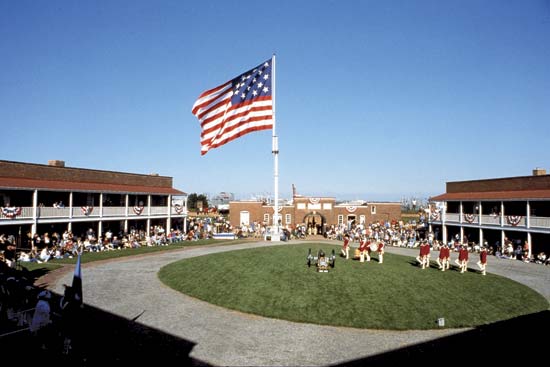
Fort McHenry
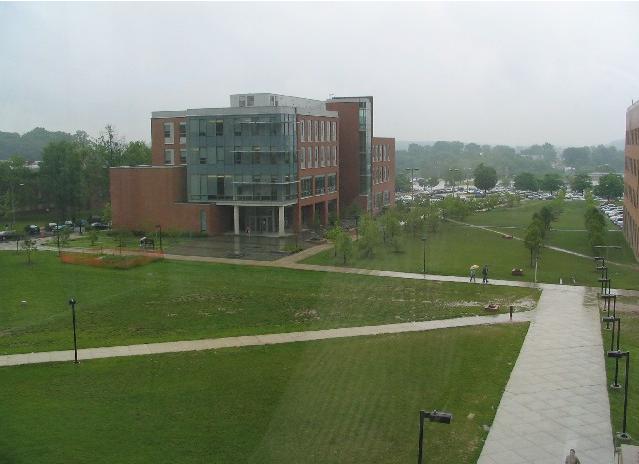
The Weather Underground Railroad

Walking around campus today, in weather that would have made a Dubliner proud, I was struck by the fashion choices I encountered. I considered myself reasonably dressed for cool, wet weather (of course, I was working, so my range of options were a little limited). For me, it was Dockers, a long sleeve dress shirt (no tie) and my UMBC windbreaker. As I said, very appropriate.


A cruddy day on campus


Passing me as I went were students in jeans and hoodies, shorts and tee-shirts, and some in heavy, winter parkas. While the weather wasn’t so extreme that any of these could be classified as signs of mental illness, it did strike me as a wonderful study in personalities.

Are the folks in shorts desperate to hold onto summer, did they spend the money their parents sent for clothes on something else, or do they just sweat more easily than others? And the people in huge winter coats, are they snow-lovers who just can’t wait, did they not have any clean clothes, or do they have circulatory problems?

And then there are the folks (mainly ladies, thank God) who wear sandals or flip flops with long pants, no matter the weather. Do they not have decent shoes? Do they imagine that their feet are really sexy, and they just can’t bear to hide them? Personally, I’ve never worn sandals or flip-flops, because I hate the way my feet feel in them, and then they get filthy inside and I hate that feeling, too.

One thing I’ve noticed that even when it’s really raining, most college students don’t use umbrellas, probably because they can’t carry them with all of the other stuff they’ve got. But they still don’t run to keep out of the rain, because then they’d look like a dork. So they just get wet.  Students who have been on campus a while, though, know how to go almost anywhere without getting wet – by dodging water-traps (like that spot under the overhang at the UC, or the numerous small lakes that develop in key locations) and by following meandering paths through close or connected buildings. It’s like the underground railroad for clever, water-adverse students.

My First, Largely Wasted Semester of Grad School

This fall I entered into my first semester of graduate school. (One of the cool perks of being a UMBC staff member is that the tuition is completely remitted. Make that a very cool perk.)

My undergraduate degree is in History, but my career path has taken me to DoIT at UMBC, so continuing my history education didn’t make much sense. Also, I needed a graduate degree that I could pursue online. For these reasons, I selected the UMBC Online Information Systems program, which fit all of my needs. The folks both at UMBC’s Graduate School and at the IS Department were great, and I was quickly accepted (because of my undergrad GPA, I didn’t have to take the GRE). (Here I also need to thank Drs. Laurie, Kars & Lindenmeyer for their recommendations on my behalf, not once, but twice. But more on that later.)

With the help of my graduate advisor (and Program Manager) Shannon Keegan, I was soon enrolled in my first two classes: IS 607, Intro to Information Systems, and IS 631 Management Information Systems. My books arrived by mail a few weeks before the start of the semester; I was ready to go.

One of my first thoughts upon starting the semester was how little the degree of difficulty seemed to have changed from my undergraduate courses. I guess I was expecting the coursework to be really, really heavy, but it was actually pretty manageable, even with a full-time job. I was used to getting A’s, but had been worried that I’d get less than a B as a graduate student and be disgracefully booted from the program. A couple of weeks into the fall semester, that fear was gone. (Don’t worry, it comes back.)

In IS 607, the coursework started with basic HTML, which seemed ridiculously easy. During the first week or two, we were asked to write simple HTML webpages and then upload these to our personal userpages for viewing by the instructor. (This is around the time when I was deciding that getting a master’s degree was going to be cake.) In IS 631, the assignments were much like what I had grown used to as a history major: read, take an online quiz (as many times as you needed to get 100%), submit a chapter evaluation to the discussion board, and write a short paper every few weeks. Again, cake.

By October, IS607 had moved out of HTML and into CSS style sheets. This is when I started remembering how much I hate coding. I mean really hate coding. But it was still OK, because there were plenty of workable examples I could use as a template (in the book and online) and I could modify these and learn enough to get by – for a time.

By mid-October, the class had moved into JavaScript, and I was panicked and lost. Hours and hours were spent banging away at the keyboard, bleary-eyed and wondering why pages weren’t rendering the way they were supposed to. More hours were spent doing internet research, trying to figure out what I was doing wrong, what key element I was missing in my code. This however, just added layer upon layer of suggestions and confusion to my already messy code, and before too long, I couldn’t tell what was broken and what worked anymore. I hate coding. I really do. I began to question whether I was cut out for online learning; maybe I needed an instructor in front of me two or three times a week. Maybe I’m just stupid.

OK, now... what's not quite right with this code...

I looked at the course catalog. Was IS607 really critical? Oh, it was not just critical, it was a prerequisite for every other class in the catalog. Awesome. Just awesome.

By Halloween, I had come to the grim and deflating decision that I had been defeated by IS607. I would withdraw, not just from the course, but from the Online IS program. I had been totally and utterly defeated – by JavaScript, no less.

Fortunately, I found another online graduate program that is more in line with my strengths, the Online Master’s in Instructional Systems Development – Training Systems. This program is more about people than code, which suits me far better, but still relates to my career in IT (think online learning, Blackboard, etc.). Even though it seemed like a lateral move to me, I had to reapply to the Graduate School ($50), forcing me to get my three recommendations all over again (thanks again Drs. Laurie, Kars & Lindenmeyer). But, that’s all done now, and I’m just waiting for the official word that I’ve been accepted so that I can get my spring classes set up.

Chuck Hodell, the nice guy at the ISD program who also wrote the book on ISD - literally!

What about IS631, you say? Well, I’m still acing that, although I must admit, not knowing if the credits will be transferable has certainly lowered my motivation, making even routine assignments feel like heavy lifting. Reading and then writing about something you won’t be needing in a few weeks gets progressively more difficult. So why not just withdraw from this class, too? Because I hated the feeling of being whipped by a class, and also it seems like such a waste, especially at this late point in the semester. I figure I might as well finish, get my A, and salvage a moral victory from my experiences this fall.

So it goes.

Blog Relaunch

(21st Century axiom: “I write, therefore I blog.”)

This blog was created because I just wanted a place where I could write whatever it was that struck me as interesting. I am a man of varied interests, so that ended up being everything from the Ravens to Sarah Palin. And that was fine.

Being a writer, I wanted to be read, so next came the promoting of the blog. Each time I publish an article, the blog software automatically posts a link to Twitter, which, in turn, automatically posts to Facebook. I also discovered that message boards were good places from which to link (great places, actually). By the second week, the number of hits on my blog was climbing out of the hundreds and into the thousands. Soon I found myself addicted to the tally, and spending way too much time figuring out how to drive traffic to my blog. The blog monster had been unleashed.

The Blog Monster - Unleashed!

By week three, the blog was beginning to feel like a part-time job. I’d write at night, post before work in the morning, and then spend the day pushing up the tally. But to what end, I asked myself? Does the world really need more commentary on Sheila Dixon and Sarah Palin? Do Baltimore sports fans wait with bated breath for my view of the Ravens next game? Probably Certainly not.

So, what unique perspective can I bring to the blogosphere, I wondered. Why should people bother to read my blog rather than a better researched opinion piece at a commercial news site? And maybe more importantly, how can I return this monster to its proper orientation in my life, so that I can enjoy blogging again? These are the things I was kicking around today, and after careful self-examination, I came up with this:

My experiences at UMBC. How many people are alumni, student and staff at UMBC, all at the same time? I’ve seen this university from pretty much all angles; I also remember it from my first go-round in the early eighties, and I can see how far its come since then. I’ve gotten to know a lot of people on campus, and I’ve experienced many things here. Plus, I’m going to be here for many years to come, so that puts me in the unique position of being able to chronicle not just the past and present, but the future as it unfolds. There are over 15,000 students, faculty and staff at UMBC, not to mention prospective students and alumni, so I have a ready-made audience as well. So there it is: this blog will henceforth be UMBC-centric, largely relating to my life here on campus, as a student and as an DoIT staff member.

How many times have I walked this path...

Having said that, however, it will not be UMBC-exclusive. I will continue History List Friday, not because I have to, but because I want to. I’ll also occasionally interject something personal or random, whenever the mood strikes me (this is in keeping with my stated objective not to have the blog feel like a job). I also intend on using images more often, because people, myself included, like to look at photos.

So, there it is. I hope you enjoy JamieUMBC, and if you do, I hope you subscribe by email, so that I have a way to gauge readership beyond the hideous tally…

Major Overhaul of this Blog Upcoming – Stay Tuned

I’ve decided to pivot away from the scattered, “a little bit of everything” focus that this blog has had. I’ve already decided where I want to go, but now I’m just working out how I want to implement the change. Stay tuned for details as I settle on them…

High School Hitman, Sexy Sarah Palin and Poor Steve Hauschka

Each of us can probably remember having to deal with a particularly difficult teacher in high school. Perhaps we didn’t like the subject (for me this would be math or science), or maybe we found the workload excessive. Sometimes there were just personality conflicts with individuals whom we found to be harsh or overbearing.

If provoked, we might, in a fit of pique, get worked up enough to say the wrong thing to our nemesis, which, if we weren’t careful, might land us in detention, or cause the teacher to have us killed. What’s that? You can’t recall any instances of teachers in your high school putting out a contract on students that angered them? Well then, you were just in the wrong high school.

At Mundy’s Mill High School in Clayton County, Georgia this fall, it seems as if 10th-grade teacher Randolph Forde had a problem student on his hands. On September 29th, he called the 16-year old out of class, demanding to know if he was gay. The next day, Forde argued with the student, and threatened “to hit him in his ‘effin mouth.” (Come on now, doesn’t that bring back memories of ol’ Mrs. Lardbottom from your school?) The student reported Forde to his school’s administration, but nothing was done. On October 9, Forde approached another student and offered to pay him for killing his classmate. Given the choice between earning some after-school money or destroying a teacher’s life, the assassin opted for the latter, and ratted out Forde. (Note to conspirators: It’s a bad idea to let the outcome of your plot to kill someone rest with the a teenage boy. Trust me on this.)

Incensed, the boy’s mother removed her son from the school and then filed a police report on October 12, resulting in Forde’s subsequent arrest and release on $10,000 bond. This, in turn, forced the school to remove Mr. Forde from the classroom (I guess being arraigned for conspiracy to commit murder is the triggering mechanism for intervention in Georgia public schools). Forde’s attorney now says it was all a joke. Funny guy, that Mr. Forde. Funny guy.

Sarah Palin, who, I’m led to believe, wants to be the leader of the free world, is using her endless, unmerited press coverage to attack Newsweek for their choice of cover photo. Palin said, “The choice of photo for the cover of this week’s Newsweek is unfortunate. When it comes to Sarah Palin, this ‘news’ magazine has relished focusing on the irrelevant rather than the relevant,” Palin wrote. “The out-of-context Newsweek approach is sexist, and oh-so-expected by now.”

"The Next President of the United States..."

Apparently, Palin posed in a skimpy running outfit for Runner’s World magazine, from where it was lifted by Newsweek. While it’s true that Newsweek was looking to make a statement by their choice of this photo, I’ve grown way past tired of hearing Sarah Palin disingenuously complain about being dealt with less than seriously by the media.  A year ago Palin could be granted an ignorance pass, but no more. If she wants to be taken seriously, she should appear on Meet the Press and Face the Nation, not Oprah. And when discussing economic policy differences with the President, she should stay away from silly-sounding comments such as:  Obama has a  “…backassward ways of trying to fix the economy.” Before you can sit at the grownup table, Sarah, you’ve got to be able to act like a grownup.

I know that just about every Ravens fan was relieved yesterday to learn that Steve “Wide Left” Hauschka had been released, but I feel terrible for him. As angry as I was when I saw his kicks sail outside the uprights, watching him walk back to the bench alone and then sit there staring at the ground, knowing that his dream was falling apart in front of his eyes… well, for me that was just heartbreaking. I suppose Hauschka knew that he was finished in Cleveland Monday night; I just can’t imagine having to continue playing, showering and dressing (without having the heart to celebrate a win) in the locker room, and then the long trip home – all the while knowing that you’re about to be fired. And then, to add insult to injury, the team’s fans dance on your grave. Good luck to you, Steve Hauschka.

Steve, we hardly knew ye

Sheila Dixon and The Doggedly Persistent Undercurrent of Race

Much is being made lately of the fact that many of Mayor Sheila Dixon‘s city constituents have come to her defense as she is tried for theft. Not surprisingly, the folks that are rallying around her are those with whom she has had contact, people for whom she has delivered subsidies and contracts from city government. Neighborhood groups and charities that subsist on taxpayer largess continue to profess faith in the mayor. The Maryland Minority Contractors Association Inc. has even started its own surreal campaign on the behalf of Dixon and a city councilwoman also under indictment, which they’re calling S.O.S. (Save Our Sisters). No one should be surprised at any of this.

It also helps if you’ve been able to convince your supporters that they are an embattled minority, and that you are their defender. This is where the undercurrent of racial politics comes into play, even though it shouldn’t, as blacks represent a majority in the city and Dixon’s likely successor is another African-American woman. For some of the Friends of Sheila, loyalty may be more about relationships built over years in city government, and more to the point, what the Mayor can deliver, should she be acquitted. In the real world, friendship and connections trump the quest for justice every time.

Beyond that, however, for many city residents, especially those in the African American community, what they see is one more black politician being hunted down and cornered by the white establishment. (The symbolism is intentional.) This is the same “defense of community” reflex that has made O.J. Simpson and former Detroit mayor Kwame Kilpatrick martyrs. Many of the people of Washington, D.C.  refused to judge Marion Barry’s actions, regardless of what the videotapes showed, and then, when he had finished his prison term for a drug conviction, promptly returned him to the office of mayor. He still serves his constituents on the City Council today.

This is why Dixon’s attorneys used six challenges to exclude whites from the jury (three finally made it) and state prosecutors used three challenges to exclude blacks (seven ended up in the jury). Even if no one wants to speak openly about it, there is a doggedly persistent undercurrent of race in these proceedings, an undercurrent that threatens to bring out the worst in all of us.

And let’s be fair: as unreasonably supportive as the African American community may be to a crooked politician who got caught with her hand in the cookie gift card jar, there is almost certainly a rush to judgement by whites anxious to bring her down, which serves only to intensify the “us vs. them” mentality and the defensiveness of the mayor’s supporters. No matter what picture we may try to paint in polite company, the issue of racial identity still cuts deep in Baltimore, and in the United States generally. Sadly, race will no doubt play a role in the verdict, and then the reaction to that verdict. After the dust has settled, expect the losing racial group to entrench its opinions even deeper. Welcome to post-racial America, everyone.

Crooked Histories: Maryland, along with a handful of other states, has a particular history of official corruption. Maryland Governors Marvin Mandel and Spiro Agnew both faced trials, convictions and in Mandel’s case, imprisonment and eventual vindication.

Illinois, however, had established itself as the king of official malfeasance long before Rod Blagojevich became a household name. His predecessor, George Ryan served a prison term for corruption, as did a number of other former governors from that state. Powerful Congressman Dan Rostenkowski was forced from office after having been convicted of mail fraud, and I haven’t even mentioned the city of Chicago. Not far behind is the state of Louisiana, the home of governors Edwin Edwards and Huey “Kingfish” Long.

So, Maryland is not alone as it endures the spectacle of yet another public official on trial for impropriety. And it is not alone in having its dishonest politicians continue to enjoy broad public support, even as embarrassing revelation follows embarrassing revelation in the press. As a matter of fact, I remember something on a much larger scale happening about ten years ago, in a case that brought together whites and blacks in common defense of a sleazy pol. Remember a guy named Bill Clinton?

See? This Dixon mess isn’t so bad after all.

It’s Not Going To Be Easy, But Here’s How The Ravens Make The Playoffs

After watching the Bengals sweep Pittsburgh yesterday, it occurred to me that the Ravens losses have been to Cincinnati, and at New England and Minnesota. Maybe they’re not really that bad, they’re just not elite. And we’ve all seen teams that were not considered elite sneaking into the playoffs and then going deep into January (actually, that would include last season’s Ravens). Having given it due consideration, the Ravens still have a path to the postseason, but it’s a narrow path. Here’s the way I see it:

These things are a given: The Patriots will win the AFC East, the Bengals will win the AFC North  and the Colts will win the AFC South. Either the Broncos or the Chargers will win the AFC West.

What’s still fuzzy are the two Wild Cards. Here are the teams still in the picture: NY Jets, Miami, Pittsburgh, Baltimore, Jacksonville, Houston and the loser of the AFC West race. Of those seven, I’m going to dismiss the Jets and the Dolphins out of hand. [Rex Ryan & Tony Sparano quietly leave through the door in the back of the room.]

Jacksonville and Houston, both 5-3, are facing games against San Francisco, New England, Indianapolis and each other. Both are unexpectedly in contention, and I suspect that at least one of them will succumb under the weight of late-season pressure. However, I also expect the AFC South survivor to earn one of the two Wild Card berths.

The loser of the AFC West race, either Denver or San Diego, each now with three losses, will very probably finish with six or seven. The Ravens have beaten both of these teams, and so have the first tiebreaker, effectively eliminating a threat from the AFC West.

This leaves the real threat to the Ravens’ Wild Card chances, the detested Steelers. The two haven’t met yet, and if one team sweeps the other, that will likely be enough to get that team into the playoffs. This is obviously true of Pittsburgh, which only has three losses, but it is also true of the Ravens, and here’s why:

If the Ravens win the games they’ll be expected to (Cleveland, Chicago, Detroit, Oakland) that’s eight wins. That leaves two games against Pittsburgh, plus Indy and a visit to Green Bay. Baltimore needs to win at least two of these games, in addition to the others. Of these four, because of the power of the tiebreaker, the two games against the Steelers mean more than matchups with the Colts and the Packers. In other words, beating the Colts and Packers will not mean as much to the playoff math as will the Steelers’ games.

(Of course, if the Ravens lose to the Browns tonight, I will quickly and politely escort them to that door in the back of the room.)

It must be galling to Rex Ryan to have lost to Jacksonville in the way he did. Rex has spent every minute since he arrived in New York talking about a new culture epitomized by defensive toughness. The defensive “genius” imported Bart Scott and Jim Leonhard to jump start that new culture, and now, a defense that looked so good early on is costing him games the Jets should have won. I guess getting away from football for a week didn’t solve all of the Jets’ problems, and now the rookie head coach will have to try and get inside the heads of the head cases he encouraged. I suspect Ryan will become less and less mouthy as the season wears him down. Lesson: Don’t make yourself a target until you’re sure you can deflect the arrows. Didn’t Rex learn anything from watching his Dad’s example?

Isn’t it amazing how excellent Ravens’ linebackers fade into obscurity once they leave the team? And we’re talking about players who were supposed to be game-changers with their new teams. Let’s see, there’s Jamie Sharper, Edgerton Hartwell, Adalius Thomas and now Bart Scott. Am I forgetting anyone?

Watching Tom Brady take apart the Colts last night gave me hope for this Sunday; of course, the Ravens aren’t the Patriots. I’m also pretty sure Peyton Manning is going to light up our secondary. The Colts’ defense is so much weaker without Bob Sanders, it’s amazing. It’s kind of the way the Steelers suffer without Troy Polamalu. I’m starting to consider strong safety the most second most important position in the NFL. By the way, I put that loss entirely on Bill Belichek, the new spokesman for Bad Idea Jeans.  His decision to go for the first down on his own 30 yard-line has to be one of the riskiest moves in recent memory, and it rightfully blew up in his face. Think about this – if Mark Clayton catches that pass, the Pats might be sitting at 5-4.

Trying to handicap the NFC makes my head hurt. The Giants and Falcons  are awesome, the Giants and Falcons suck. The Cowboys are a joke, the Cowboys are pretty good, the Cowboys suck. The Cardinals and the Panthers are pathetic, the Cardinals are going to run away with their division and the Panthers are beating some pretty good teams. The Packers are average, good, terrible, beating Dallas. Come to think of it, maybe the Ravens should play in the NFC…

Five Greatest American Field Commanders

For today’s edition of History List Friday, I’m looking at what I consider to be the five best American field commanders of all-time. (Note that I didn’t say “United States,” because two of them displayed their genius while making war against the United States.)

Ready? OK, here we go:

5. Winfield Scott – Scott spent fifty years as a commander in the army, and participated in some of its most notable campaigns during the first half of the 19th century. In the War of 1812, Lt. Colonel Scott led the American assault on Queenstown Heights, Ontario. His troops were winning until New York militia refused to cross the river in support; Scott was forced to surrender. Exchanged in 1813, Scott commanded the First Brigade in the Niagara campaign of July 1814, decisively winning the battle of Chippewa before being wounded at the Battle of Lundy’s Lane, ending his involvement in the war. In the Mexican War, Scott led a successful amphibious invasion of Mexico at Vera Cruz, and then through a series of flanking maneuvers, forced Santa Anna’s army to backpedal into Mexico City. (No less an authority than Wellington himself had predicted that Scott’s army would never be heard from again.) Santa Anna, believing that the walls of Mexico City could not be breached, fortified the town and secured the fortress-less castle of Chapultepec and dared Scott to attack. Scott did attack, his men carried Chapultepec, and Mexico City quickly fell. Wellington, learning of the feat, now called Scott the world’s “greatest living general.” At the outbreak of the Civil War, Scott was the commander of the Union forces, and as such, was the primary architect of the Anaconda Plan, which was a naval blockade of the South. While this plan took years to show concrete results, it was key in eventually choking the South off from resupply and severing in into easily managed segments.  During his lifetime, Scott published the Abstract of Infantry Tactics, Including Exercises and Manueuvres of Light-Infantry and Riflemen, for the Use of the Militia of the United States in 1830 and in 1840, he wrote Infantry Tactics, Or, Rules for the Exercise and Maneuvre of the United States Infantry.

4. U.S. Grant – Grant might not have been a brilliant military strategist, but he was at the least a very good one. It was Grant’s battlefield demeanor, however, that places him in the top five. Named a brigadier general in August of 1861, Grant quickly established himself as a bold, aggressive commander, seizing Paducah, Kentucky, a key port on the Ohio River.   (In the Western Theatre, control of the rivers would be the key to victory, and Grant understood this from the beginning.) A few months later, Grant seized Fort Henry on the Tennessee River and Fort Donelson on the Cumberland. At Fort Donelson, Grant’s army suffered a surprise attack while he was away; Grant regrouped and counterattacked, and Donelson surrendered a few days later. In was here that Grant earned his nickname of “Unconditional Surrender” Grant. When asked for terms by the Rebel commander, Grant coolly replied that he would accept no terms except “unconditional and immediate surrender.” Grant’s troops were taken unawares at Shiloh, but, once again, Grant calmly regained the offensive the next day and carried the field. Grant’s dogged persistence and gutsy, imaginative campaign at Vicksburg resulted in the capture of the last Confederate stronghold on the Mississippi. Coming east after having been given command of all Union Armies in March of 1864, Grant’s campaigns against the heretofore unconquered Robert E. Lee were brutally effective, though terribly costly. It is worth noting that Grant’s tactics changed when he changed theaters; in the West, he maneuvered to gain control of critical waterways. In the East, he used his massive manpower advantage to bleed Lee white. In both cases, he was ultimately successful.

3. George S. Patton – George Patton was the father of American armored tactics. During World War I he was the first officer assigned to the U.S. Tank Corps, and became a vocal advocate for expanded use of armor in battle during the interwar years. In 1942, following U.S. entry into World War II, Patton trained his tanks for battle in California before participating in the successful capture of Morocco from Vichy France.  Given command of II Corps after its disastrous losses against the Afrika Korps, Patton counter-attacked, and in combination with British General Bernard Law Montgomery, drove the Germans out of North Africa.  In Sicily, Patton commanded the U.S. 7th Army brilliantly, driving westward across the island and then north, again in conjunction with Montgomery, until the Germans and Italians were compelled to evacuate. Unfortunately (or fortunately, depending on how you look at it), while on Sicily, Patton’s slapping of a serviceman cost him the chance to follow the 7th Army into Italy, and he was instead rotated among several locations as a decoy to the Germans, who expected Patton to lead an invasion wherever he went. Eventually he was assigned to England, where again he was a decoy for the fictitious “First U.S. Army Group,” which the Nazis were convinced would be assaulting Calais. This misinterpretation resulted in the misplacement of several German Panzer divisions, making them unavailable at Normandy on D-Day. After D-Day, Patton was given command of the Third Army, which he relentlessly drove across France (until he outran his supplies and was forced to stop; the interval allowed the Germans to fortify Metz, which resulted in a protracted siege). When the Germans surprised allied troops with their 1944 Winter Offensive, Patton disengaged a corps-sized element of his army and turned it north toward the “bulge.” This complicated and dangerous move was executed to perfection, and within days Patton’s men were fighting at Bastogne, which the 101st Airborne were barely holding. The Germans, seeing the strength of the forces opposing them, retreated.  Patton’s army then continued moving east, cutting a swath across southern Germany, finally reaching Czechoslovakia in May as the war ended.

2. Stonewall Jackson – Thomas J. Jackson received his famous nickname at the First Battle of Bull Run (First Manassas), when his brigade’s unflinching stand in the face of coordinated Union assaults helped turn the tide of battle. In his historic 1862 Valley Campaign, Jackson’s 17,000 men marched 646 miles in 48 days, engaging three different Union armies (totaling about 60,000 men), and preventing them from reinforcing George McClellan’s drive against Richmond during the Peninsula Campaign. Union leaders were intimidated by Jackson, and refused to release any of the valley troops, fearing that Jackson would turn his attention to Washington, D.C. Called to Richmond’s defense just before the Seven Days Battles, Jackson removed his men by train unnoticed, and much to the chagrin of Union commanders, turned up in Richmond just as McClellan prepared to attack. Jackson joined Lee’s army for the battles around Richmond, but he did not distinguish himself there. It has been suggested that he was at his best when given independent command. Jackson’s men did much better at Second Bull Run, Antietam and Fredericksburg, but his fame was sealed at the Battle of Chancellorsville. There Jackson accomplished his famous flank march, which annihilated the right of Joseph Hooker’s Union Army and sent them flying north in panic. Sadly for Jackson, however,  as he was scouting for a night attack, he was accidentally shot by his own pickets. He died of pneumonia while recovering.

1. Robert E. Lee – No American commander has ever been as beloved as Robert Edward Lee. Taking command of the rebel army in June of 1862, with George McClellan’s vastly superior federal forces only nine miles outside of Richmond, Lee discounted the odds and audaciously attacked the Union troops repeatedly over a seven day period, driving them back down the Virginia Peninsula from which they had come. With the exception of the battle at Gaines Mill, each of Lee’s attacks had cost him more men than it had McClellan, but the federal commander was so disturbed by the carnage that he treated them as losses. Lee continued his aggressive tactics at Second Bull Run, where John Pope’s Union Army of Virginia was shattered. Largely because of bad luck (Lee’s campaign orders somehow fell into the hands of a Union soldier), his Maryland Campaign ended badly at Antietam, although the odds there were not in his favor. Lee routed the Union forces again at Fredericksburg in December and at Chancellorsville the next spring, before launching into the north again with a campaign that would end disastrously at Gettysburg. From this point forward, with Confederate supplies and men dwindling, Lee changed his tactics and took up a more defensive posture. In doing so, he was able to inflict devastating casualties on numerous Union armies. However, with the elevation of the determined Grant to command, and the reelection of Abraham Lincoln in November of 1864, Lee and the South were doomed. Ground down to a mere 25,000 men by the spring of 1865, Lee held out for as long as possible before accepting Grant’s offer to surrender. Rather than dispersing his army and continuing the struggle with guerrilla warfare, Lee asked his men to go home and become good citizens; his men did as they were told, and the nation’s reconciliation began. Even at the hour of his greatest defeat, Lee demonstrated that he was still a successful leader of troops.

On Sheila Dixon, Freed Killers, College Pornography and More

Finally, after what seems like forever, Sheila Dixon is getting her day in court. Accused of stealing gift cards intended for needy families, Dixon can justifiably say that she has already been convicted in the press, and therefore, the court of public opinion. Of course, to say that is somewhat disingenuous, as politicians rise on the backs of the press and public opinion, and almost certainly fall from there as well. But the press won’t be the ones acquitting or convicting her (which makes her threat not to “allow the media to control this trial” all the more laughable), and public opinion probably won’t be changed by the verdict. For almost all interested observers, she’s already a martyr or a felon, due process be damned. (A quick check of the Sun’s message board is enough to confirm this.) Helping to diffuse potential race and gender issues is the fact that, if convicted and removed, Dixon will be replaced by Baltimore City Council President Stephanie C. Rawlings-Blake, another African-American woman. This is a blessing. Now perhaps we can focus on the fate of just another politician accused of small-time larceny.

When I first heard that alleged killer Dante Parrish had recently been released from prison after having served only ten years for murder, I was incensed. Having read a little more, it seems as if Parrish was the victim of bad counsel at his original trial and that witnesses from that time were now recanting, forcing the state to strike a deal. What I’m thinking about now though, is the role played by the intervention of a well-intentioned (but in this case, horribly wrong)  organization, the Maryland Innocence Project, that provided the legal assistance that caused Parrish to be loosed upon the population. Did Parrish deserve a new trial? It would seem so. Was a new conviction unlikely? The state thought so. Once the trial errors were pointed out, was there really any other choice but to let Carter go? Probably not. So, does this killing lie at the feet of the Innocence Project? Emphatically: No. If individuals wrongly convicted can be exonerated by DNA evidence, then we would be worse than human to not avail them of the chance to be so. If Carter was truly guilty of the 1999 murder, then the state shouldn’t have fouled up the case. If Carter wasn’t guilty in 1999, he shouldn’t have been in jail. It’s natural to blame the liberal do-gooders when something blows up in their faces, but this one’s on the original prosecutor.

The University of Maryland Board of Regents yesterday, in a move that appeared to surprise everyone, stood up to state Delegate Andy Harris and refused to be the first university system to attempt to define and then restrict pornography. Good for them. This courageous stance comes at the threat of legislative action once the new session convenes in January, but I suspect that there’ll be more important matters in the State House than deciding how much exposed breast is too much exposed breast. If I remember correctly, the state has a bit of a financial crisis that should keep our elected officials plenty busy.

When Carrie Prejean, the former Miss California, was denied the Miss USA title because of her belief in traditional marriage, she had my full sympathy. Now, after months of ugly revelations and nasty legal tiffs, it’s become clear that she’s not the poster-child for family values that she made herself out to be. In fact, she’s become quite the media gadfly, crafting inventive ways to stay in the public eye without ever having to accomplish anything. Last night, having accepted Larry King’s invitation to appear live, she abruptly decided that she didn’t like the format and removed her microphone (oddly enough, she didn’t leave; she just sat there like a stunned duck). Frankly, I’m way past tired of these reality show, event driven insta-celebrities who have neither talent nor aspirations beyond staying topical. We should attach a clinical-sounding name to the phenomenon. How about “Gosselinistic Personality Disorder?”

The Ravens tried out a couple of other kickers, but apparently they were even worse than Steve Hauschka. Hauschka says that the players “are backing me up.” Be careful there, Steve. They just might be backing you up against a wall if you miss another clutch kick…