As A Teenager in Iceland (While The Orioles Win The Series)

The flag of Iceland, in the Flag Court at the Commons

I’ve only been to one foreign country in my entire life, and I had to miss watching the Orioles win the World Series to get there, but I wouldn’t trade the experience for anything.

In the summer of 1983, I was a nineteen-year old working in passenger service for Butler Aviation (handled today by Signature Flight Support) at BWI Airport. I was one of perhaps a dozen pax service reps, with a number of kids my age, and we acted as the on-site crew for charter flights and airlines with limited service, such as Air Jamaica and Icelandair. It was a pretty good group, mixing youth with experience and we were good at what we did. Generally, we had a great time, mixing in laughter with the work, meeting interesting people from around the world, in the easy days before international airports were high security facilities.

A lot of my most interesting memories are from this time in my life. Probably the best is when the wonderful folks at Icelandair decided to send a few of us (myself, Lisa Merkey and Debbie Hutton) to Iceland for the weekend, all expenses paid. We were informed late that summer, and since none of us had passports, we had to hustle down to an office in Washington to get them. If I remember correctly, it didn’t seem like much of a hassle at the time (except for going into Washington). We were scheduled to leave on Friday, October 14, providing our flight had open seats (being freebies, they wouldn’t let us be the reason seats weren’t sold, but this is standard airline procedure, and we understood).

As the date of departure approached, the Orioles advanced through the playoffs. My future wife and I saw games 1 & 2 of the American League Championship Series at Memorial Stadium. The Birds lost Game 1, but came back to take Game 2. It suddenly occurred to me that I might be in Iceland as the Orioles played for a championship; I was uneasy at this, but never once considered passing up the chance of a lifetime to watch baseball. What if I turned this opportunity down and they lost?
When the appointed day arrived, we arrived at the airport, luggage in tow, to work the flight that would eventually take us across the ocean. We knew from the passenger list that we would probably make the flight, unless people showed up at the last minute wanting a ticket (you could do that back then). Iceland in the fall is not a popular tourist attraction, so we felt pretty confident. (Why did people go to Iceland at all? Icelandair offered inexpensive continuing service to Luxembourg, in the middle of Europe, as long as you didn’t mind a stop in “Ísland.” At the time there was little service to Europe from the area, so this was a popular option.)

That night was also the third game of the World Series, which the Orioles won 3-2,  putting them up in the series 2-1 over the Phillies. I was a huge O’s fan, and now it seemed entirely possible that they could win it all before I got back home to see it. It was dangerous to think this way, but I was pulling for one Philadelphia win, so that the series would return to Baltimore.

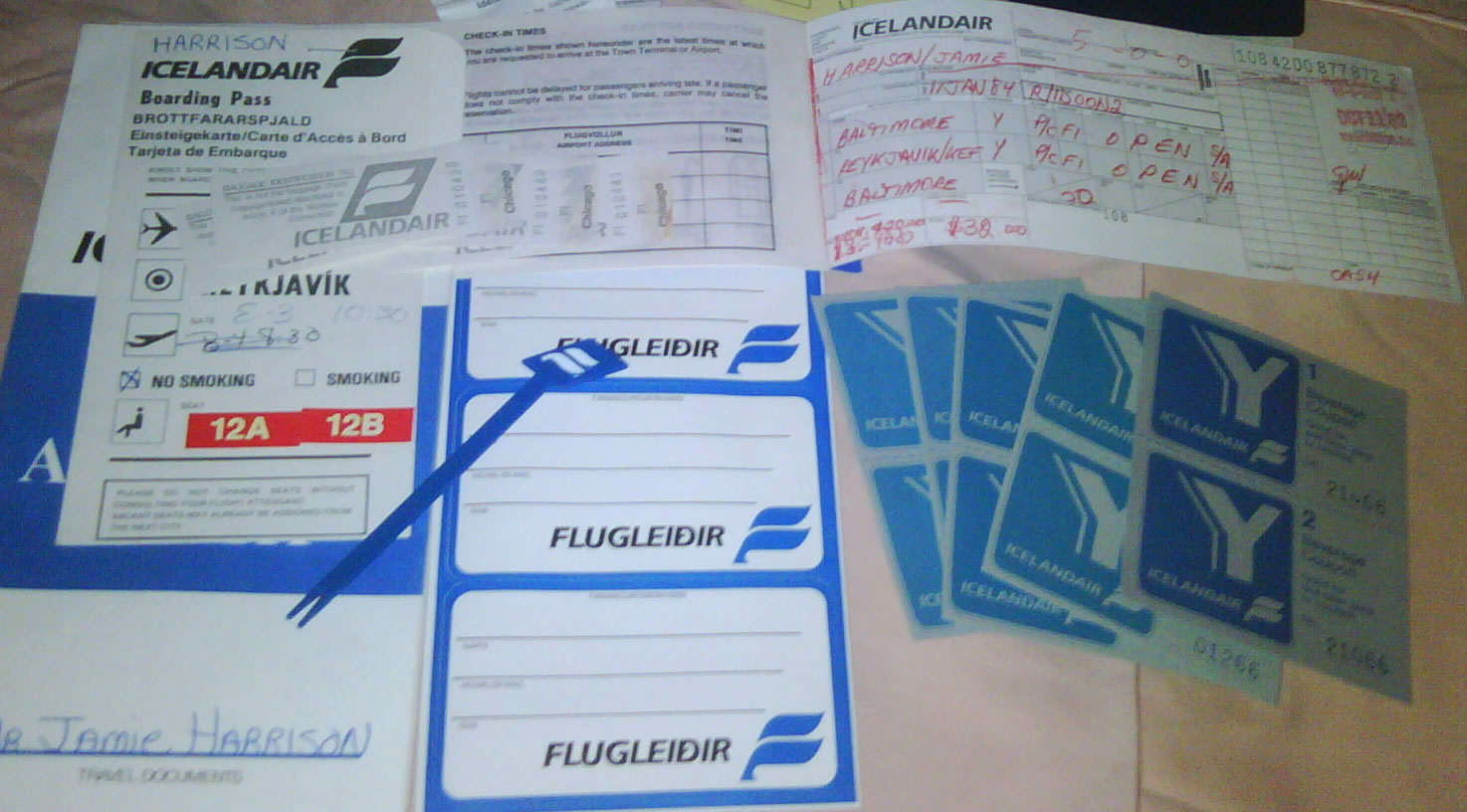
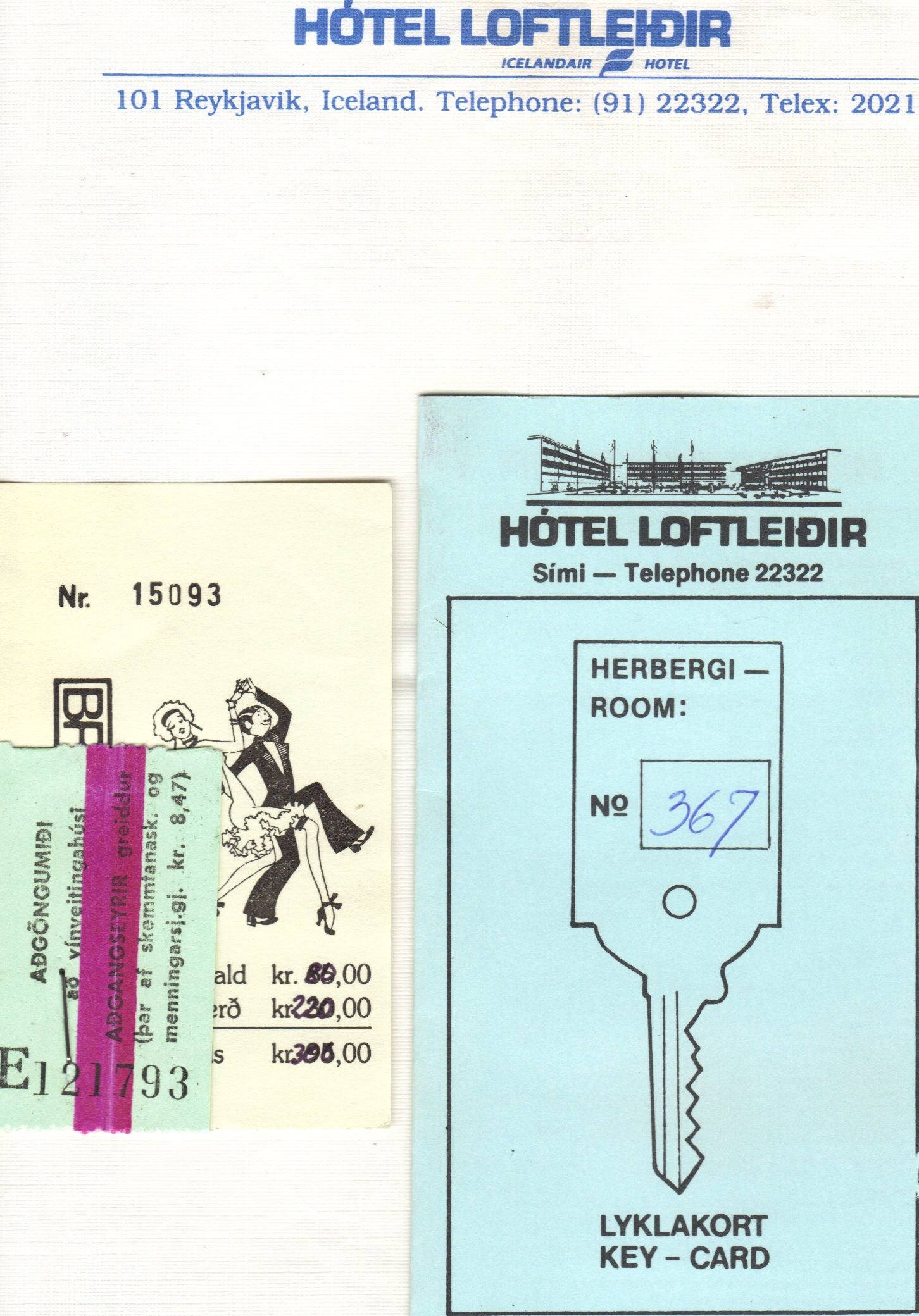
The flight left late at night, and when we got on, because we were left to open seating, the three of us were scattered throughout the 707. On the bright side, however, we were given a stack of free alcohol coupons! (See the bottom right corner of the photo above.) I was feeling very grownup and worldly, so I used mine on Grand Marnier, which helped me doze off.

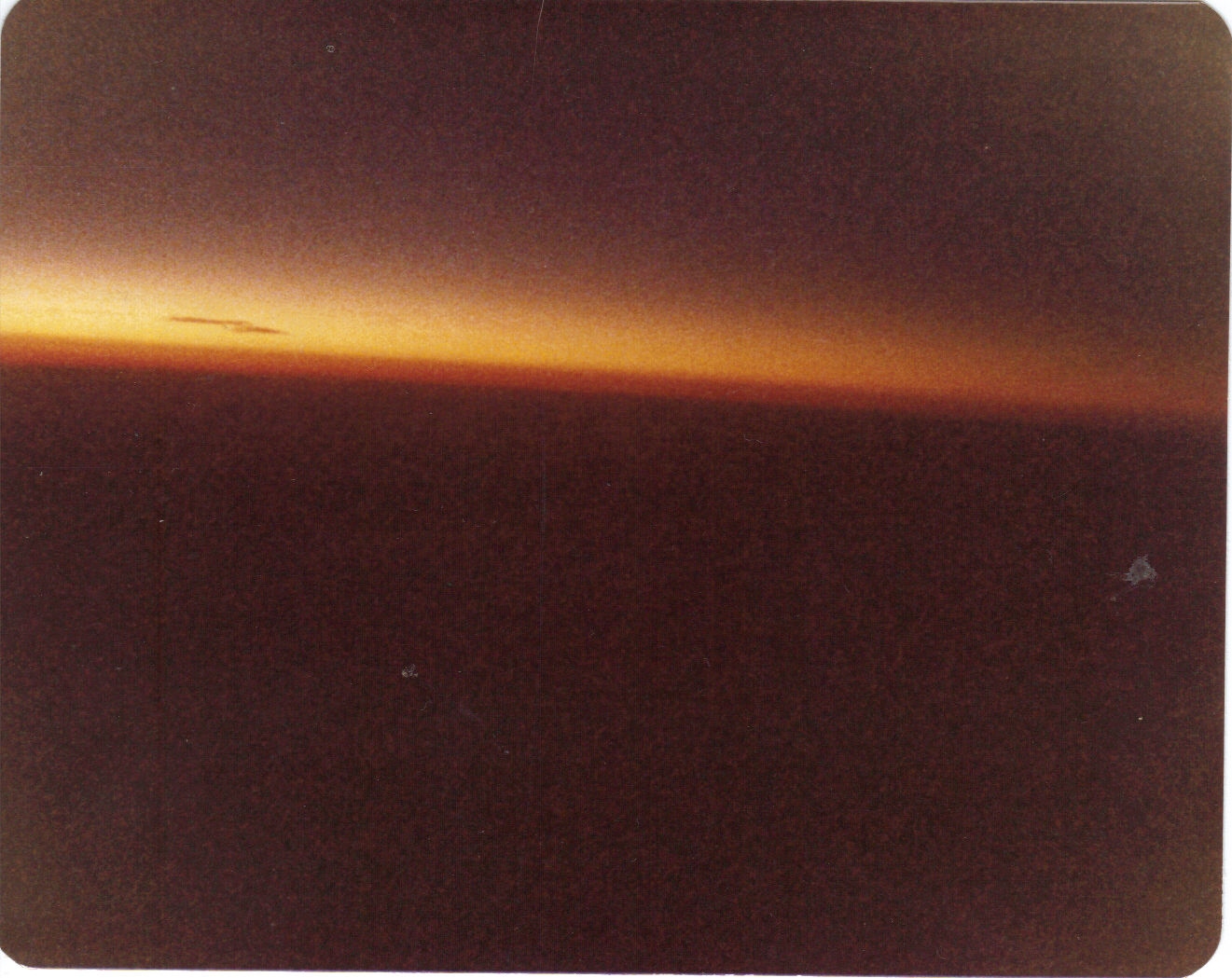
I woke up in the wee small hours of the morning, and looked out of the window at a vast unbroken whiteness. This was Greenland. I was too excited to return to sleep. Just before the sun rose, I snapped this photo:
A few hours later, it was Saturday morning. The plane touched down at Keflavik Airport, and the pilot announced that the temperature outside was 43°. I was shocked; I was in Iceland and that was no different than Baltimore in December. What he didn’t tell us was that the winds were blowing at about 20 miles per hour, and they cut right through you. There was no jetway, just roll up stairs on the tarmac, so the frigid air punched me in the face as soon as I stepped out of the plane.

After getting our bags, we took a van to the Hotel Loftleiðir, which wasn’t plush, but that didn’t matter, because we were in Iceland.
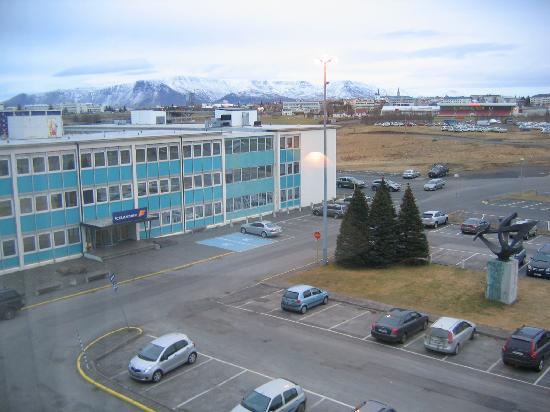
The view from the hotel was amazing. The countryside appeared nearly flat, except for the beautiful ice-covered mountains visible from my window. Here’s a picture I took:

We didn’t have much time, so that afternoon we went out to see the town of Reykjavik. Reykjavik is Iceland’s capital and its largest city, but of course, this is relative. To us it seemed like a quaint, small town. It also seemed as if every business was closed. (We later found out that closing for the weekend was the norm.) We walked around the small streets and took in the chilly, windy atmosphere. Soon we found ourselves at the water’s edge, where I snapped this photo:

We were hungry, and finally found what appeared to us to be a small delicatessen that was open; the shop specialized in salads and fish. I ordered a fish sandwich, and tried to tell the young lady who took my order that I didn’t want lettuce. Having left my Ensk-islensk Vasaordabok (English-Icelandic Dictionary) in my hotel room, I couldn’t come up with the word. (Icelandic is the language of the original Viking explorers, almost perfectly preserved today.The only Icelandic word I remember today is þakka þér fyrir, which sounds like “thakka thair feerer” and means “thank you very much.”) As it turned out the word was salat. Salat/salad. I felt stupid.

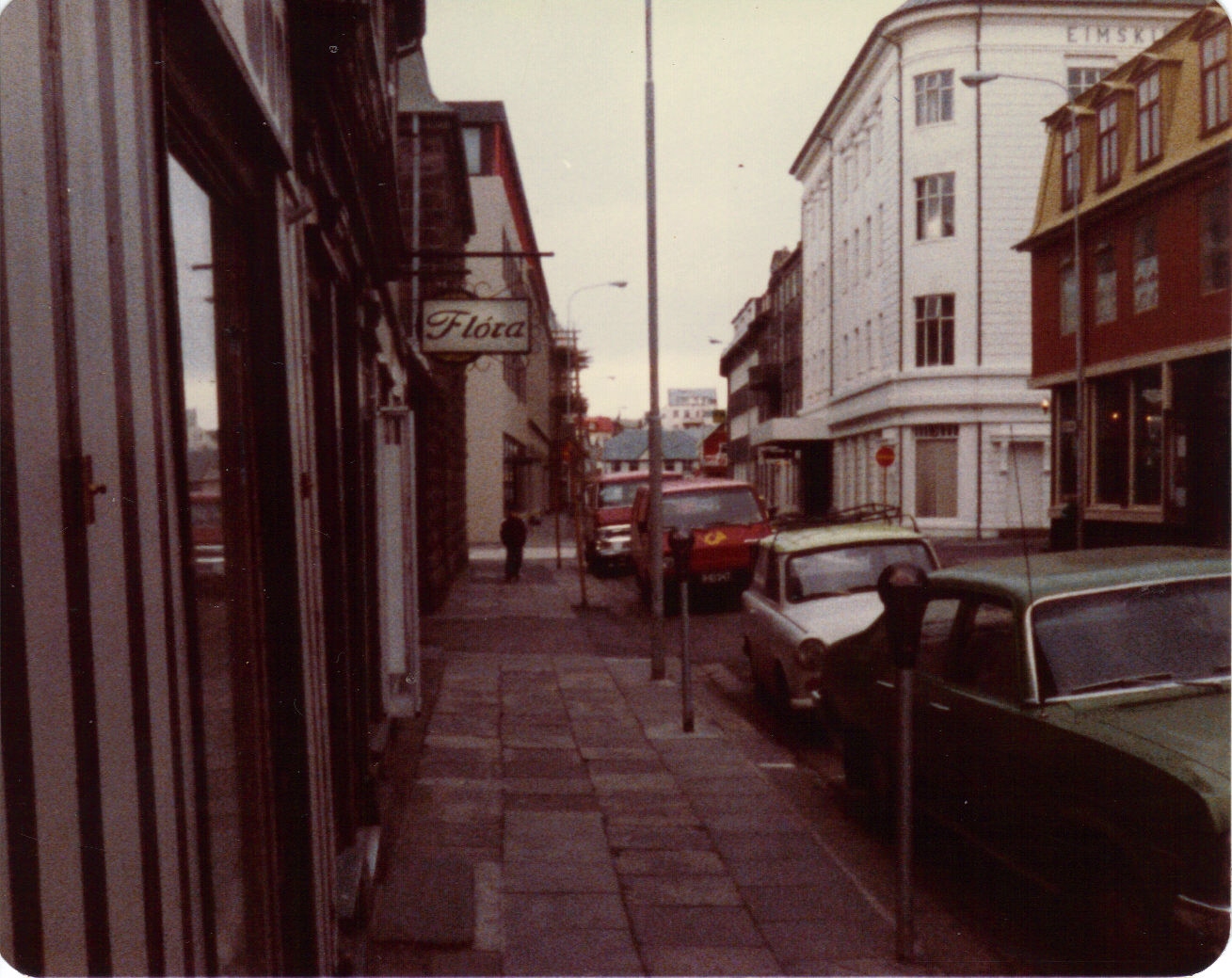
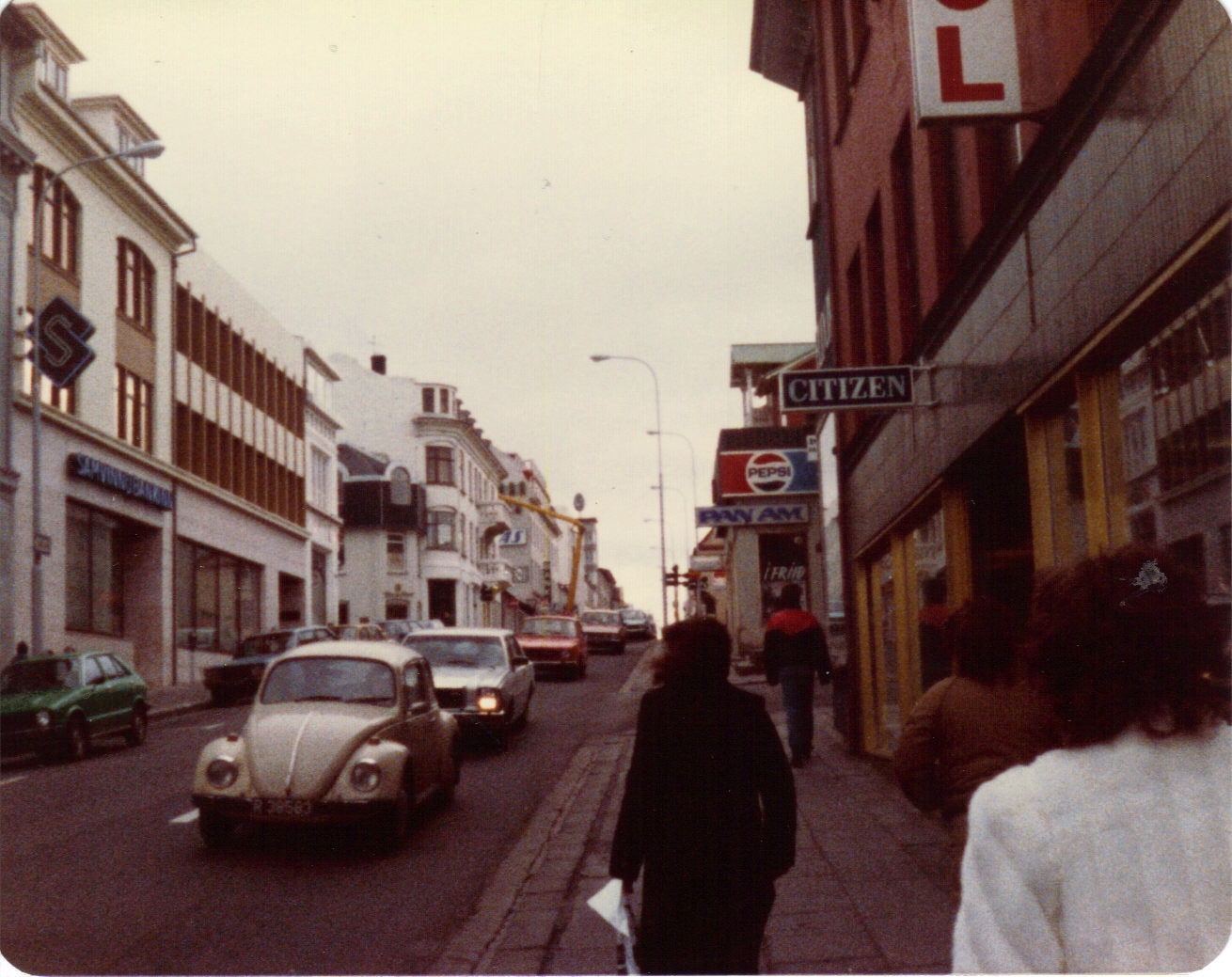
Continuing our walk around town, we were struck by the lack of trees, shrubs and animals, which no doubt are made rare by the biting cold. Here are some pictures I snapped as we walked:
After a time, we saw this large tower on the top of a slight rise that looked like a promising tourist attraction, so we made our way to it:

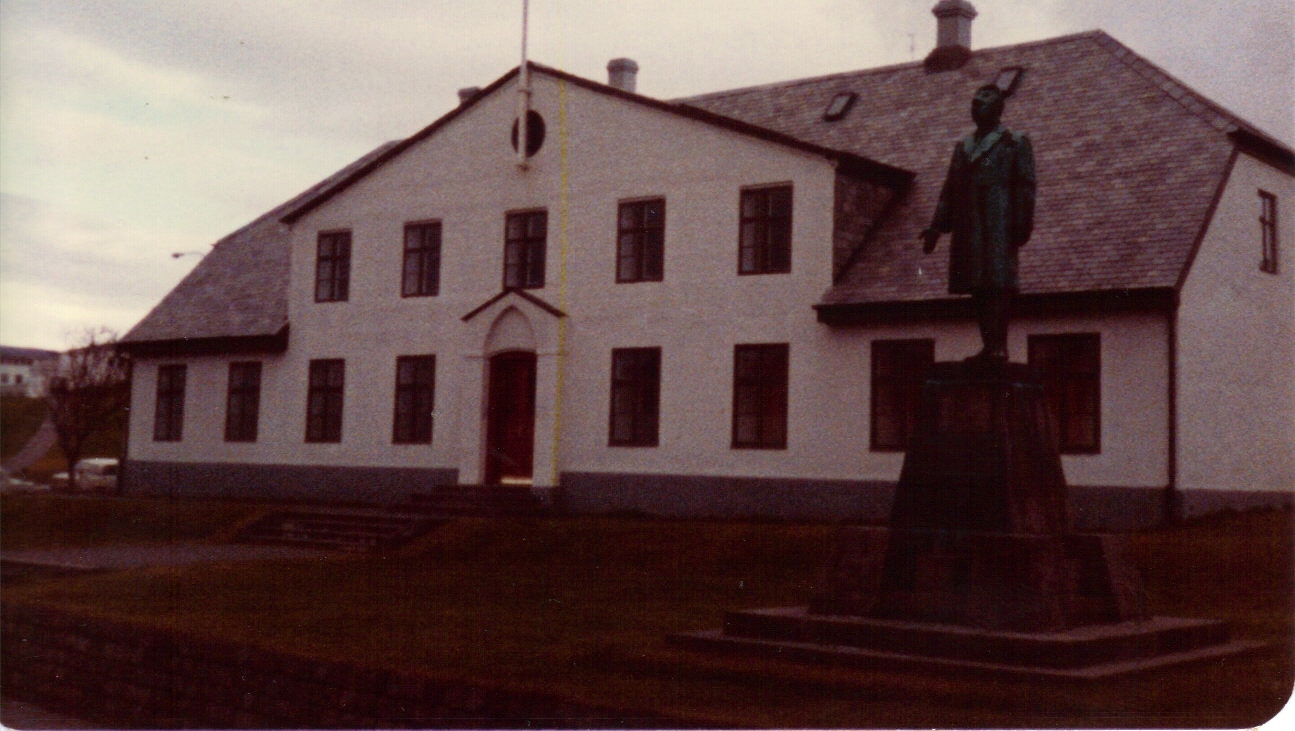
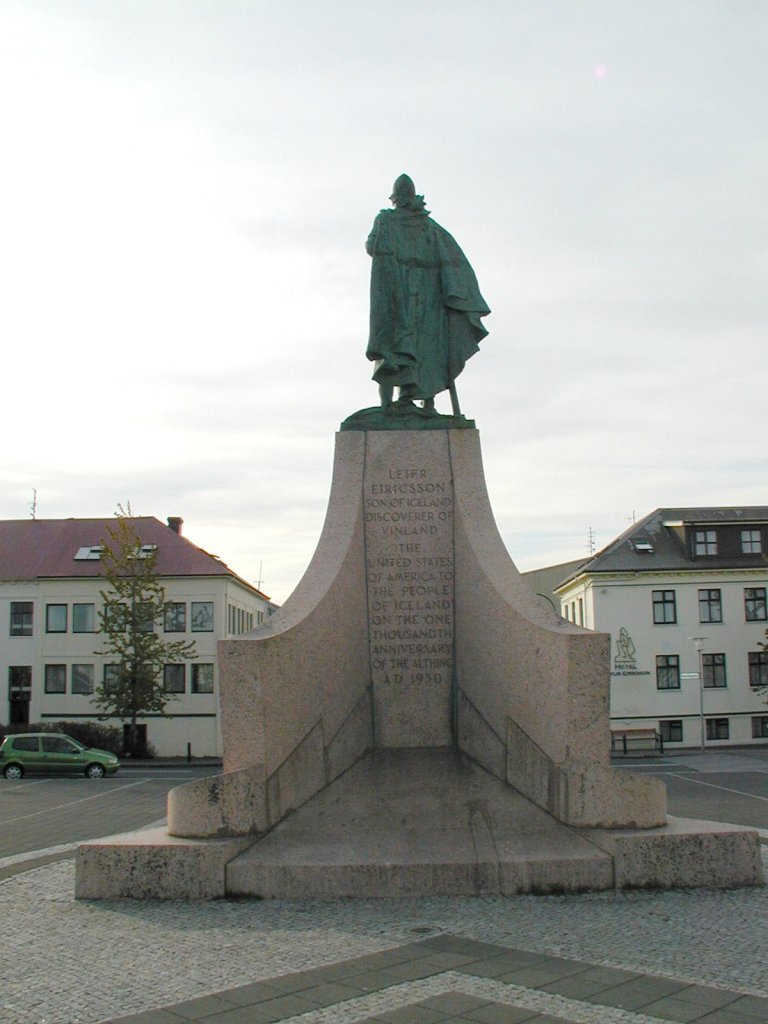
As it turns out, this is a church with a statue of Leif Erikson in front of it. The statue was a gift from the United States in 1930:
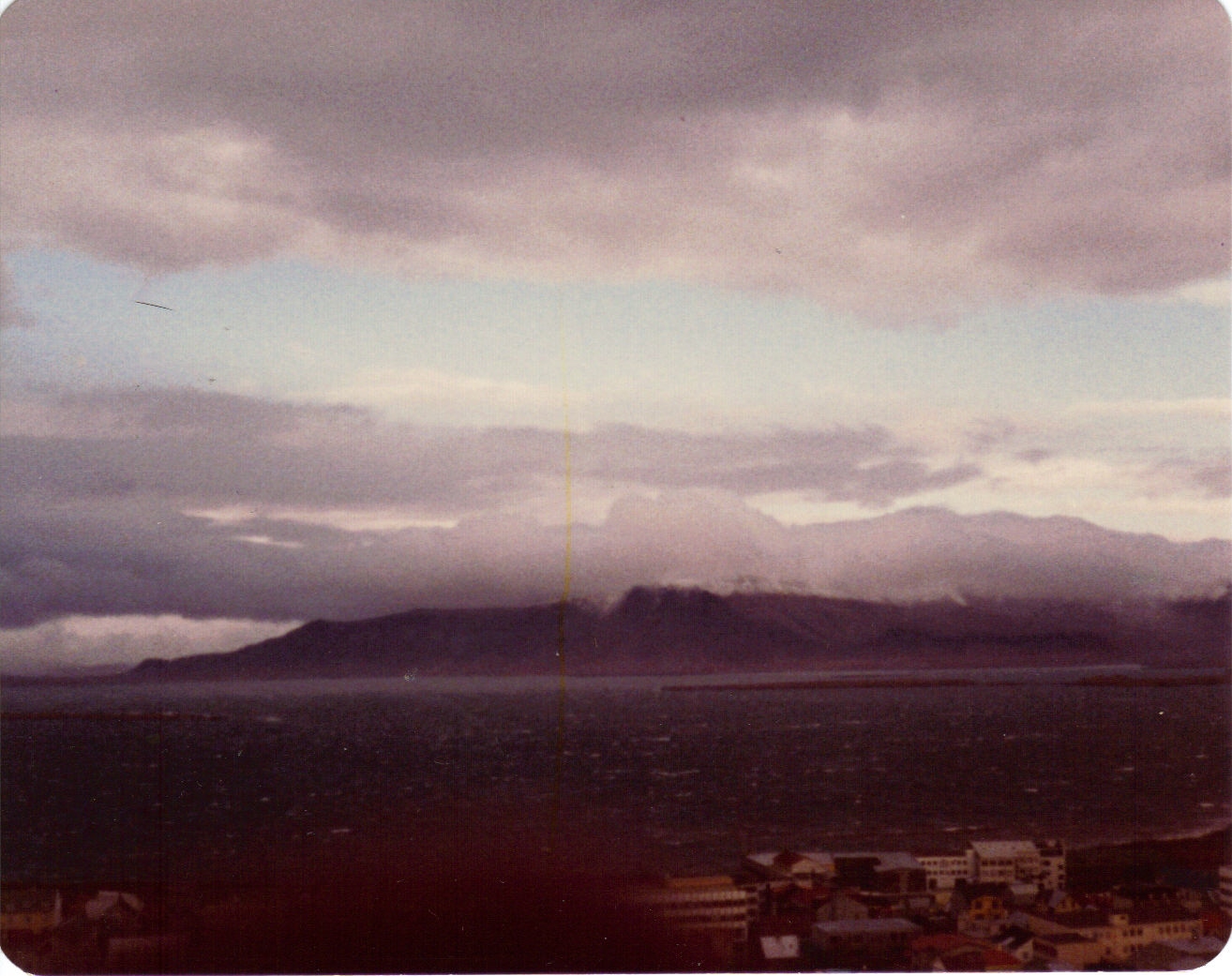
The church was unlocked, and we climbed to the open windows at the top (stronger, even colder winds up there), from where I took this photo:
At this point we were frozen solid, and since nighttime, with its promise of even more frigid weather, was closing in quickly, we decided to head back. With some difficulty we hailed one of the few taxis, which returned us to the hotel. This was another strange experience. As the cab idled in front of the hotel, and we tried to figure out how much kronur we owed, the meter kept running, changing the total. Kronur is worth a lot less than dollars, so every time we looked up, the number seemed outrageously higher. Eventually we threw a bunch of Icelandic money at him and dashed out of the cab. We knew we had probably overpaid, and that we had probably been taken advantage of, but we were foreigners, and teenagers at that. What could we do?

When I got back to my small, sparse hotel room, I discovered a radio built into the wall above my bed; soon I was on Armed Forces Radio, listening to the Orioles game. I only heard a couple of innings, however, before the ladies arrived to pick me up for another cab ride, this time to the Club Broadway in Reykjavik.
The Broadway was smoky, loud and crowded, a place where people had no problem invading your personal space and putting their hands on you, which, as an American, I found very awkward. A live band was playing American music badly, and we soon found a few open seats at one of the long tables. I went to the bar and ordered a vodka and orange juice, which was made as an Old Grand Dad and orange juice. After much struggle to explain what I wanted, I settled for a gin and tonic.

When I got back to our table, I found myself seated next to a chatty Icelandic guy in his early twenty’s who considered himself a bit of an expert in things American.  He spent the next hour explaining to me that America had been infiltrated by a vast Ku Klux Klan conspiracy; he even showed me, by tearing apart his pack of Marlboro cigarettes, how they sent secret messages to each other using the colored circles on the inside flaps of the box. I listened politely before excusing myself to get another gin and tonic. After a few more hours of smoke, loud music and screaming at the person sitting right next to you, we headed back to the hotel, exhausted from our long day.

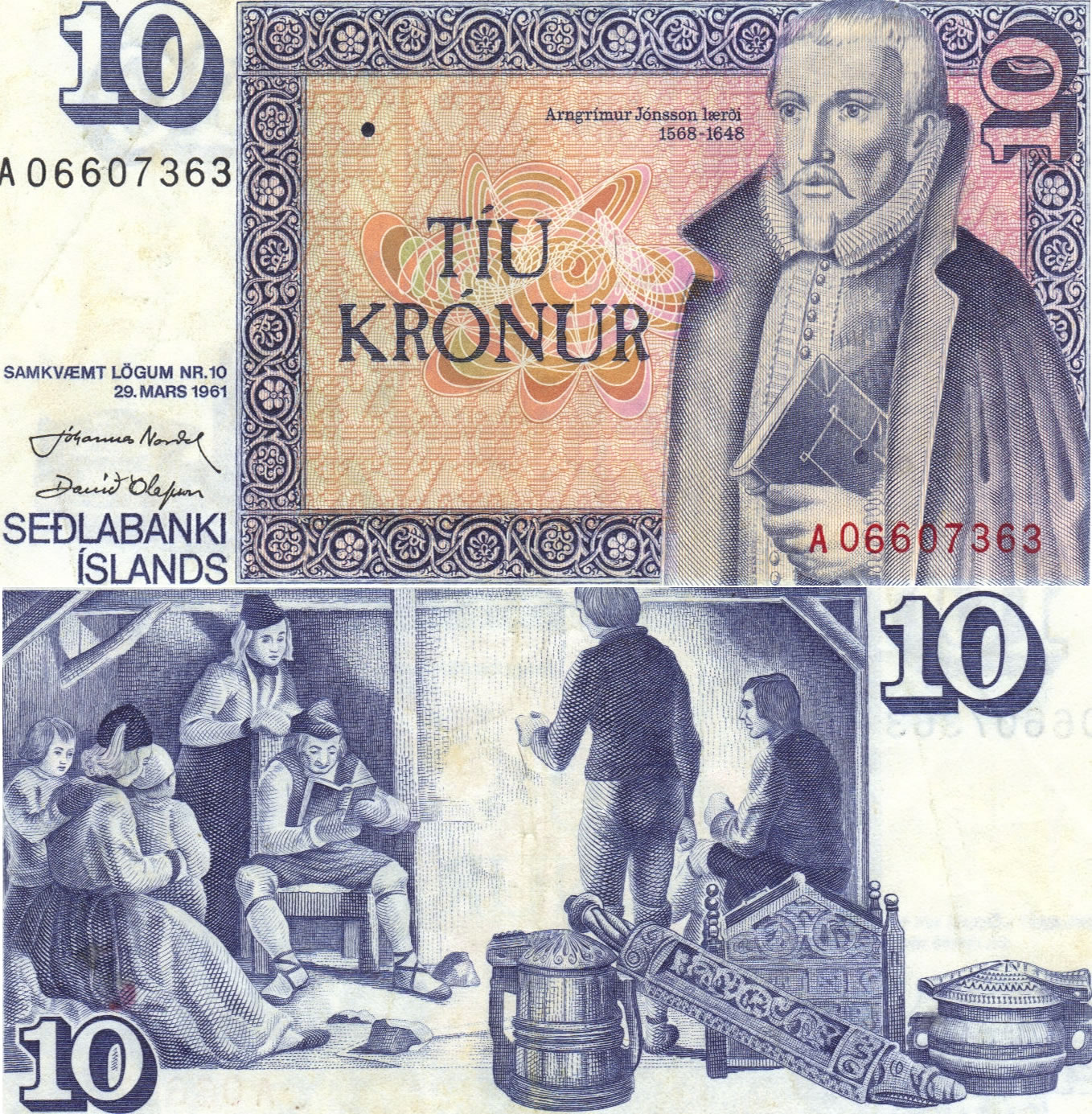
The next day we stayed close to the hotel, because we had a flight to catch. I did a little shopping at the hotel store, where I discovered, after finally figuring out how to convert kronur to dollars, that my cokes were costing me six dollars each. On the other hand, a nice wool scarf (which I still have) and a jar of caviar were dirt cheap. (I didn’t get the caviar because I was down to my last ten kronur, which didn’t buy anything. I still have it:
Finally, it was time to check out and head to the airport. Here’s my hotel tab and receipts from what little shopping I did:

And here are my souvenirs:

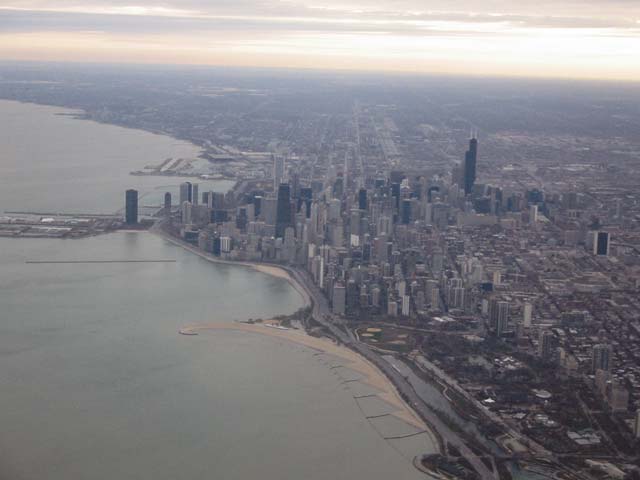
On the flight home, the ladies took the last two open seats and I got the “jump seat.” This is a fold-down seat located directly behind the cockpit. It wasn’t very comfortable, but I was happy to be on the plane at all. Another perk to being up front with the crew is that when we descending into O’Hare in Chicago, I was called into the cockpit. The pilot pointed out the window excitedly and said, “Loook. See-Ka-Go, See-Ka-Go!” As I peered curiously through the clouds, I began to see the entire city of Chicago, sitting on Lake Michigan and laid out before us. I thanked the captain for his thoughtfulness; it was a nice touch.
In Customs at O’Hare, I found the first American man and asked, “I’m from Baltimore. Have you heard about the World Series? What’s going on?” Gruffly, he said, “Yeah, I dink you guys won it.” And that was how I learned that the Orioles were World Champions. We got into Baltimore in time to see the buses from Philadelphia arrive at Memorial Stadium, where they were attacked by the throngs of fans who had been waiting all night. I was later told by coworkers that BWI had broadcast the end of the game on monitors around the terminal, and that when the last out was made, the concourses shook.

No matter. I had my memories of a very cool weekend in Ísland (take that however you want to), and I wouldn’t have traded it for the world, not even for the World Series.

My Top 20 Christmas Songs

Christmastime is here, and in honor of the season, I’m going to do a few Christmas lists. The first one out of the gate are my twenty favorite Christmas songs:

1. I Believe in Father Christmas – Greg Lake. From Christmas 1975 – Lush, gorgeous music paired with a biting, cynical message (“Hallelujah, Noel, be it heaven or hell; The Christmas you get you deserve.”) Not exactly uplifting, but awesome nonetheless.

2. Happy Xmas (War Is Over) – John & Yoko. A sentimental favorite. I’m a huge Beatles/Lennon fan, and this is typical John, reminding everyone that there’s much to be done.

3. You’re A Mean One, Mr. Grinch – Thurle Ravenscroft. If there’s a recurrent theme in this list, it’s that we carry our childhood around with us forever. I love How The Grinch Stole Christmas (the original animated version, not that sin against nature that Jim Carrey foisted upon us), and I’ve even memorized most of the Suess script. BTW, did you know the guy who sang this was the voice of Tony the Tiger, the Kellogg’s Frosted Flakes spokescharacter? Heeee’s Great!

4. Frosty the SnowmanJimmy Durante. Another throwback to my youth. This version is from the animated classic, which so impressed me in my youth that I eventually went out and got myself my own cute blonde girl and married her. How’s that for influence?

Karen

Laurie

5. 2000 Miles – The Pretenders. I’m a big fan of Chrissie Hynde and the Pretenders, and I love her contribution to the Christmas season.

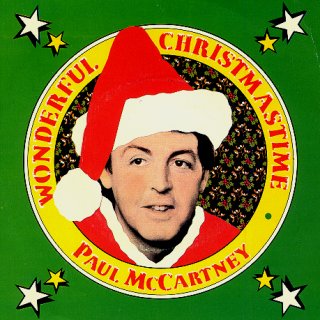
6. Wonderful Christmastime – Paul McCartney. My Beatles thing influencing me again. Bouncy, upbeat, hopelessly optimistic. In short, perfectly Paul.

7. God Rest Ye Merry Gentlemen – Barenaked Ladies & Sarah McLachlan. This is a really great folksy mashup  of God Rest Ye Merry Gentlemen and We Three Kings. I wish it was played more often on the radio.

8. Let It Snow, Let It Snow, Let It Snow – Dean Martin. The definitive version by the always smooth, slightly intoxicated Dino.

9. Have Yourself a Merry Little Christmas – Judy Garland. This is a sad song anyway, but when Judy sings it, it’s got a tragic, almost heartbreaking feel about it. If you’re a potential holiday suicide candidate, stay away from this one.

10. Sleigh Ride – Leroy Anderson. The original version, and for me the signature tune of the Christmas season.

11. Holly Jolly Christmas – Burl Ives. Another childhood memory, this time from Rudolph the Red-Nosed Reindeer. Whenever I hear this song, I don’t think of Burl Ives, I think of Sam the Snowman.

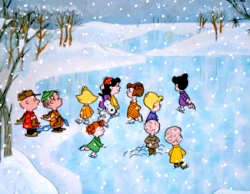
12. Christmastime Is Here – Vince Guaraldi Trio. From the opening scene of A Charlie Brown Christmas, where the Peanuts gang is skating. Whenever I hear this song, in my mind I also hear the sound effects from the cartoon. Weird.

13. The Christmas Song – Nat King Cole. The definitive version from the definitive voice. Classy, smart and timeless.

14. Do You Hear What I Hear? – Bobby Vinton. When my mom tucked me in every Christmas Eve, she let the small radio play next to my bed so that I could listen to the news bulletins tracking Santa’s movements across the globe (I always dozed off when he was up around Newfoundland). For some reason, this version of this song was always on that station, and thus became welded to my childhood Christmas memories.
15. Santa Claus Is Coming To Town – Bruce Springsteen. Proof that you can be cool and rock Santa Claus. I wonder: Did Clarence ever get that new saxophone? Good stuff.

17. The Little Drummer Boy – Harry Simeone Chorale. Another memory from the radio next to my bed on Christmas Eve.

18. Rockin’ Around The Christmas Tree – Brenda Lee. It was only very recently that I actually saw a picture of Brenda Lee for the first time. I had always imagined her looking like Sandra Dee. You cannot imagine my disappointment.

Sandra Dee


Brenda Lee

18. White Christmas – Bing Crosby. Bing’s original rendition is ancient and perfect.

19. O Holy Night – Mario Lanza. A voice from the heavens, crazy powerful and booming, almost compelling you to “fall on your knees” and ‘hear the angel voices.” Perhaps the greatest vocal performance of all Christmas songs.

20. Silver Bells – Elvis Presley. The King, doing his Christmas thing. A bit bluesy, all Elvis. Thank you, thank you very much.

21. Baby, It’s Cold Outside – Steve Lawrence and Eydie Gorme. Steve and Eydie did a few Christmas songs that I like, and I inadvertently left them off the list, until reminded by the intrepid Melissa Smith. Curiously, though, I can’t think of Steve & Eydie without being reminded of the Sinatra Group, an SNL skit that was a send up of the McLaughlin Group. Mike Myers and Victoria Jackson do a great job, with the late, great Phil Hartman as ol’ Blue Eyes.

Have a swinging Claus-Day, Jack.

Proposed Math Requirement Should Be Reconsidered

In today’s Baltimore Sun, University of Maryland System Chancellor William E. Kirwan, a former math professor, says that he wants to see university-bound high school seniors forced to take challenging math courses. His object is to better prepare students for college and for STEM (science, technology, math and engineering) careers. It is his hope that forcing students into math classes will produce more STEM majors at the university level.

If the object is to channel more students toward math and technology careers, then we should be spending more time identifying likely prospects far earlier in their lives, not using a “one-size fits all” approach after having ignored differences in aptitude for a child’s first three years of secondary school.  As a former high school teacher, I can tell you that it is usually clear by a student’s sophomore year whether or not he or she will be a math scholar. The 300 lb. gorilla in the corner of the room is the fact that many of our children are just not equipped for advanced math courses, and for them, surviving basic math classes is challenge enough. Compelling kids to take advanced math courses will not change this, and is patently unfair to a student who will derive no real benefit from it.

This brings me to a second ugly truth that mathematicians hate to admit: very few adults retain and use advanced math skills in their daily lives. In the Sun article, Skip Fennell, a professor at McDaniel College and former president of the National Council of Teachers of Mathematics, in defending the proposed requirement, says as much. “If you don’t use it, you lose it…” Mr. Fennell, this applies to nearly everyone who isn’t in on a STEM career path. More to the point, many kids never had it to begin with, and won’t miss it as adults.

The narrow utility of advanced math skills sits in stark contrast to the broad and sweeping utility of English language skills. Whereas mastering calculus is of dubious value to the majority of graduates, being able to use language at a high level is absolutely essential for anyone hoping to do more with their lives than settle for low-paying, menial work. Additionally, I can personally attest to the weakness of our high school graduates in the areas of reading and composition, and these students (and their instructors who are forced to slog through their papers) suffer as a result. It may even be true that a STEM major at the university level will spend as much time crafting sentences as equations, and yet we hear nothing of increasing requirements for this critical, and universally necessary skill.

If this suggestion becomes reality, there is little doubt that those students with an aptitude for mathematics will enter college more prepared for STEM classes. But not every college-bound senior has this aptitude. If we truly want to be about the business of creating STEM scholars, then we had better get on it while our children are still in elementary school, rather than penalizing them as high school seniors.

For my part, I would rather see our educational system geared to identifying each student’s strengths at an early age and then directing their coursework to produce citizens highly equipped to succeed in life. Not every child has the intellectual makeup for success in math and science; to act as if they do does both the student and the national economy a disservice. Rather than requiring every peg to fit into a round hole, why not invest time and treasure in identifying the peg’s shape, and then creating holes that fit?

After What I Saw Last Night, Monday Night in Green Bay is Now Critical

Yes, it was ugly, and it was far closer than it should have been, considering who didn’t play. Yes, at times the Ravens looked like a team that has no business having playoff aspirations. And yet, there the Ravens sit at 6-5, in the thick of the Wild Card chase.

But after what I saw last night, just don’t expect them to do it again on December 27th at Heinz Field.

Still, with five games to play, there is at least a reasonable chance that the Ravens will qualify for the postseason, and isn’t that why we play the games? And remember, every year a team sneaks into the playoffs and makes a surprising run. Why not the Ravens?

So, even though we’ve had to endure (fill in the blank with: Mark Clayton’s drop, Ray Lewis’ penalty, Steve Hauschka’s miss,  Joe Flacco’s interception), the dream lives on.

Here’s how the dream breaks out now:

The NY Jets, Miami, Pittsburgh, Baltimore, Jacksonville, Houston, Tennessee and Denver are all still mathematically alive. The Titans, Jets, Dolphins and Texans already have six losses and thus must finish 5-0 to have a chance of making the playoffs. I don’t see any of those teams having a 5-0 finish in them, and so can be safely dismissed.

That leaves Jacksonville at 6-5 and facing games against Houston, Miami, Indianapolis and New England. I think there’s at least one loss in there somewhere, probably two. Look for them to finish no better than 10-6, but more likely 9-7.

Denver, at 7-4, still must travel to Kansas City, Indianapolis and Philadelphia. They also will probably finish no better than 10-6 and the Ravens, having beaten them, will have the first tiebreaker.

The 6-5 Steelers, locker room dissension notwithstanding, are still in the best position of all, with few real difficult games ahead. The only challenges for Pittsburgh are at home to Green Bay and Baltimore and at Miami. Expect the Steelers to finish at least 10-6, maybe 11-5. (All of this presumes Ben Roethlisberger returns to the lineup Sunday and finishes the year.)

The Ravens, another 6-5 team, should be able to win against Chicago, Detroit and Oakland. If they can steal one at 7-4 Green Bay on Monday night, 10-6 becomes very possible. If they lose, the game at Pittsburgh becomes a must-win, which, after watching Dennis Dixon move the ball effectively last night, seems like a bridge too far. If the Ravens lose both games, they’ll need lots of help to make the playoffs, and are likely left on the outside looking in.

But again, if they beat the Packers Monday Night, the Ravens can lose to Pittsburgh on the 27th and probably still make the playoffs. While taking one from Green Bay at Lambeau on national television seems, at first glance, to be an impossible task, it’s not. Aaron Rodgers is inconsistent, and the Packers have really only beaten one quality team this season (Dallas at home); the rest of their schedule has been filled up with the likes of Detroit, Chicago, Cleveland and St. Louis. In any event, this challenge seems to me to be far simpler than being in a must-win situation in Pittsburgh. Bring on the Packers, baby.

(This is going to be a long, long week.)

10 Worst Days in United States History

In honor of Black Friday, this week’s History List ranks the ten darkest days in U.S. history. In drawing up this list, I take into account not just fatalities, but also the impact that the event had upon the nation’s psyche. For this reason, only one battle makes the list.

Ready for a depressing trip down America’s Memory Lane? Here we go:

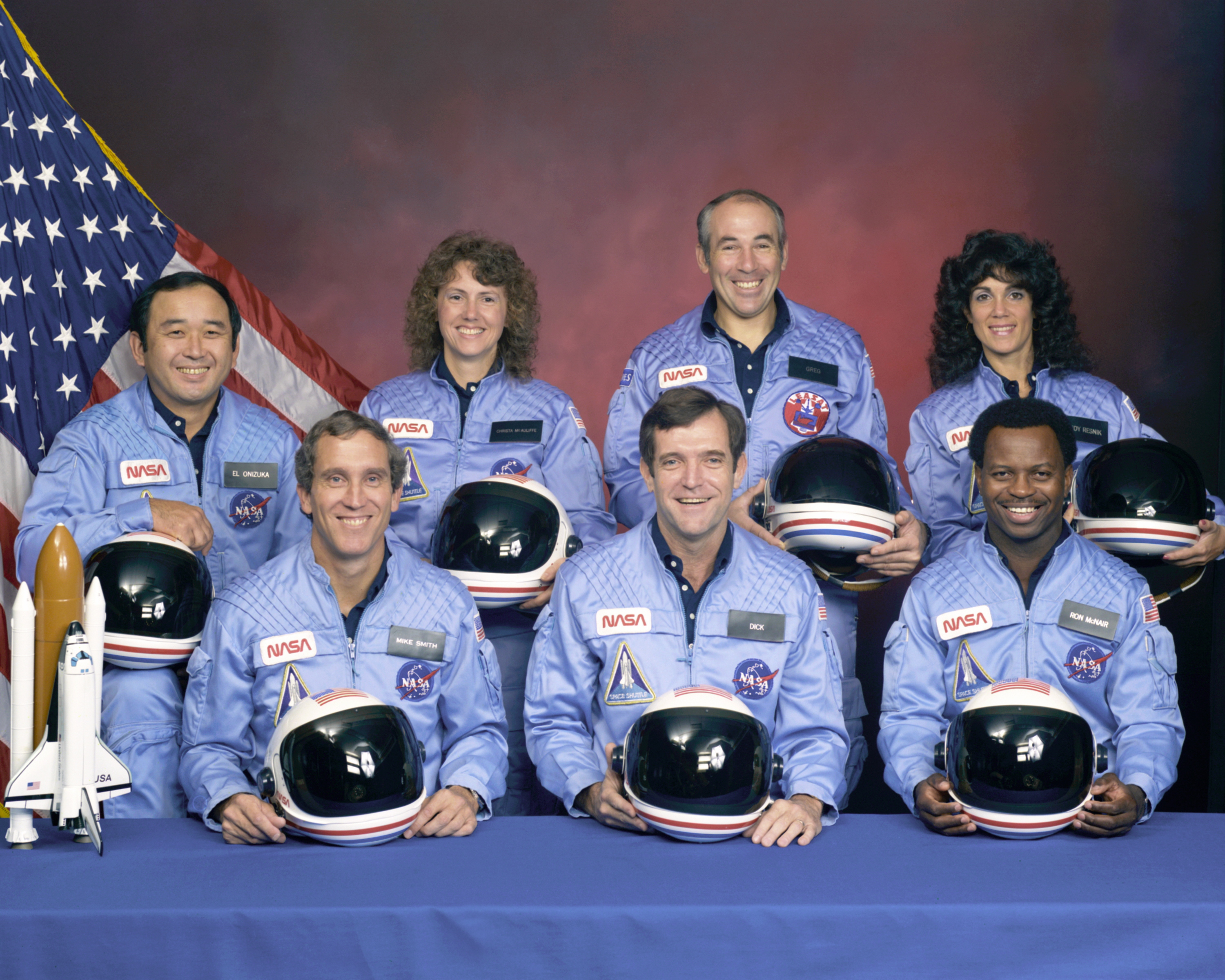
10. 01/28/1986 (Space Shuttle Challenger) – Before this tragedy, the U.S. space program had experienced nothing but success since the fatal January 27, 1967 Apollo I launchpad fire. I suspect that we had begun to take this success for granted, going so far as to include a civilian on this mission, Christa McAuliffe, a high school social studies teacher. America watched the shuttle explode live on television, instantly killing all on board, and then got to see the confused and horrified reaction from the crowd at the launch site, including McAuliffe’s parents. It was a stunning and sobering reminder that the United States was not infallible, and that space exploration was still very dangerous business.

Christa McAuliffe, in the back row, second from left.

9. 04/18/1906  (San Francisco earthquake, 3,000-6,000 dead) As devastating as this 8.0 magnitude event was, the subsequent fires that tore through the largely wooden buildings caused 90% of the damage in the city. In addition to the dead, 300,000 survivors lost their homes, with losses estimated at $6.5 billion (in 2009 dollars).

8. 04/04/1968 (Martin Luther King, Jr. Assassinated) The murder of Dr. King, followed by days of bloody race riots, heralded the end of the spirit of non-violence the slain civil rights leader had championed, and initiated a period of extreme anger and confrontation. 1968 would soon see the assassination of Robert F. Kennedy, the chaotic Democratic National Convention and a call for a return to “law and order.”

7. 09/08/1900 (Galveston hurricane, 6,000- 12,000 dead) At the time of the hurricane, Galveston, on the Gulf coast, sat just 8 feet above sea level. The storm surge alone was 15 feet high. You do the math. After the town had been obliterated, the stench of corpses could be smelled for miles; they were collected on carts and hauled outside of town for mass burial.

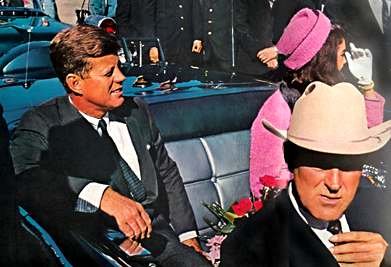
6. 11/22/1963 (Kennedy Assassination) For all of his moral flaws and practical inability to get much done, John Kennedy was perhaps the most inspiring leader of his time. While his popularity represents the triumph of style and ideals over substance and achievements, millions of young Americans saw him as representative of their (and America’s) future. His brutal killing in Dallas, followed by a very public period of mourning, will forever mark the end of an American period of innocence, and it set the stage for a darker, more conflicted time in America’s history.

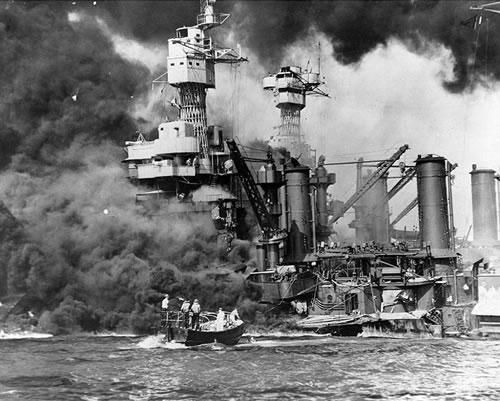
5. 12/07/1941 (Pearl Harbor) As Christmas 1941 approached, most Americans were thankful to have thus far avoided the scourge of war, and assumed that the nation would continue to do so. The Japanese attack on the U.S. Navy’s Pacific fleet’s base at Pearl Harbor, Hawaii, ended this illusion. The tally: 4 battleships sunk; 4 battleships damaged including 1 run aground; 2 destroyers sunk, 1 damaged; 1 other ship sunk, 3 damaged; 3 cruisers damaged; 188 aircraft destroyed, 155 aircraft damaged; 2,345 military and 57 civilians killed, 1,247 military and 35 civilians wounded. Images of the Pearl Harbor disaster covered newspapers the next morning, and a Japanese invasion of the American Pacific coast was considered entirely possible. The internment order for Japanese-Americans would soon follow.

4. 09/11/2001 – Before this day, Americans assumed that terrorism was something that other countries had to worry about, as if our geographic separation from the Middle East would save us. The sheer magnitude of the 9/11 attacks stunned the people of the United States and reminded them of their vulnerability in what could be a very frightening world. It also brought to the surface the depths of the hatred with which some Muslims viewed Americans, and the lengths to which they would go to kill Americans (2,976 on this day alone). Feeling insecure in the aftermath of these attacks, Americans willingly accepted intrusive laws, a government with unheard of investigative powers, and military intervention in the Middle East.

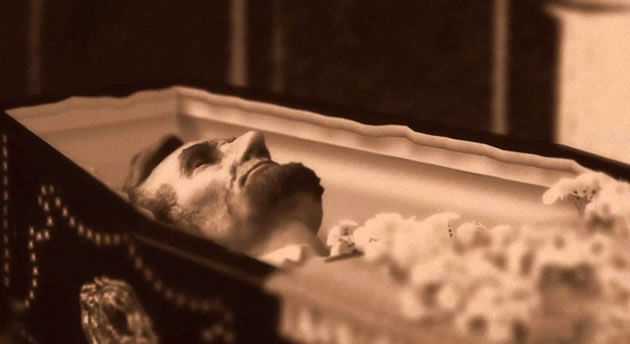
3. 4/15/1865 (Lincoln dies) Abraham Lincoln was the nation’s one constant during the trial of civil war. Generals came and went, territory changed hands and the fortunes of war rose and ebbed, but Lincoln never wavered. Only weeks after having been inaugurated for a second term as president, Abraham Lincoln was dead at the hands of an assassin with Southern sympathies. Just when it had seemed as if the nation would be restored without further antagonism, the main proponent of “letting the Rebels up easy”  had been murdered, and the victors held the vanquished fully responsible. What came next was Radical Reconstruction, as many in the North sought not so much reconciliation as retribution. The Old South would be militarily occupied for another dozen years, and forever relegated to the status of economic backwater.

2. 10/29/1929 (stock market) The largely unregulated stock market, full of excesses that had fueled the Roaring 20’s, met with disaster on this day. Banks that had invested poorly folded, taking businesses and family savings with them. The ripple effect brought on the Great Depression, sending millions to the unemployment rolls and devastating the nation’s economy for 12 years, where it could only be ended by the ramp up to World War II. The financial turmoil of this event helped dictators rise to power in Europe and left scars upon a generation that never fully healed. (Just ask anyone over 75.)

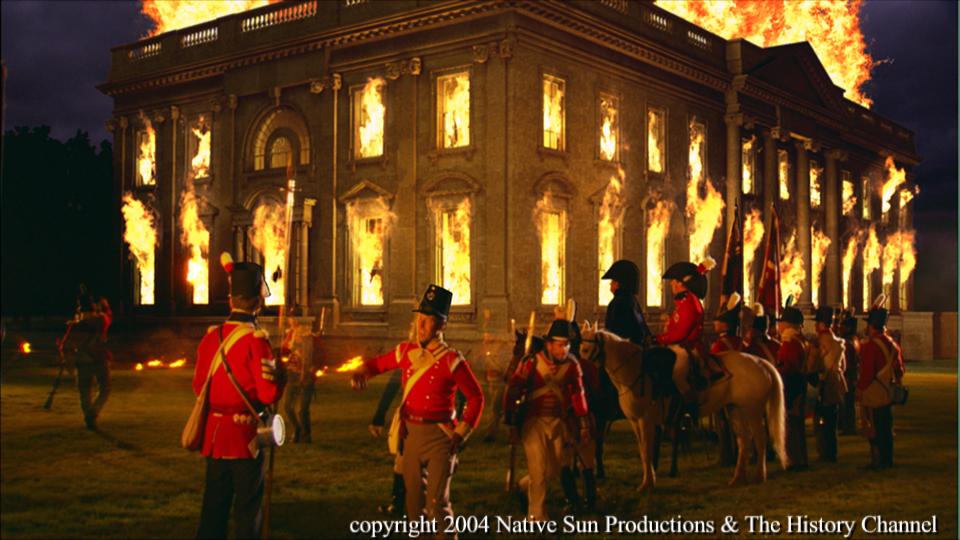
1. 08/24/1814 (Washington, D.C. burned) In an event that is today little talked about and even less understood, the capital of the United States was occupied by a foreign power and laid waste. And Americans were helpless to stop it. In 1814, the third year of the War of 1812, England, having finally dispatched Bonaparte, focused its full attention on the wide expanse and paltry military of the United States. While its army and navy occupied eastern New England and planned multiple invasions, British negotiators demanded large land cessions as the price of peace (seeking not only to establish a neutral Indian buffer state in what is now the states bordering the Great Lakes, but also revising both the Canadian‐American boundary and the terms of the 1783 Treaty of Paris that had established the United States as an independent nation). When Washington, D.C fell, almost effortlessly, to the British invasion forces, many thought that the United States was finished as an independent nation. New England actually considered seceding from the United States, and made plans to hold a convention with that object in mind. At the end of August 1814, America teetered at death’s door as a political entity. Fortunately, there would be miracles soon forthcoming at Baltimore and Lake Champlain.

(Dis)Honorable Mentions, in no particular order:

04/12/1861 (Ft. Sumter)

11/16/1776 (Ft. Washington abandoned)

3/06/1857 (Dred Scott)

04/12/1945 (FDR’s death)

04/09/1942 (Bataan)

09/17/1862 (Antietam)

Happy Thanksgiving! I Might Be OCD! (No, I’m Sure Of It Now.)

I love holidays. This is tied very closely to my love for traditions and seasons, which I think, is tied very closely to my need for order and predictability. Let me explain.
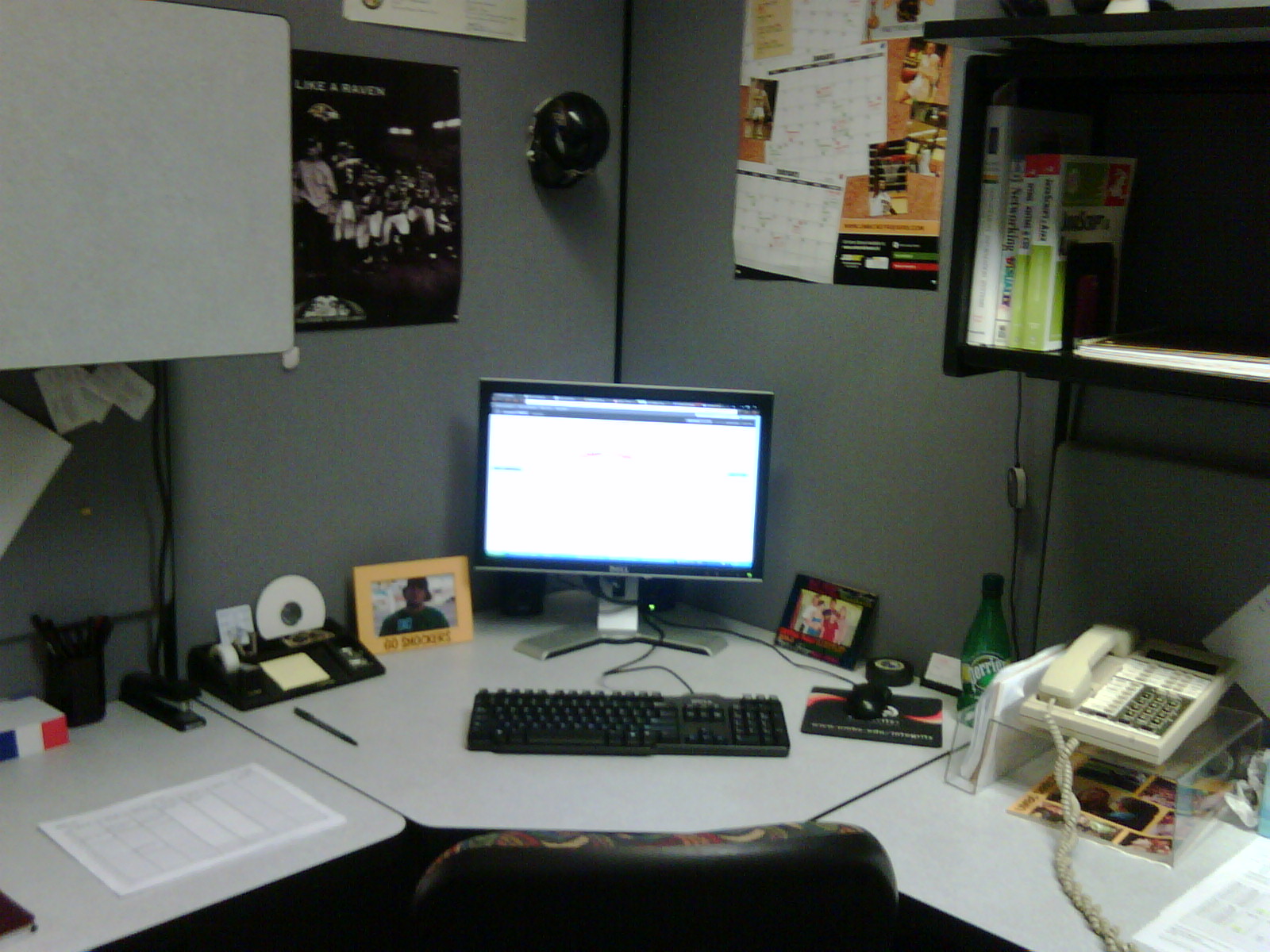
My desk is very neat and very regimented. Everything has a place, and everything is in its place – all the time. I don’t like things to be drifting into areas where they do not belong, because, well, that’s not where they belong. When something is displaced, I notice and return it immediately. There is order in my universe.

My orderly universe

I also love the seasons, especially the changing of the seasons. I like how there’s a definitive start and stop date to seasons, and I ensure that my personal routines adhere to this framework as much as possible. For example, I will not turn on the heat in the house before November 1st – period. That’s when my heating season starts. On the other side of the year, I will not turn on the air conditioning until June 1st. Every fall, I neatly fold my “summer clothes,” tee shirts, shorts, etc., and box them away in the closet until spring, replacing them in my dresser with the sweatshirts that had been stored away for the previous six months. I guess this is my way of marking the passage of the seasons, and thus the passage of time, in an orderly, disciplined manner.

Likewise, my holiday schedule is similarly regimented. Halloween decorations are to be displayed from October 1-31 only, because September isn’t Halloween season yet and November is Thanksgiving season. So, on November 1st every year, the Halloween decorations return to their boxes and the Thanksgiving decorations go up. On the day after Thanksgiving, “Black Friday,” I can’t be bothered with shopping, because that is the day when the Thanksgiving decorations must go away, being replaced by the Christmas decorations. (While we decorate, my wife and I prepare a second, smaller Thanksgiving meal, because we rarely get enough leftovers from the actual feast.) Because of the sheer number of decorative items and the degree of difficulty involved (the tree alone may take hours to adorn satisfactorily), I allow Friday and Saturday to complete this task. But be assured, by the end of the Saturday after Thanksgiving, it is done. Christmas season officially ends for me on January 1st. On that day, all the Christmas decorations will come down and be stored away for the year. This act officially ends my holiday season.

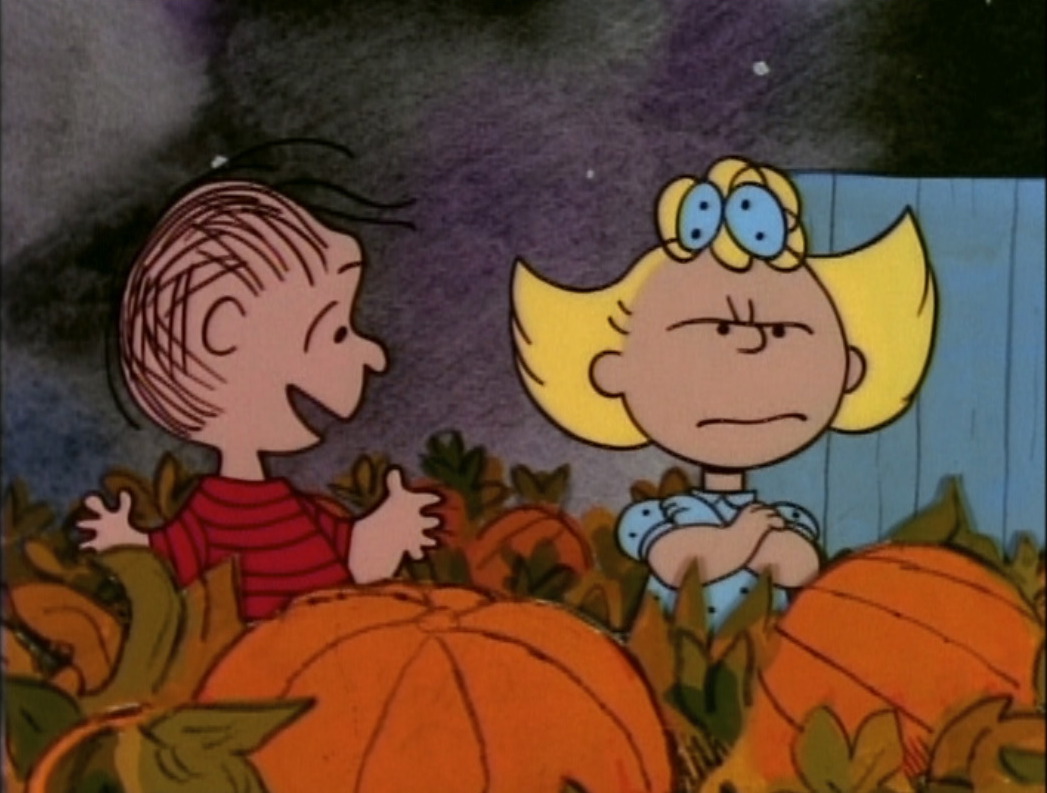
But really, it goes farther than this. During the various holiday seasons, there are certain activities that I must engage in, or else I’ll feel like I’ve missed out on a key component. For example, I must watch all of the original Charlie Brown specials in their appropriate season (The Great Pumpkin, Charlie Brown Thanksgiving & Charlie Brown Christmas).

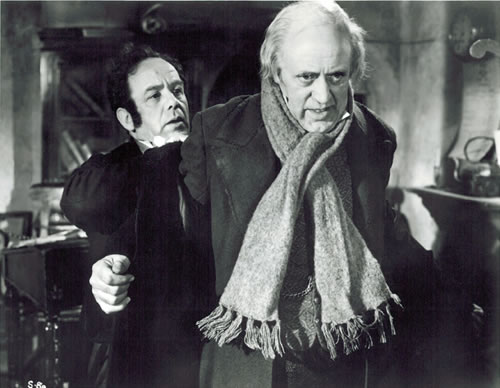
I must also see all of the other TV specials from when I was a child (The Grinch, Frosty the Snowman, Rudolph, etc.)  I must also watch Alastair Sims’ 1951 version of A Christmas Carol.

"It's not convenient - and it's not fair!"

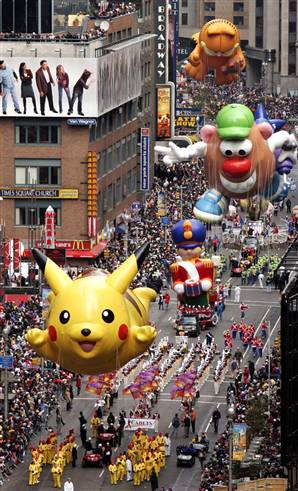
Now back to Thanksgiving. Today, I will wake up and watch the Macy’s Thanksgiving Day Parade on NBC. I will not pay much attention to the Broadway nonsense and endless interviews with actors from struggling NBC television shows, but I will become increasingly focused during the last 90 minutes as the ratio of inflatables to dancers picks up. I will attempt to interest my (now teenage) children in this and they will be less than excited (but that’s part of the tradition, too).

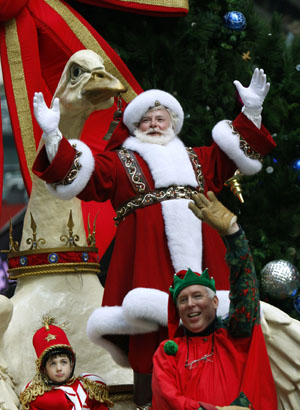
At the end of the parade, I will not take my eyes from the screen until Santa has disappeared. This may take a few minutes, as he continues to smile, wave and Ho, Ho, Ho as the credits roll for what seems like forever. But he is Santa, so I will wait.

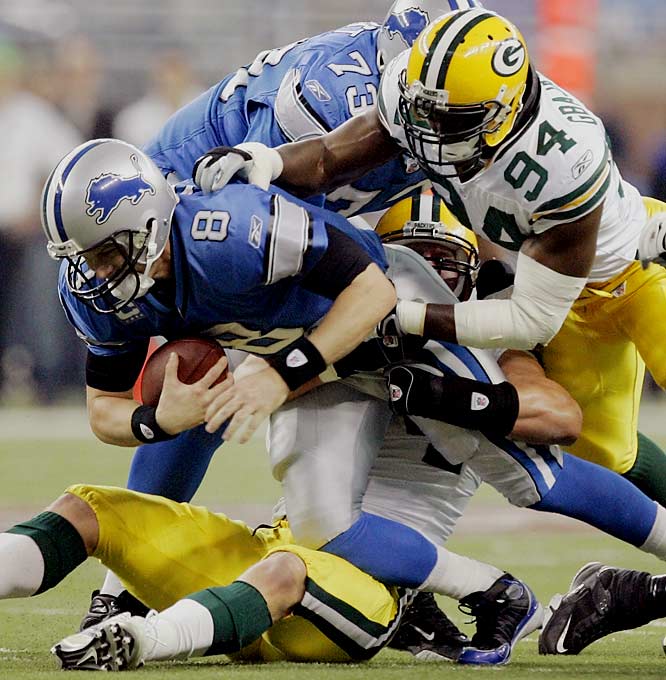
After the parade, the television goes to football, where I must watch the Detroit Lions valiantly struggle against their inevitable fate, almost as if they were the central character in a Greek tragedy. Struggle they may, but in the end, they will be vanquished by whatever team is lucky enough to be playing them (this year it’s the Packers). At halftime, my wife, our children and I will leave our home and make the short drive to her mother’s home, where the Lions game will be waiting for us. Watching the Detroit Lions lose is also an important part of my Thanksgiving routine.

About the time the Lions’ opponents are running out the clock, dinner will be served; the fare is predictable and correct to the holiday. During the meal the television will be switched over to the Cowboys game, but I feel that this game is more peripheral to the day, and so I watch it with less intensity, often times dozing off. Eventually, the “let’s get ready to go home,” noises start to be made, the children are rounded up, and we, with a few token leftovers as souvenirs, make our way home to prepare for the work ahead of us on Friday and Saturday.

With all of this having been accomplished, with each benchmark having been achieved, I will feel satisfied that one season has successfully passed into another, and I didn’t miss anything in the process. It will have been a good Thanksgiving.

I wish an equally wonderful Thanksgiving for each of you today.

Help Desk Thanksgiving Party!

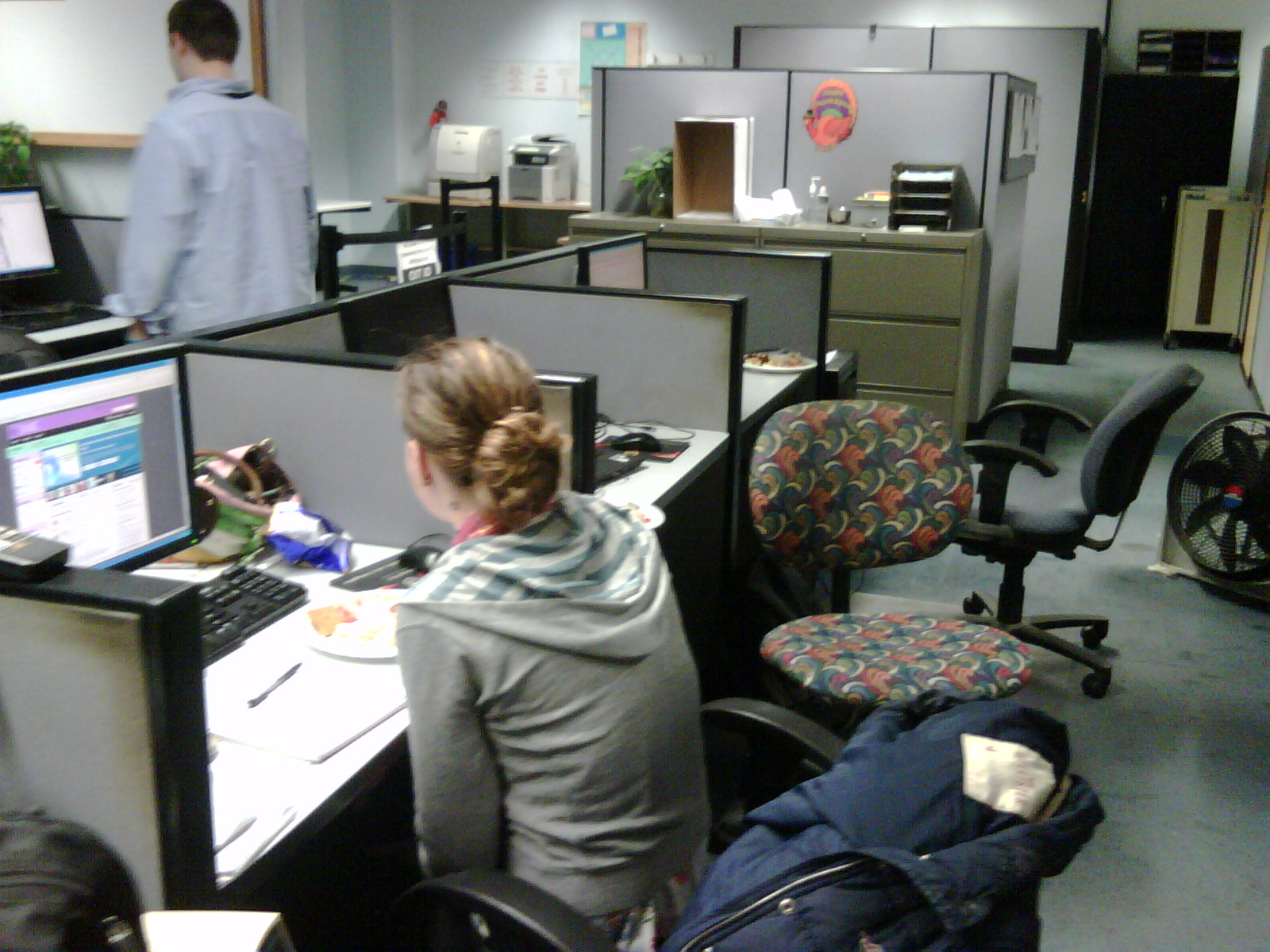
Today, the Help Desk was the scene of an all-day potluck dinner. Lots of folks brought in food, desserts and beverages. Here’s the menu (I think this is everything):

Sliced turkey, Cranberry sauce, Deviled Eggs, Apple Pie, Stuffing, Crab Dip, Chocolate cake, Pumpkin Pie, Green Bean casserole, Sweet Potato Pie, Shrimp Cocktail, vegetable platter, chips & soda.

Here are some photos:


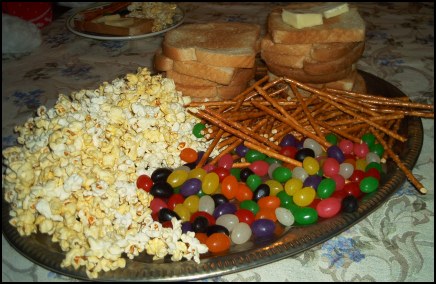
If we had been at Charlie Brown’s house, this would’ve been the fare:

Happy Thanksgiving!

Addendum: It’s only 2PM, and I’ve already consumed more calories than I would in an average day (the Belgian Chocolate cake finally got me). Not good! (And there’s still tomorrow…)


Sadly, Sondheim Still Sans Spectacles

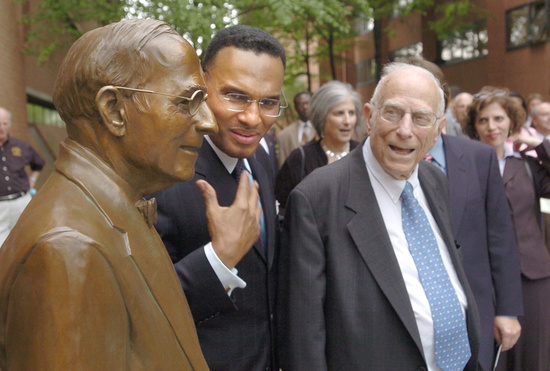
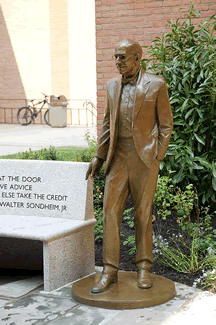
On May 11, 2005, the Social Sciences Building was renamed – and rededicated – to the legacy of Walter Sondheim, Jr. , a leader in the fight for school desegregation in Baltimore, and also a visionary in the revitalization of the Inner Harbor. Since 1999, UMBC has been home to the Sondheim Public Affairs Scholars Program, targeting students seeking to become community leaders themselves. Positioned at the main academic walkway in front of the building is a cast bronze statue of Sondheim, also dedicated that day, and granite benches inscribed with his words. Here’s the original press release.

Dr. Hrabowski and Sondheim at the dedication ceremony.

“Like Mr. Sondheim, this statue is inspiring and educational,” said sculptor Antonio Tobias Mendez. “In the future, students who view it will understand his character and dedication to community service.”

The Walter Sondheim statue, with glasses.

In early 2008, someone was apparently inspired to deface the statute – or more accurately, despectacle the statute. On Tuesday morning, February 5, Campus Police noticed that the statue’s glasses were broken. They’ve been gone ever since.

Sonheim, sans specs.

The Sondheim statue today.

It’s been almost two years since the original glasses were removed. Are there plans to restore them or have we admitted defeat? Certainly Mr. Sondheim is worth another try, isn’t he?

Of Squirrels and Ships and Sleeping Students, Of “Out Of Service” Rings

I’m a fan of the UMBC squirrel community, presently 50,000 strong (or so it seems). I even joined their Facebook group. I’ve always thought it was pretty cool how they have no fear of people; they just go about their hyperactive business, ignoring all passersby, often only a few feet away. It’s not unusual to see a number of them working the same small area of grass at the same time, involved in general digging, jumping and scurrying while the academic year passes around them.

The rare UMBC chameleon squirrel.

In spite of my esteem, I must admit that the squirrels’ foraging habits are sometimes, well, less than dignified. In fact, to make their trash-diving easier, the ingenious squirrels installed “squirrel doors” on many of the older trash cans around campus.

Trash can with "squirrel door."

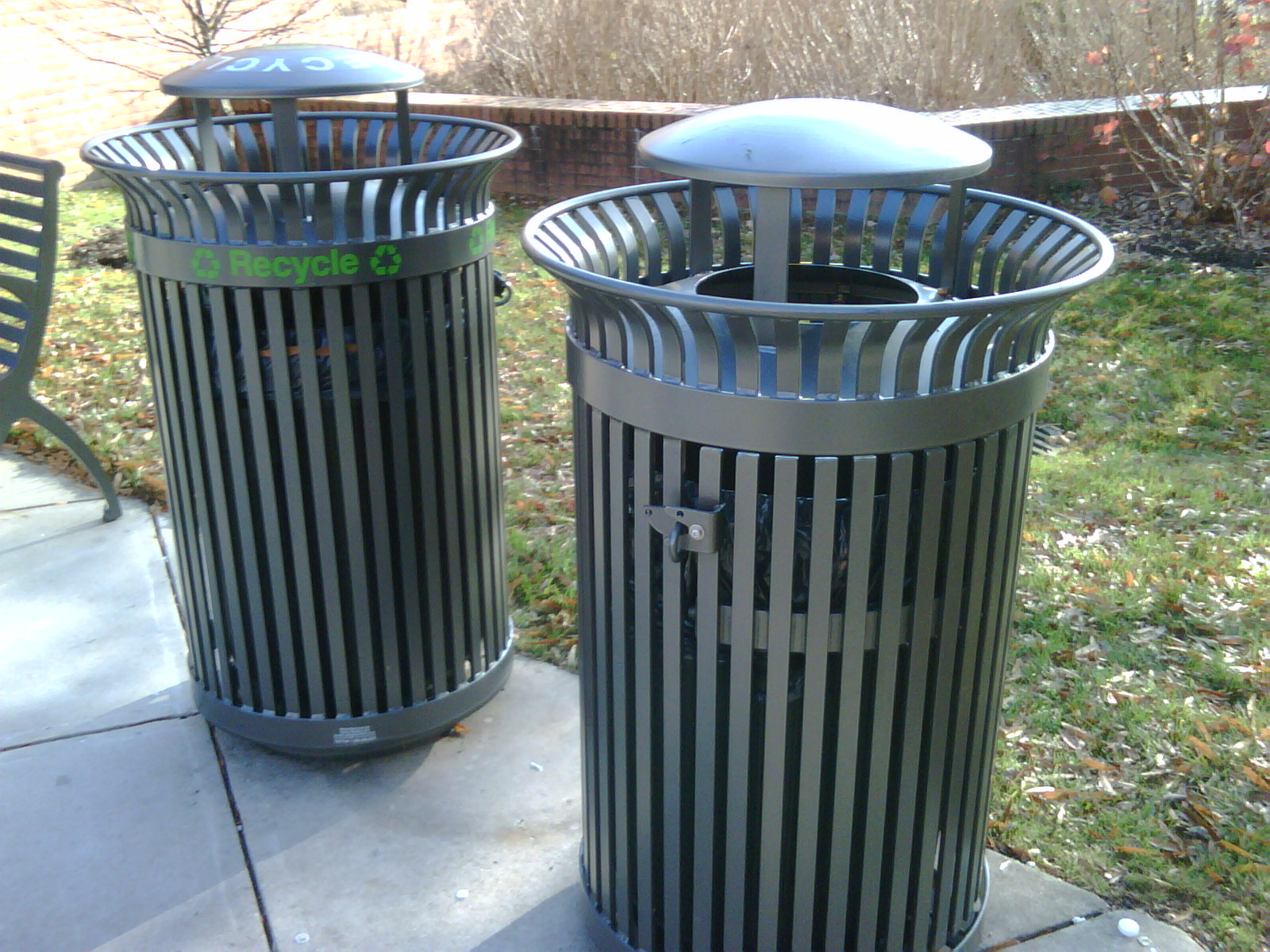
This semester, though, we’re starting to see upgraded trash receptacles that have a different design:

Are these supposed to be "squirrel proof?"

Maybe these have been added for ascetic purposes (they do look much better than the old cans), but if these are an attempt to stop the dumpster-diving of our furred population, I think someone has underestimated their ingenuity. I give the squirrels two months before they’ve figured out the new design.

Before I came to UMBC, I actually thought squirrels hibernated inside the trunks of trees (where they store their forage).  This is not so. Rather than hibernate, the squirrels are active year-round, and live in what, to the untrained eye, appears to be over sized birds’ nests.

The winter home of Stephen B. Squirrel.

Recently, a U.S. flagged cargo ship (that had been the subject of much pirate drama earlier this year), successfully repelled a pirate attack near Somalia. What I don’t understand is why any vessel would operate in those waters without being armed to the teeth. The pirates, from what I’ve seen, are lightly armed, and these ships are huge. Why not mount machine guns, SAMs and grenade launchers on these ships and teach the sailors how to blow these dingys out of the water?

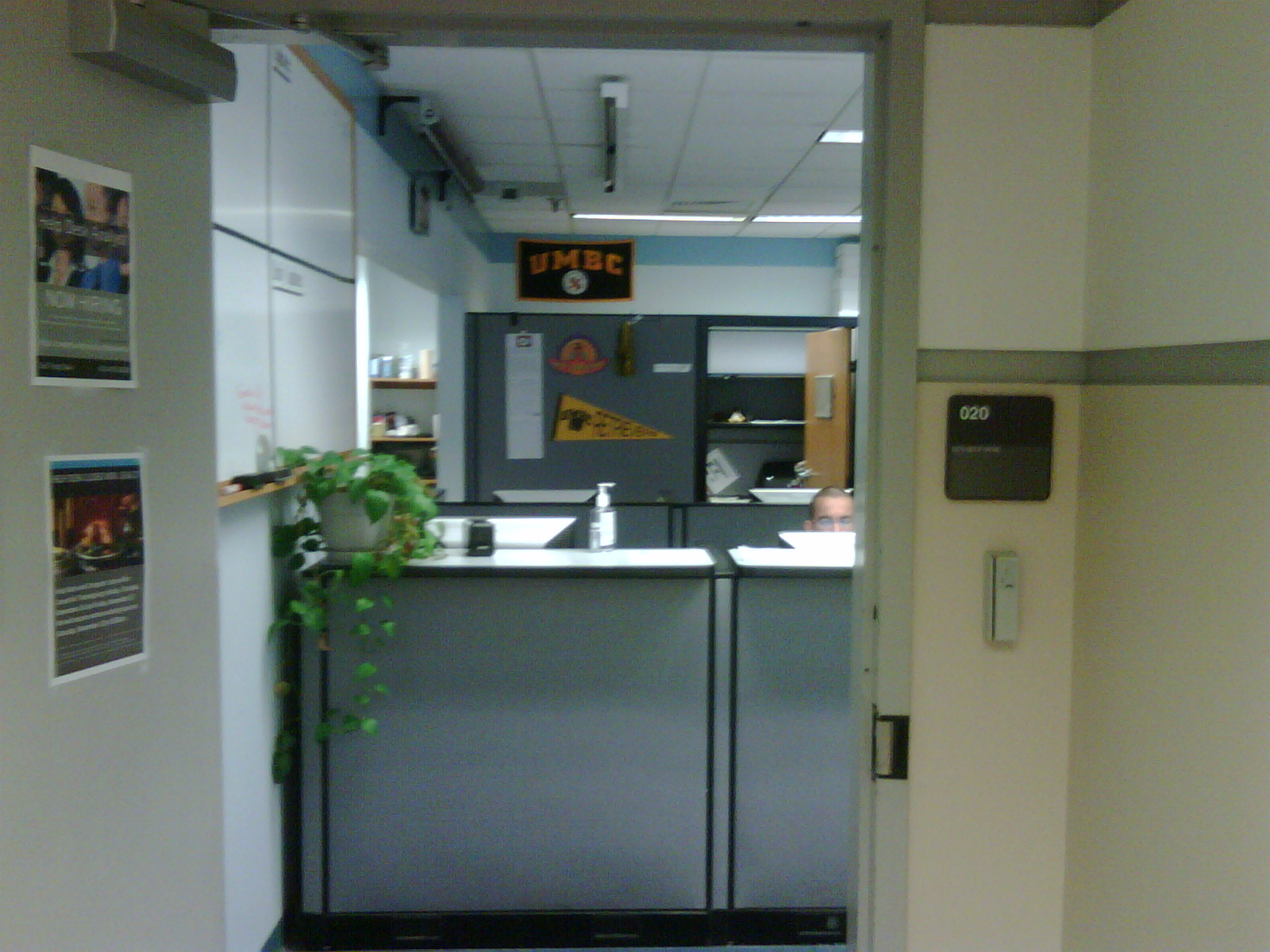
I work in the ECS building, at the Help Desk.

This is where I work. That's my office in the background.

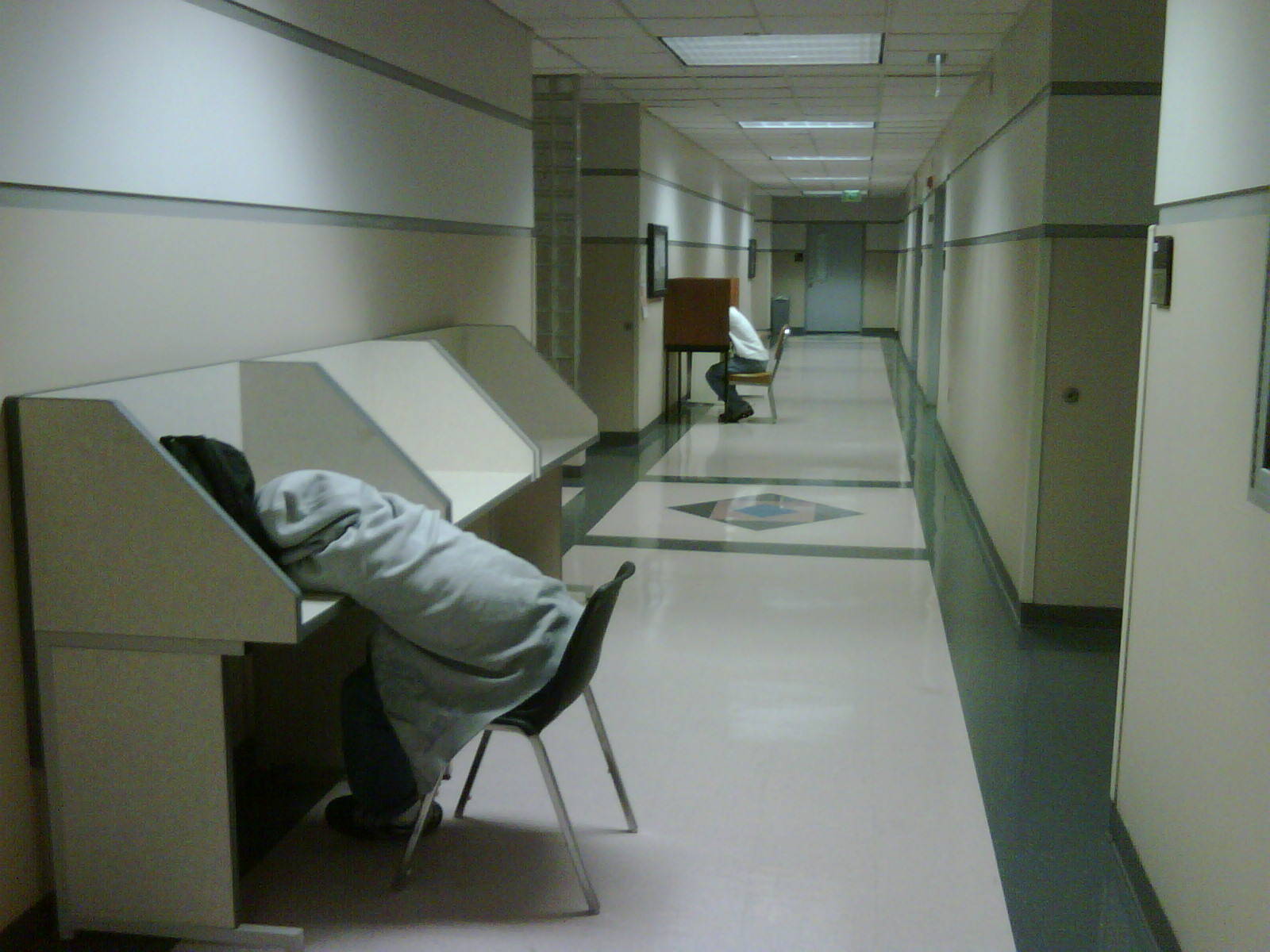
One of the things I think that we need to be more grateful for are the sleeping stalls that have been conveniently scattered across the campus for student use. Clearly, the administration knows how little sleep most young people get, and in appreciation of that fact, they have distributed throughout the buildings temporary rest stations. I am pleased to report that these sleeping stalls are being put to good use on a daily basis.

Sleeping stalls at max power in the ECS Building.

As I walked near the pond next to the AOK library recently, I saw this out-of-order fire hydrant.

The "Out Of Service" ring tells us not to bother in the event of a fire.

Well, at least this hydrant isn’t near anything really combustible, like thousands of books and irreplaceable documentsMaybe they can just pump the pond water if there’s ever a fire.