I’m a Mac; No, I’m a PC; No, Wait…

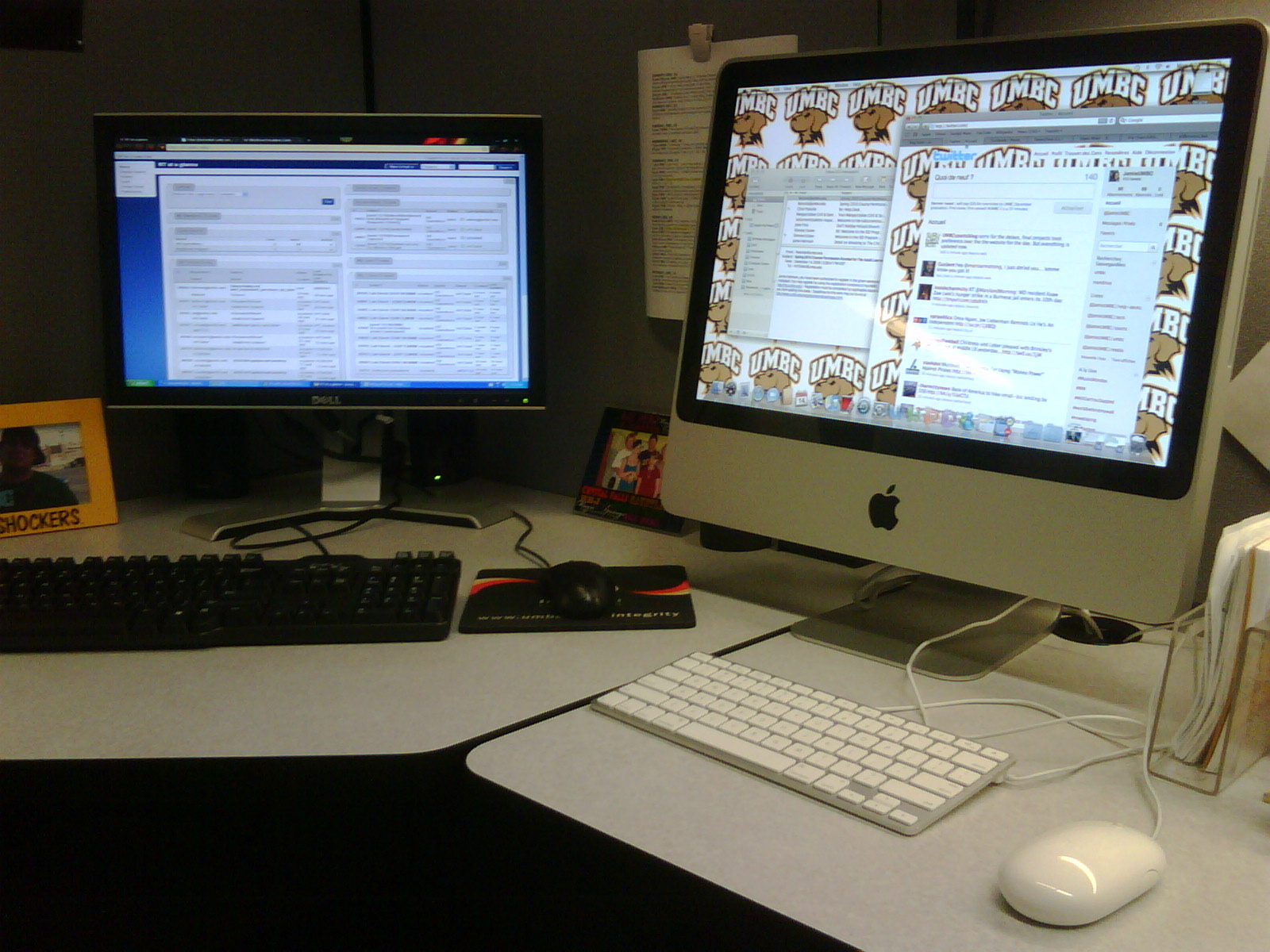
The Help Desk gets phone calls occasionally from Mac users, and this is an area where I have little practical experience. So, last week, hoping to make myself a more well-rounded Help Desk Support Staffer, I acquired my first Mac.

My first assignment was to do a clean install of the new Snow Leopard operating system. I’ve done hundreds of operating system installs in my life from Windows 95 to Linux Fedora 12, so I figured that installing a Mac OS from a disk would be no big deal. I was wrong. The entire process, from the keyboard shortcut that enables the Mac to boot from disk, to the not-very-intuitive partitioning process, was so alien to me that I ended up having someone from Desktop Support just do it for me. Linux looked much easier to install, and that’s saying something.

Once the OS was installed, then I had to download a few updates and reboot a couple of times. The Mac’s reboot process was fast, so this ended up being no big deal. Next, I installed Microsoft Office for Mac 2008, which took almost as long as did the OS install. After that was done, I set up Apple Mail, which was easy, since the icon (a postage stamp with an Eagle on it) is on the Dock at the bottom of the screen, and the two or three settings are the same as in any other mail client. Finally, I was ready to use my Mac.

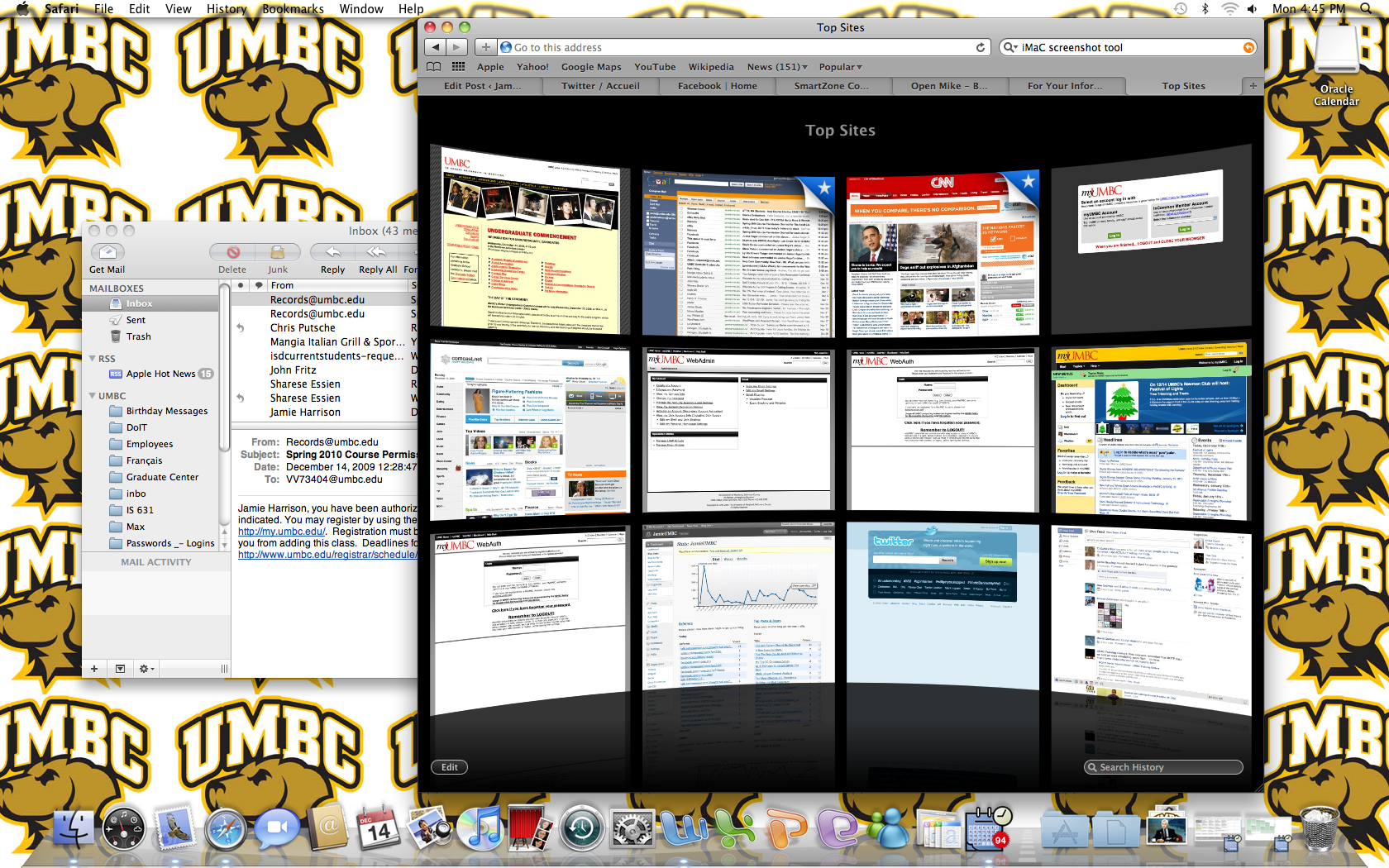
Almost all of the work I do is through systems that are accessed by a web browser, in this case Apple’s Safari, which reminded me a bit of the Google Chrome browser I had been happily using on my PC. Safari is fast and has the thumbnail collage view of recently visited pages and bookmarks that I’d come to rely on in Chrome.

I quickly discovered that Internet Explorer keyboard shortcuts mean nothing in Safari; in Safari, F5=Command+R, for example. Also, when a word is misspelled, I was used to using my right-click function to access the auto-correct; in Macville, this is done by Ctrl+left-click. This is where I made a neat discovery, which was that the Mac/Safari tricks worked on Chrome! One thing I don’t like about Safari (or Firefox for that matter), is that the address in the address bar doesn’t highlight with just one click. This means that if I want to enter a new address, I have to drag the cursor across the address; if the address if terribly long, this might require multiple attempts. (In Chrome, the address bar doubles as a Google search bar, too.)

I haven’t had to use Word for Mac much, but so far, I’m not impressed. At first glance, almost all of the radio buttons I’d come to depend on in the Windows version is gone. After a little exploration, it looks like the functionality is there, but it’s just inconvenient to access. Perhaps after I get used to it, I’ll find that it’s no different, but for right now, it’s awkward.

I really like Apple Mail. It’s easy to use, it highlights messages that are associated with each other (Re: ‘s) and when you send a message, it makes a cool “whoosh” sound. When a message arrives, there’s an audible alert and a number (representing unread messages) appears over the postage stamp icon.

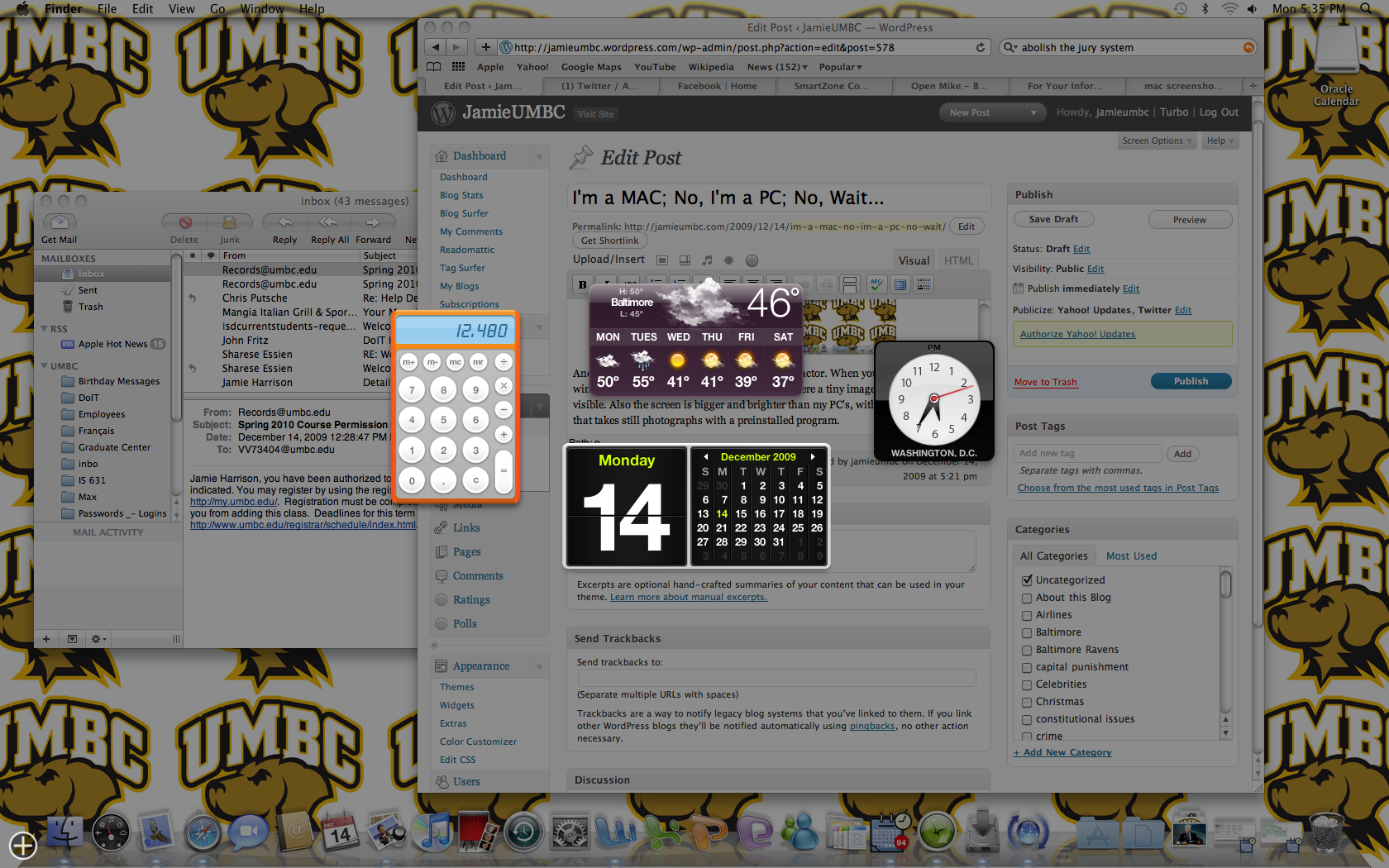
Another big plus with the iMac is the coolness factor. When you hide a window, the window seems to be vacuumed into the dock, where a tiny image of the window remains visible. Also the screen is bigger and brighter than my PC’s, with a built-in webcam that takes still photographs with a pre-installed program. The dashboard (represented by the black circle icon second from the left of the dock) is a neat feature, especially if you find yourself using the calculator a lot.

Clicking the dock icon makes the dashboard appear; clicking anywhere outside of one of the four apps makes it vanish.

The mouse is a bit strange. It feels small, and not having a right-click button takes some getting used to. The keyboard I am not in love with. It’s like an abbreviated version of a normal keyboard, and most notably lacks the numeric keypad that I’ve grown dependent on.

One thing that is very nice about the Mac is that there’s no tower for me to knock my knees against. Everything is self-contained behind the monitor, including the CD drive, and the only cords leaving my desk area are the power cord and the ethernet cable, which means there is very little wasted space.

So far, I really like the iMac, although some things have to be relearned and will take some getting used to. Of course, I wonder if I like it so much that I’d be willing to spend an extra $700 on it in the real world. Probably not, but that’s one of the perks of working in IT, right?

I’m also wondering whether, as a Mac user, I’m required to grow a “cool-guy” half beard, like Justin Long.

Justin Long - He's a Mac

Winter Commencement, Regalia and The Mad Scramble for Graduation Tickets

In less than two weeks, I will publicly receive my undergraduate degree in History from UMBC. I officially graduated in August, and my diploma came in the mail in October, so, yes, to some degree (no pun intended), this event will be anti-climactic.

Still, I figured, why pass up a chance to celebrate one last time? It’s also a celebration for my wife and children, who had to endure the not-so-slight inconvenience of Dad returning to college. After a day of teaching History at Cardinal Gibbons School, rather than return home, I would head to UMBC for class. For me, taking classes was, for the most part, a blast. I loved my History classes, enjoyed my other Humanities classes and tolerated well the other GFRs. For them, it was a family often short one person.

Because they shared in my burden, it’s important that my wife and three children also share in the public culmination of that achievement. I would’ve liked for my parents to have been there also, but my father died seven years ago, and my mother’s back won’t allow her to sit through the ceremony (we’ll pick her up afterwards for the big-deal restaurant lunch we have planned). My mother-in-law, who I am very close to, also wants to be there, and I’d like her to be there too. This, however, is a problem.

If your commencement from UMBC is this Spring, it will be held at the 1st Mariner Arena (capacity 13,500). If your commencement is in December, it will be held in the Retriever Activities Center (capacity 4,000). This disparity in available seating creates a scarcity in graduation tickets, with each graduate receiving four tickets only. If you were doing the math one paragraph above, you now know my dilemma. I need one more ticket. (The university offers overflow seating in Lecture Hall III, where those voted off the island will have to watch by closed-circuit broadcast, but this is hardly an acceptable option for just one family member.)

The four tickets I was issued

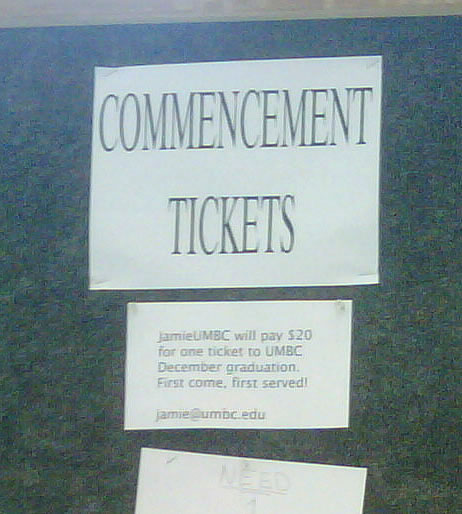
Obviously, I’m not the only person with this problem. Apparently there are so many graduates looking for tickets that the university has set up a bulletin board outside of the Bookstore. Here you can pin your desperate plea for extra tickets, in much the same way that prayers are inserted in the Western Wall in Jerusalem.

The Board of Faint Hopes

That's mine, right under the sign

(If anyone knows a December graduate with a ticket to spare looking to make an easy $20, please let me know.)

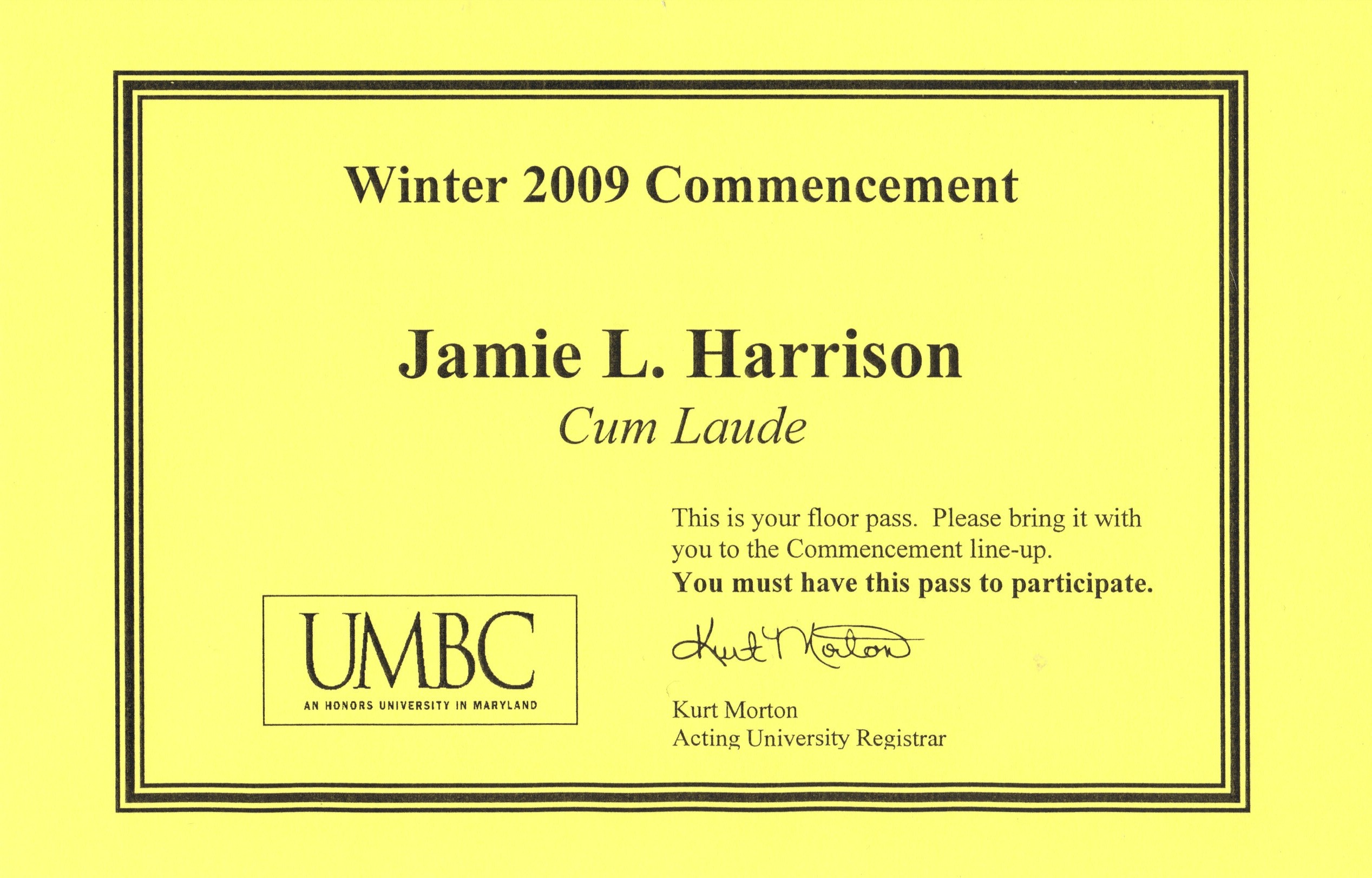
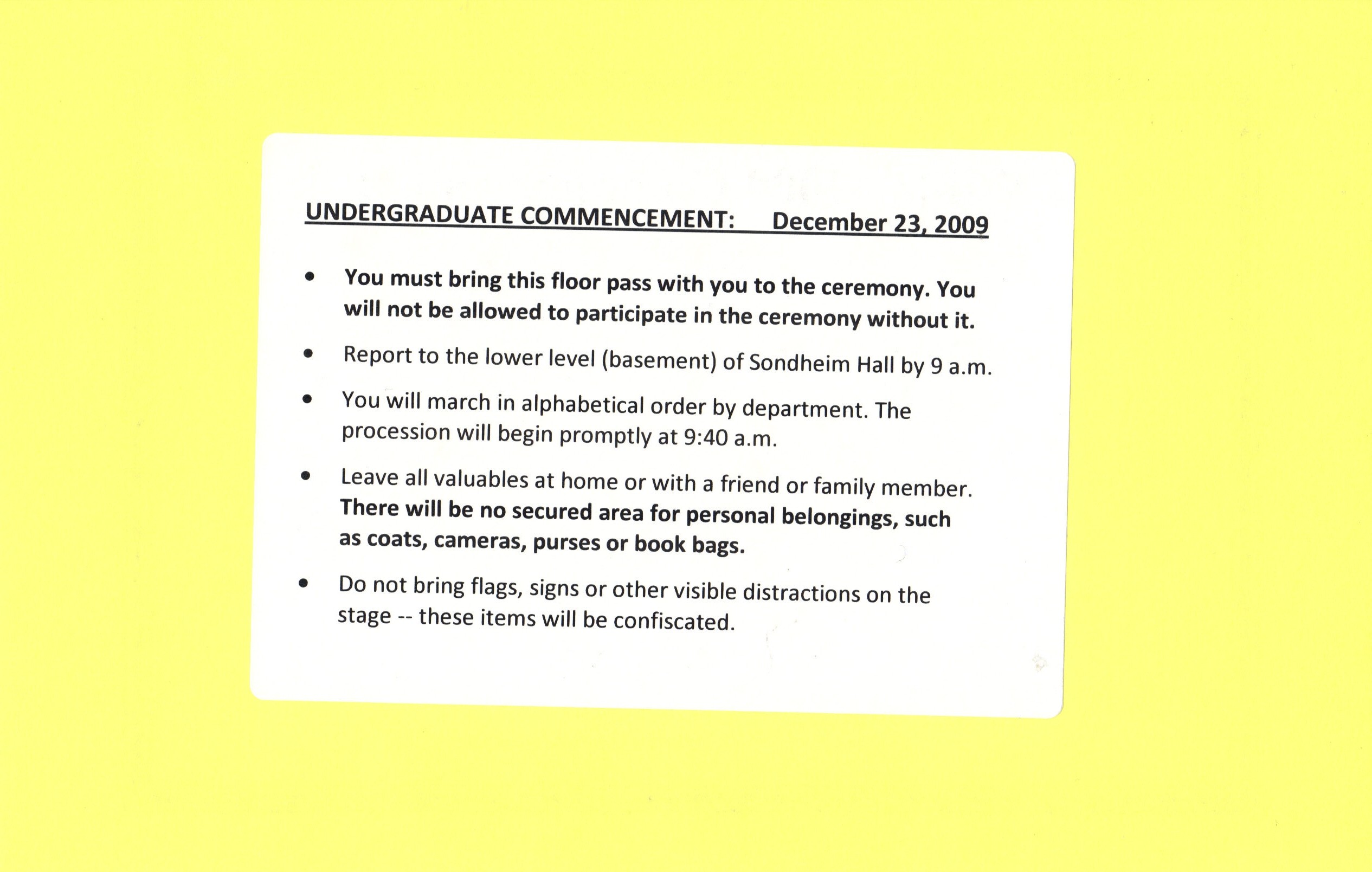
Also, I get a commencement pass of my own:

Front

Back

Another part of the commencement experience is the regalia. The regalia I’ve been given comes with a long black gown, a gold sash (signifying that I’m graduating with Honors), a tassel and a really strange cap. I’ve already tried on the cap at home, and there’s absolutely no way I can wear this cap without looking like a twit. I can’t figure out how the tassel is attached, or where it hangs.  As you can tell, I’ve never worn regalia.

My sixteen-year-old son Zachary is an excellent amateur photographer (he’s been published in multiple newspapers) and he’ll be bringing his good camera to the ceremony. I’ll also make my guests patiently wait so that I can have my picture taken with True Grit. (Again, how many times in my life will I get to do this?)

After that, we’ll head to my car (I’ll use student parking, since I have a student pass due to my Graduate Student status), pick up my mother and then it’s off to The Olive Grove in Linthicum, which has become the traditional celebratory restaurant for our family.

While we’re there, I’ll be preoccupied examining the digital photos on Zachary’s camera to see how idiotic I looked in that funky cap.

Top Ten Not-To-Be-Missed Christmas Shows

There are plenty of Christmas television specials and movies out there; how do you decide which ones to watch? Well, here are the ones I stay home for:

10. Elf – One of the few Will Ferrell movies I can sit all the way through. It’s cute, it’s funny, and Bob Newhart plays Papa Elf. Fortunately, I don’t have to make time for this movie, because it’s on sixteen separate cable channels every day during the month of December.

9. Scrooged – I detest remakes of A Christmas Carol that repeat what’s already been done better. I’m fine with versions that update the story or take it places where it hasn’t been. In this version, Bill Murray is a cynical, vicious television executive who gets the Dickens scared out of him by an excellent supporting cast, which includes John Forsythe and David Johansen (below with Murray).

8. It’s A Wonderful Life – The 1946 Frank Capra classic. Yes, it’s a sappy story, but it reminds us of all the good we can do, and maybe already are doing, for the people around us every day. At this point it’s passed from being a film to being a Christmas tradition, which makes it immune to cinematic criticism.

7. Saturday Night Live Christmas – SNL has done a lot of really funny stuff over lo these many Christmases – none funnier than Steve Martin’s Christmas Wish.

6. A Christmas Story – I’ve never seen a film become iconic quite as quickly as did the story of Ralphie’s quest for the elusive Red Ryder Ranger Model Air Rifle. A huge bonus is the acting of Darren McGavin, who also played Carl Kolchak in the Night Stalker series. If you like this movie, you can see it for 24 hours straight on TBS.

5. Rudolph the Red-Nosed Reindeer – Debuting Christmas 1964, this is the claymation classic that started it all. As much as I enjoy Rudolph, every year Santa seems to become more and more of an insensitive jerk. If this were remade today, Rudolph wouldn’t run away, he’d sue Santa under the Americans with Disabilities Act.

4. Frosty the Snowman – A little song becomes an indelible part of our lives with the help of great voiceover performances from Jackie Vernon (Frosty), Billy De Wolfe (Professor Hinkle) and Jimmy Durante.

3. How the Grinch Stole Christmas! – Dr. Suess’ Christmas staple first appeared in December of 1966, complete with narration by Boris Karloff and singing by Thurl Ravenscroft, who was also the voice of Kellogg’s Tony the Tiger. Directed by Chuck Jones, of Tom and Jerry fame.

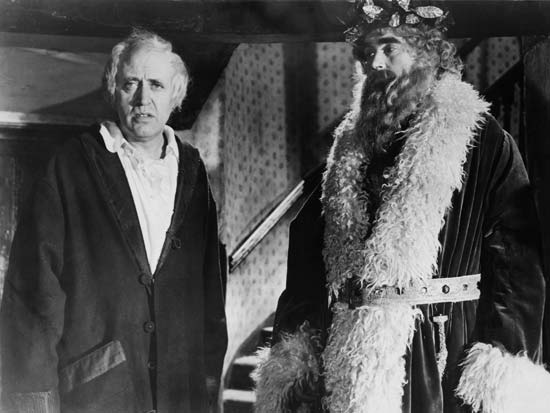
2. Scrooge (1951) – The definitive version of Charles Dickens’ A Christmas Carol, a brilliant cast headed by Alastair Sim set the bar so high that all other Scrooge films seem like disasters by comparison. The original was in black and white, but the colorized version really brings out the feel of London in the early 19th century. Another bonus is how close this version stays to Dickens’ text.

1. A Charlie Brown Christmas – For me, Christmas is in full swing when I hear Linus say, “That’s what Christmas is all about, Charlie Brown.” Released in 1965, when people weren’t afraid to quote the Gospel of Luke and some actually had aluminum Christmas trees illuminated by rotating color wheels, the message is about rejecting the commercialization of Christmas. If Rudolph created claymation holiday specials, Charlie Brown did the same for animation. [Irony Central: Let me say here how disappointed I am with ABC for cutting a full five minutes from A Charlie Brown Christmas last night so that they could squeeze in more commercials. Being the network that gets to broadcast “ACBC” is a sacred trust, which ABC violated for the sake of commercialism. Shame on you, ABC.]

Honorable Mentions:

The Year Without a Santa Claus

‘Twas the Night Before Christmas

The Little Drummer Boy

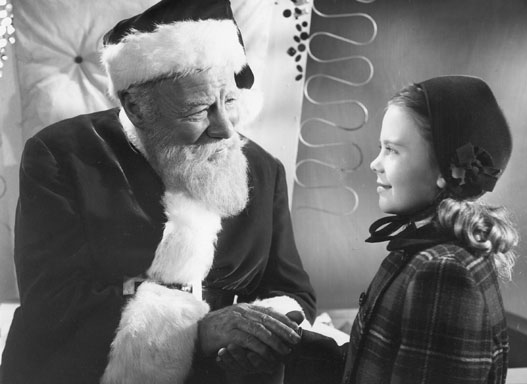
Miracle on 34th Street

Santa Claus Is Comin’ to Town

The Day The Music Died – For Me

We’ve all heard somber-sounding people on television or the radio asking the question: “Do you remember where you were when you heard about (insert traumatic event here)?”

For my parents, there was Pearl Harbor and then the assassination of John Kennedy. For most people of my generation, we have 9-11. But I think there exists a second category of psychic traumas, traumas that are not national ins cope, but are more personal, and leave their scars on a smaller, more targeted audience.

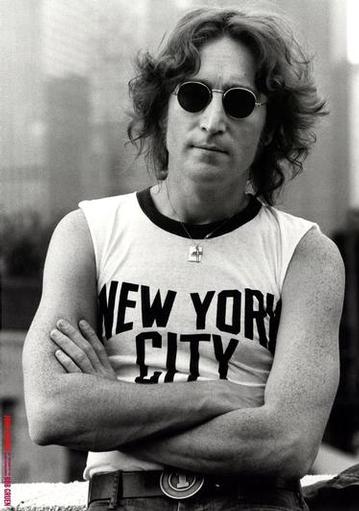
For me, the shooting death of John Lennon on December 8, 1980 falls into this category. I’ve always been a Beatles‘ fan, surrounded as I was by older brothers who were Beatlemaniacs (until I was 8, I was led to believe that all music was Beatles’ music). As I got older, I developed my own love for the Beatles, and for John Lennon’s music in particular. Being a sixteen-year-old in the winter of 1980, I guess I identified with Lennon’s rebellious nature, his brutal honesty and the raw truth in his lyrics. Lennon bowed to no one, and had a reputation as a troublemaker. All of this I found very appealing.

On the night of December 8, 1980, I spent a good deal of time tying up my parents’ telephone line in conversation with my best friend, Dave Padgett (that was how we communicated with each other back in the day). We laughed as we imitated Monty Python skits, in particular, The Piranha Brothers, and we talked about playing an elaborate practical joke on my brother Alan. It was a typical, nondescript Monday night.

Much of America heard about Lennon’s shooting on Monday Night Football. At that moment, however, I was in my family’s upstairs bathroom, having just finished washing my hair. As I was vigorously toweling it dry, my mother, who had been watching the Tonight Show with Johnny Carson in the living room, called to me that NBC News had just broken into the program to say that a Beatle had been shot. I rushed downstairs, telling myself that she must have misunderstood, that someone with a similar sounding name or something must have been shot. It had to be a mixup. When I got there, Johnny was back on the air, seeming completely oblivious to the incredible news (I didn’t realize that his show was taped).

Flipping around the few channels we had in 1980, I found a reporter in front of Lennon’s building in New York, the Dakota, with a growing crowd behind her. As the taped interviews with witnesses and the updates from Roosevelt Hospital came in, it became clear: John Lennon was dead. I called Dave, who hadn’t been watching television. We hung up quickly to watch the coverage, which alternated between reporters at the hospital and the chaotic, sad scene outside the Dakota. By 1 AM, there were literally thousands of people gathered around Yoko’s building, singing John’s songs, hugging and weeping.

Radio stations of all formats immediately switched to all-Beatles programming, and I stayed up all night, listening to the music, listening to the tributes, listening to the DJs struggle to make sense of it all. It was strange, but I kept checking the newscasts, almost believing that there was still a chance that it was all a mistake, but the facts remained unchanged. John Lennon was dead, killed by a mentally ill fan. We later found out that Lennon had signed a copy of Double Fantasy for his killer, Mark David Chapman, earlier that evening, and the moment had been captured by an amateur photographer:

At school the next day, Dave and I made plans to travel to New York for what was certain to be a massive public funeral. As it turned out, there would be no funeral. Instead Yoko opted for ten minutes of silence on Sunday the 14th; it is said that tens of millions stopped to observe it.

During that week, it seemed like every magazine featured a tribute to John Lennon, and I wondered how much money was made from the grief.

For my part, I kept reading newspapers, listening to the radio tributes and talking to Dave. I sent a short letter to Yoko expressing my feelings of loss, knowing that it was one of a million letters she’d never see. It all seemed surreal.

Over the next few weeks, it felt like we struggled to place John Lennon in context. Was he a pop superstar, a troubled poet, a rebel rocker, a peace activist, or a feminist house husband? How could we label him for easy, convenient packaging? Lennon reinvented himself so often it was hard to pin him down. I remember DJs starting to refer to him as “The Master,” as if he required a label (maybe because Elvis was “The King?”). Thankfully, the attempts to label John Lennon soon passed. The selling of John continues unabated, however, and I expect that he will be redefined and repackaged by each succeeding generation; such is the price of immortality.

For me, though, it was more personal than that; I felt robbed of Lennon’s future almost as if it were my own. I recall being in a record store in Lansdowne soon after and overhearing two middle-aged women discussing the tragedy. They were tsk-tsking it, saying what a shame it was. You have no idea, I remember thinking. You have no idea.

Pearl Harbor: A Date That Is Being Rapidly Forgotten

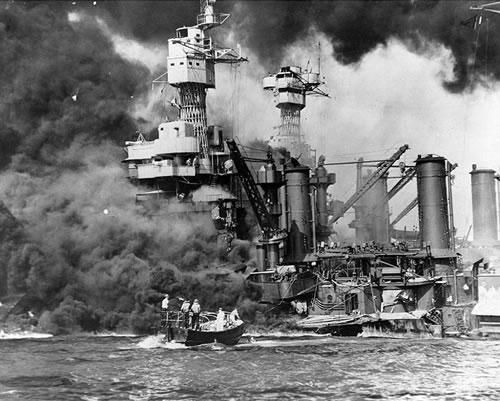
Sixty-eight years ago today, your grandparents’ generation had their 9-11 moment. On that day, the Empire of Japan decided to sucker-punch the United States Pacific Fleet, stationed at Pearl Harbor near Honolulu, Hawaii. The Japanese military leadership hoped that by destroying America’s naval presence in the Pacific, they could bully the United States into accepting Japanese hegemony in the Far East. This would allow their aggressive expansionism to continue unchecked.

The attack began at 11:55AM Eastern time (6:55AM local time), with the aerial bombing beginning almost an hour later. The Americans at Pearl Harbor were taken by surprise, and nearly 3,000 were killed. The destruction was nearly complete: 4 battleships sunk; 4 battleships damaged including 1 run aground; 2 destroyers sunk, 1 damaged; 1 other ship sunk, 3 damaged; 3 cruisers damaged; 188 aircraft destroyed, 155 aircraft damaged; 2,345 military and 57 civilians killed, 1,247 military and 35 civilians wounded.

The United States, however, was fortunate on this day. The decisive weapon of the war in the Pacific would not be battleships, but aircraft carriers, and the American carriers were out to sea when the Japanese struck, and thus they survived. What the attack had accomplished more immediately, however, was to thrust the United States into the Second World War.

For the next six months, the Japanese Empire ran amok in the Far East, capturing nations at will as the United States at first reeled, and then began to build the most formidable war machine in human history to that point. By the summer of 1942, the United States had begun the process of taking the fight to the Japanese, winning two stunning victories at Coral Sea and Midway. From then on, the Japanese were on the defensive. But on December 7, 1941, Americans didn’t know how things would turn out.

Many expected a Japanese invasion of the West Coast; any American with an Oriental look about them was soon considered suspect. Many whites had no time for subtleties  -to them, they all looked like the guys flying Zeros at Pearl Harbor and Midway. Not long after this, the internment order for Japanese-Americans would be issued.

For my father, then a seventeen-year-old living at St. Mary’s Industrial School on the present site of Cardinal Gibbons School, the entry of the United States into the war brought him to enlist in the Marines. He would eventually be wounded on the Japanese island of Okinawa in 1945, but lived to tell the tale. He quickly recovered and would have been part of the invasion of the Japanese mainland had not the atomic bomb ended the war. For this, I probably owe my existence, because conservative estimates put American casualties in Japan at around one million.

Marines on Okinawa

The day after Pearl Harbor, President Roosevelt said that the date would “live in infamy.” For many younger Americans, the date has already lost its meaning, and the future looks bleak as less than 50 survivors of the attack remain. Soon, there will be no one to recall the events of that day, and we will become dependent on books, photographs and films.

But today, while we still have them here, let’s not pass up a chance to pause for a moment or two and recall their 9-11 moment, just as we hope that sixty years from now, our grandchildren will be able to recall ours.

As A Teenager in Iceland (While The Orioles Win The Series)

The flag of Iceland, in the Flag Court at the Commons

I’ve only been to one foreign country in my entire life, and I had to miss watching the Orioles win the World Series to get there, but I wouldn’t trade the experience for anything.

In the summer of 1983, I was a nineteen-year old working in passenger service for Butler Aviation (handled today by Signature Flight Support) at BWI Airport. I was one of perhaps a dozen pax service reps, with a number of kids my age, and we acted as the on-site crew for charter flights and airlines with limited service, such as Air Jamaica and Icelandair. It was a pretty good group, mixing youth with experience and we were good at what we did. Generally, we had a great time, mixing in laughter with the work, meeting interesting people from around the world, in the easy days before international airports were high security facilities.

A lot of my most interesting memories are from this time in my life. Probably the best is when the wonderful folks at Icelandair decided to send a few of us (myself, Lisa Merkey and Debbie Hutton) to Iceland for the weekend, all expenses paid. We were informed late that summer, and since none of us had passports, we had to hustle down to an office in Washington to get them. If I remember correctly, it didn’t seem like much of a hassle at the time (except for going into Washington). We were scheduled to leave on Friday, October 14, providing our flight had open seats (being freebies, they wouldn’t let us be the reason seats weren’t sold, but this is standard airline procedure, and we understood).
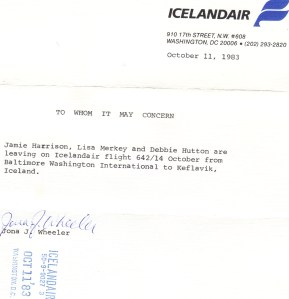
As the date of departure approached, the Orioles advanced through the playoffs. My future wife and I saw games 1 & 2 of the American League Championship Series at Memorial Stadium. The Birds lost Game 1, but came back to take Game 2. It suddenly occurred to me that I might be in Iceland as the Orioles played for a championship; I was uneasy at this, but never once considered passing up the chance of a lifetime to watch baseball. What if I turned this opportunity down and they lost?
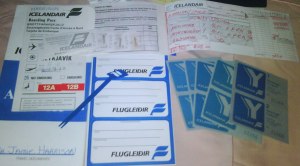
When the appointed day arrived, we arrived at the airport, luggage in tow, to work the flight that would eventually take us across the ocean. We knew from the passenger list that we would probably make the flight, unless people showed up at the last minute wanting a ticket (you could do that back then). Iceland in the fall is not a popular tourist attraction, so we felt pretty confident. (Why did people go to Iceland at all? Icelandair offered inexpensive continuing service to Luxembourg, in the middle of Europe, as long as you didn’t mind a stop in “Ísland.” At the time there was little service to Europe from the area, so this was a popular option.)

That night was also the third game of the World Series, which the Orioles won 3-2,  putting them up in the series 2-1 over the Phillies. I was a huge O’s fan, and now it seemed entirely possible that they could win it all before I got back home to see it. It was dangerous to think this way, but I was pulling for one Philadelphia win, so that the series would return to Baltimore.

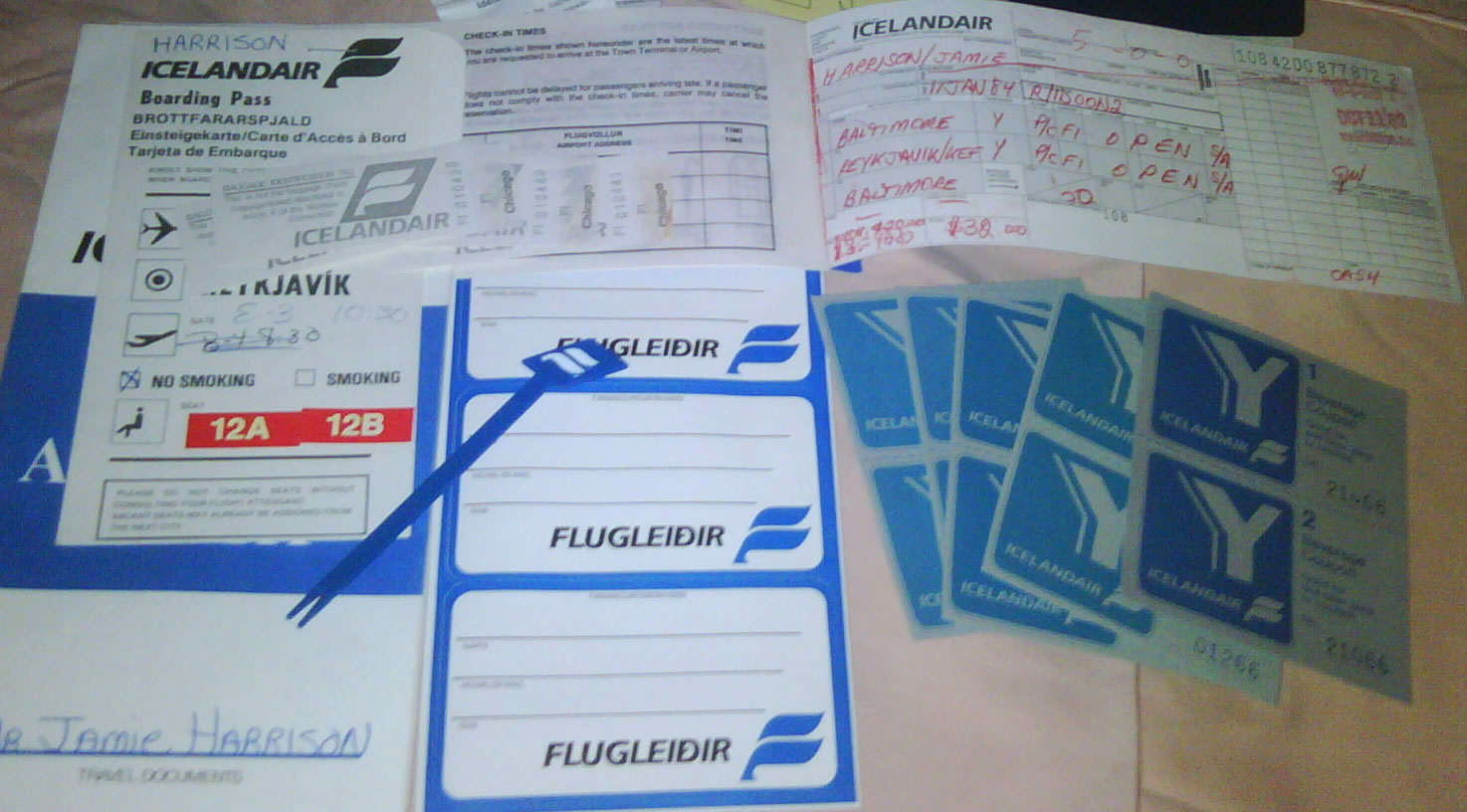
The flight left late at night, and when we got on, because we were left to open seating, the three of us were scattered throughout the 707. On the bright side, however, we were given a stack of free alcohol coupons! (See the bottom right corner of the photo above.) I was feeling very grownup and worldly, so I used mine on Grand Marnier, which helped me doze off.

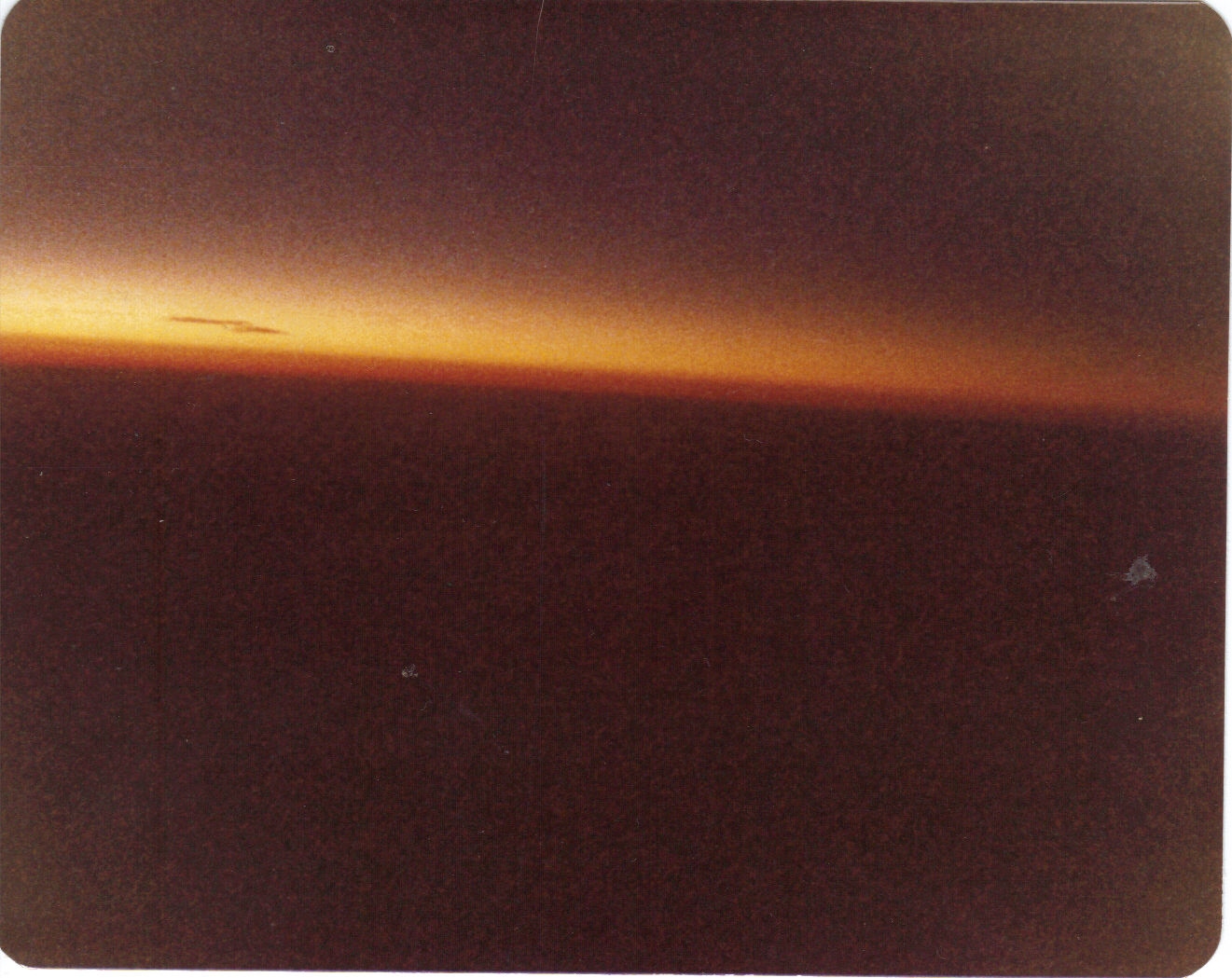
I woke up in the wee small hours of the morning, and looked out of the window at a vast unbroken whiteness. This was Greenland. I was too excited to return to sleep. Just before the sun rose, I snapped this photo:

A few hours later, it was Saturday morning. The plane touched down at Keflavik Airport, and the pilot announced that the temperature outside was 43°. I was shocked; I was in Iceland and that was no different than Baltimore in December. What he didn’t tell us was that the winds were blowing at about 20 miles per hour, and they cut right through you. There was no jetway, just roll up stairs on the tarmac, so the frigid air punched me in the face as soon as I stepped out of the plane.

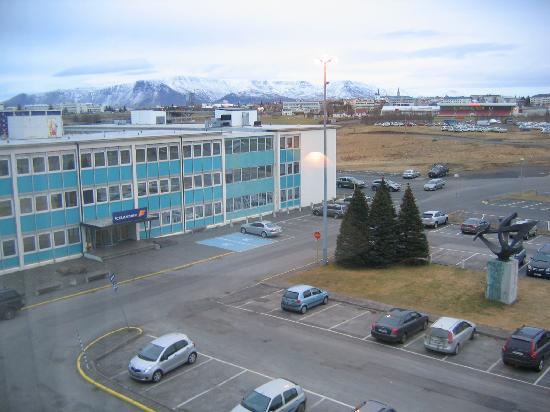
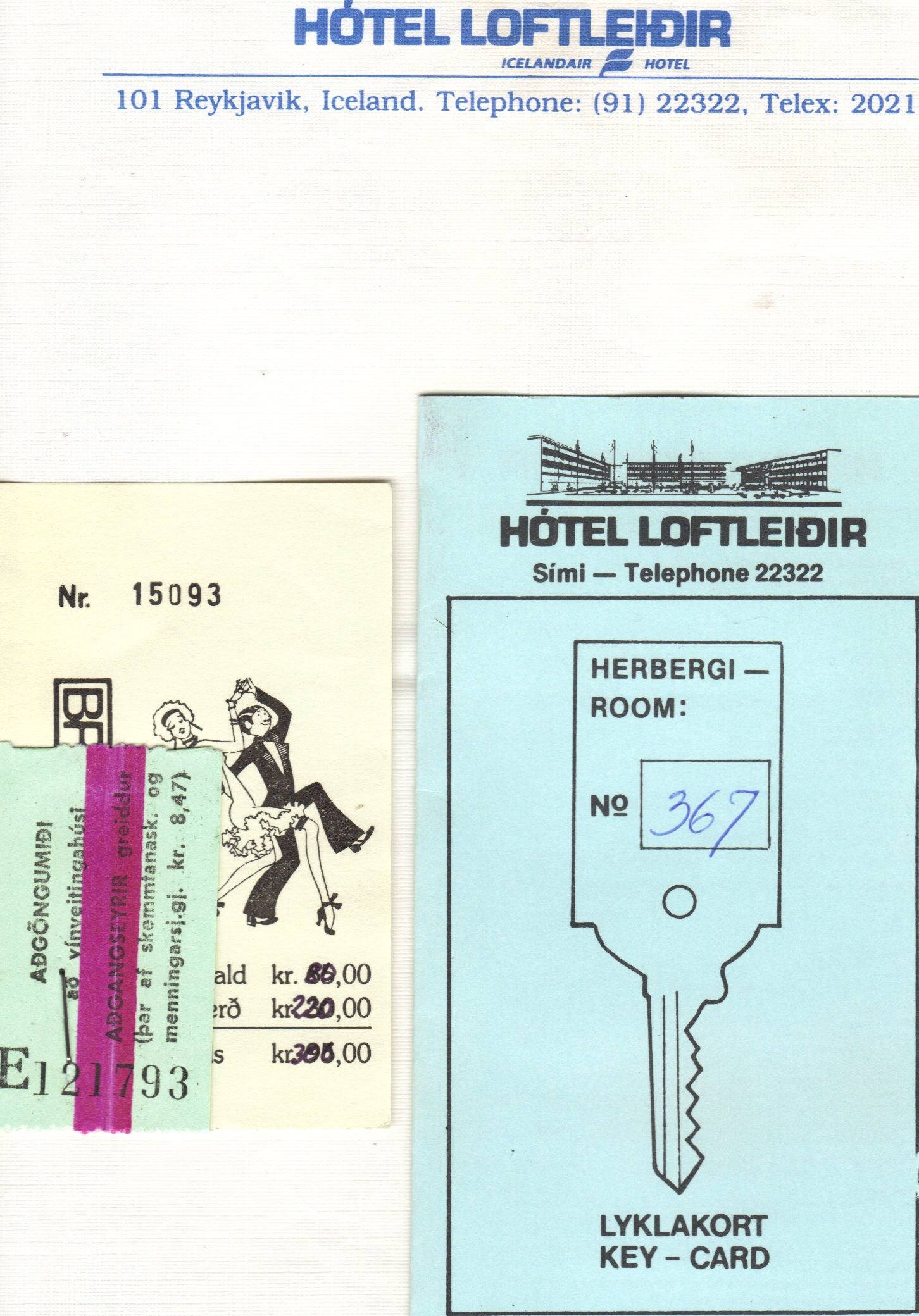
After getting our bags, we took a van to the Hotel Loftleiðir, which wasn’t plush, but that didn’t matter, because we were in Iceland.

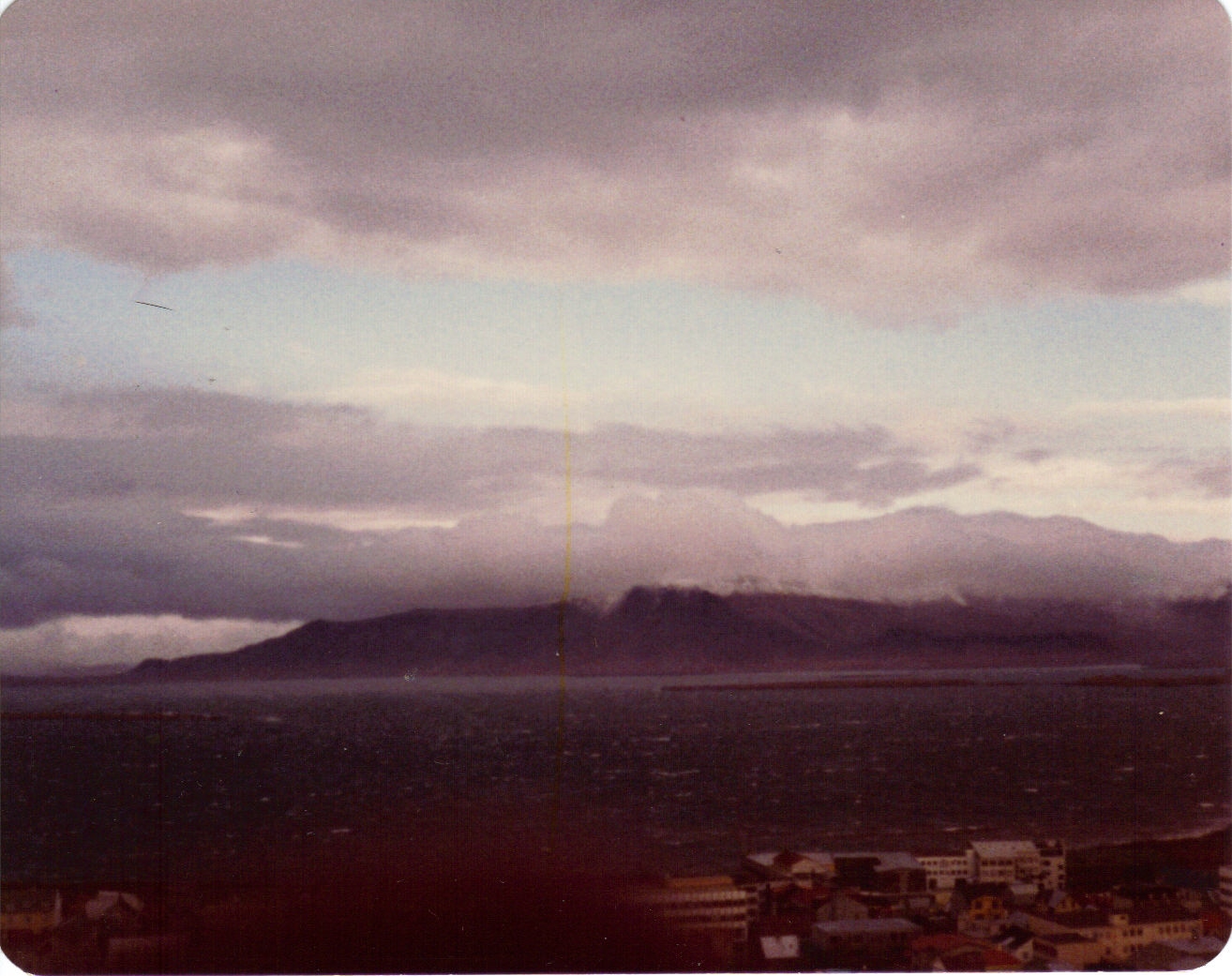
The view from the hotel was amazing. The countryside appeared nearly flat, except for the beautiful ice-covered mountains visible from my window. Here’s a picture I took:
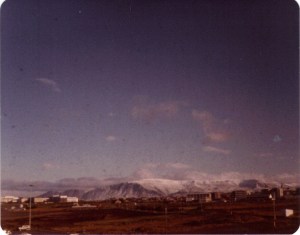
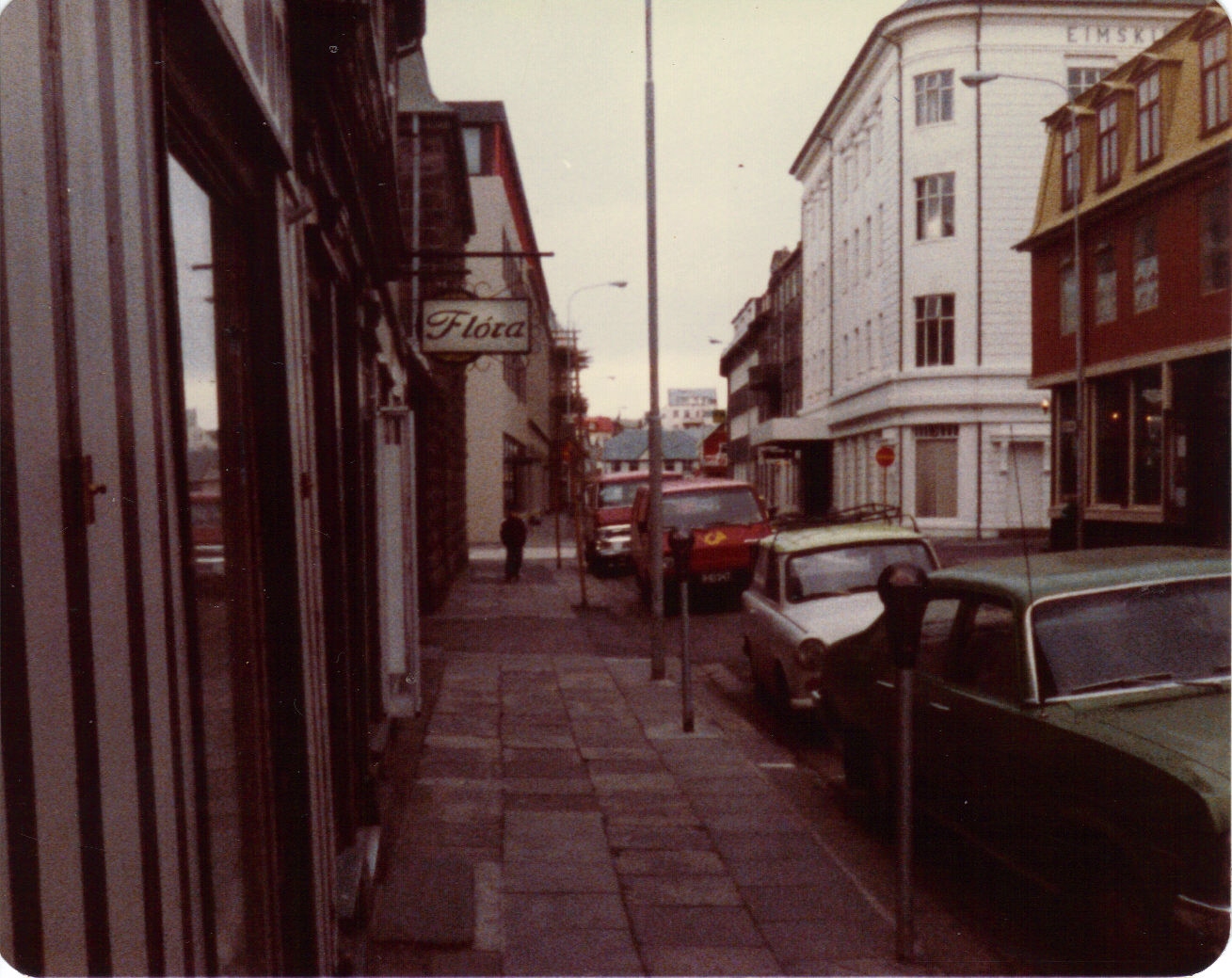
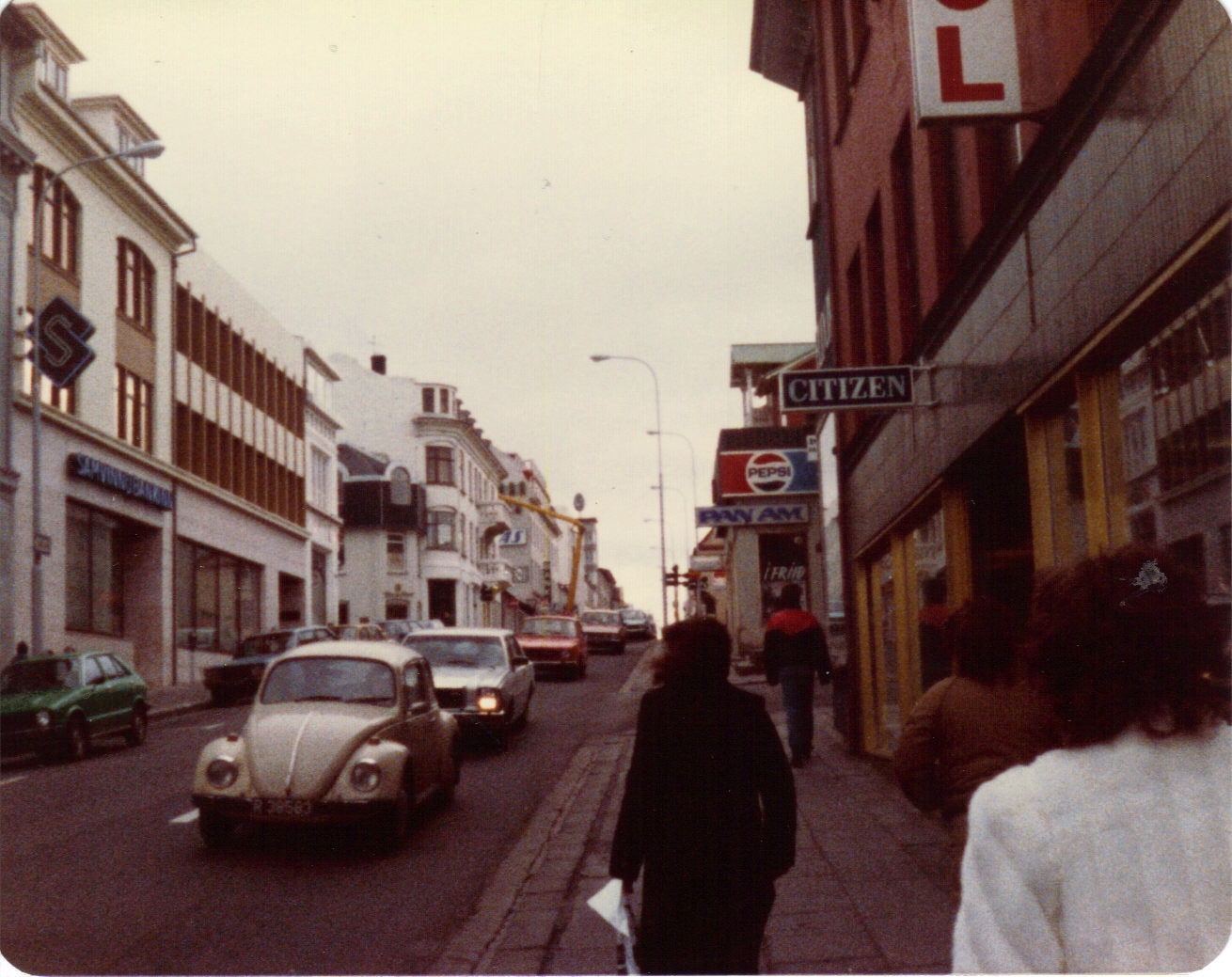
We didn’t have much time, so that afternoon we went out to see the town of Reykjavik. Reykjavik is Iceland’s capital and its largest city, but of course, this is relative. To us it seemed like a quaint, small town. It also seemed as if every business was closed. (We later found out that closing for the weekend was the norm.) We walked around the small streets and took in the chilly, windy atmosphere. Soon we found ourselves at the water’s edge, where I snapped this photo:

We were hungry, and finally found what appeared to us to be a small delicatessen that was open; the shop specialized in salads and fish. I ordered a fish sandwich, and tried to tell the young lady who took my order that I didn’t want lettuce. Having left my Ensk-islensk Vasaordabok (English-Icelandic Dictionary) in my hotel room, I couldn’t come up with the word. (Icelandic is the language of the original Viking explorers, almost perfectly preserved today.The only Icelandic word I remember today is þakka þér fyrir, which sounds like “thakka thair feerer” and means “thank you very much.”) As it turned out the word was salat. Salat/salad. I felt stupid.

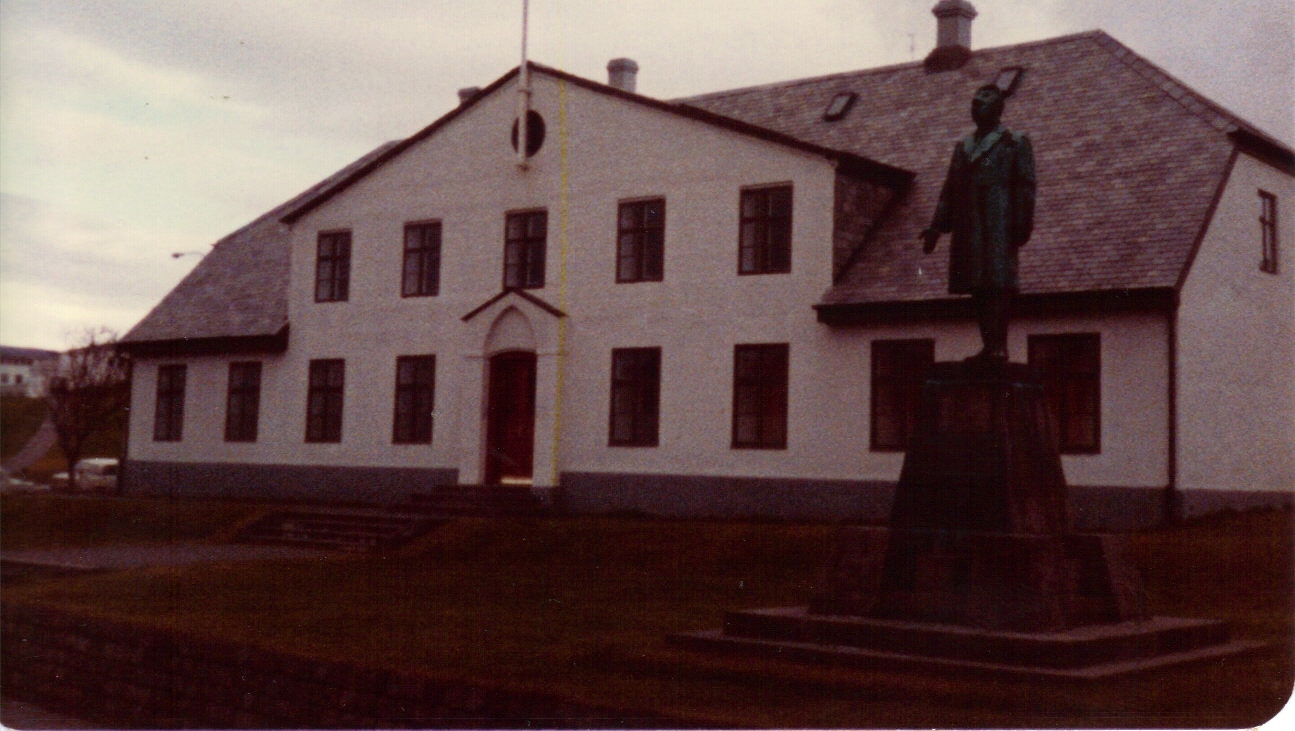
Continuing our walk around town, we were struck by the lack of trees, shrubs and animals, which no doubt are made rare by the biting cold. Here are some pictures I snapped as we walked:
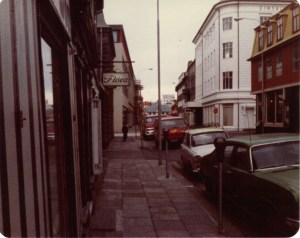
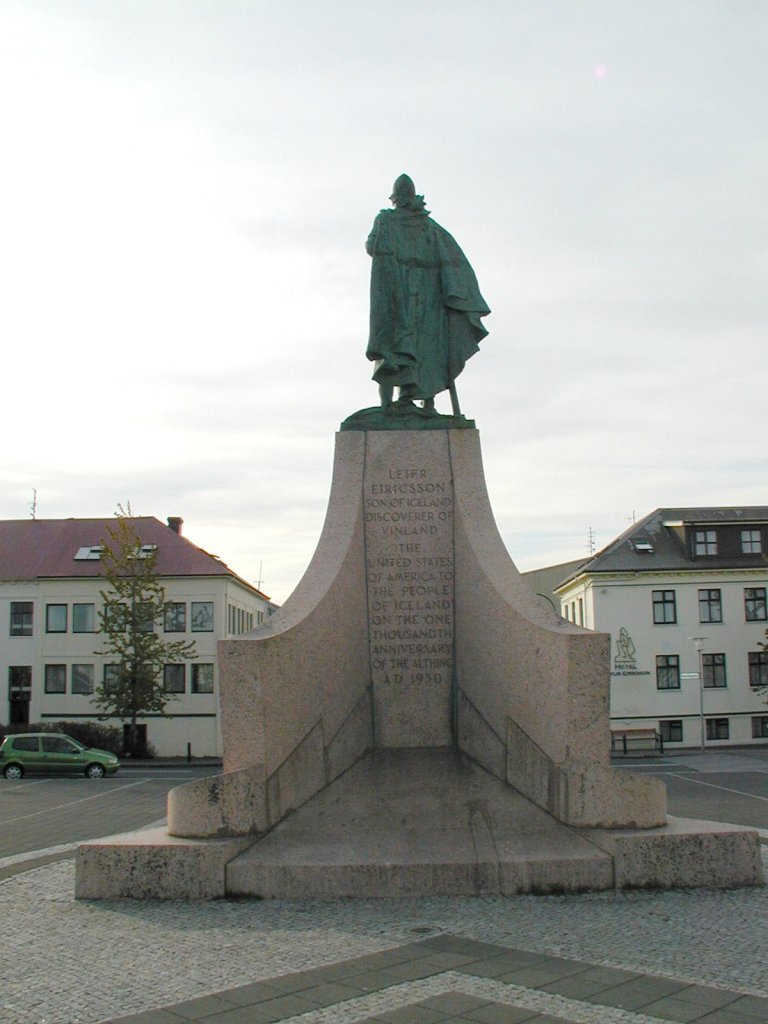
After a time, we saw this large tower on the top of a slight rise that looked like a promising tourist attraction, so we made our way to it:
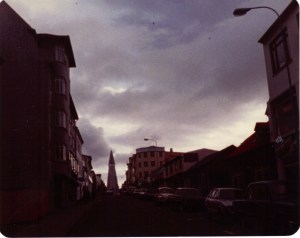
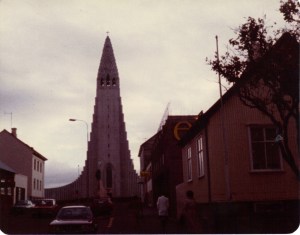
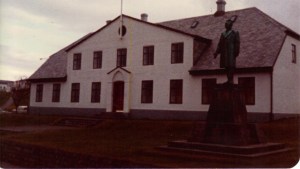
As it turns out, this is a church with a statue of Leif Erikson in front of it. The statue was a gift from the United States in 1930:

The church was unlocked, and we climbed to the open windows at the top (stronger, even colder winds up there), from where I took this photo:

At this point we were frozen solid, and since nighttime, with its promise of even more frigid weather, was closing in quickly, we decided to head back. With some difficulty we hailed one of the few taxis, which returned us to the hotel. This was another strange experience. As the cab idled in front of the hotel, and we tried to figure out how much kronur we owed, the meter kept running, changing the total. Kronur is worth a lot less than dollars, so every time we looked up, the number seemed outrageously higher. Eventually we threw a bunch of Icelandic money at him and dashed out of the cab. We knew we had probably overpaid, and that we had probably been taken advantage of, but we were foreigners, and teenagers at that. What could we do?

When I got back to my small, sparse hotel room, I discovered a radio built into the wall above my bed; soon I was on Armed Forces Radio, listening to the Orioles game. I only heard a couple of innings, however, before the ladies arrived to pick me up for another cab ride, this time to the Club Broadway in Reykjavik.
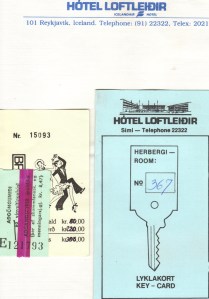
The Broadway was smoky, loud and crowded, a place where people had no problem invading your personal space and putting their hands on you, which, as an American, I found very awkward. A live band was playing American music badly, and we soon found a few open seats at one of the long tables. I went to the bar and ordered a vodka and orange juice, which was made as an Old Grand Dad and orange juice. After much struggle to explain what I wanted, I settled for a gin and tonic.

When I got back to our table, I found myself seated next to a chatty Icelandic guy in his early twenty’s who considered himself a bit of an expert in things American.  He spent the next hour explaining to me that America had been infiltrated by a vast Ku Klux Klan conspiracy; he even showed me, by tearing apart his pack of Marlboro cigarettes, how they sent secret messages to each other using the colored circles on the inside flaps of the box. I listened politely before excusing myself to get another gin and tonic. After a few more hours of smoke, loud music and screaming at the person sitting right next to you, we headed back to the hotel, exhausted from our long day.

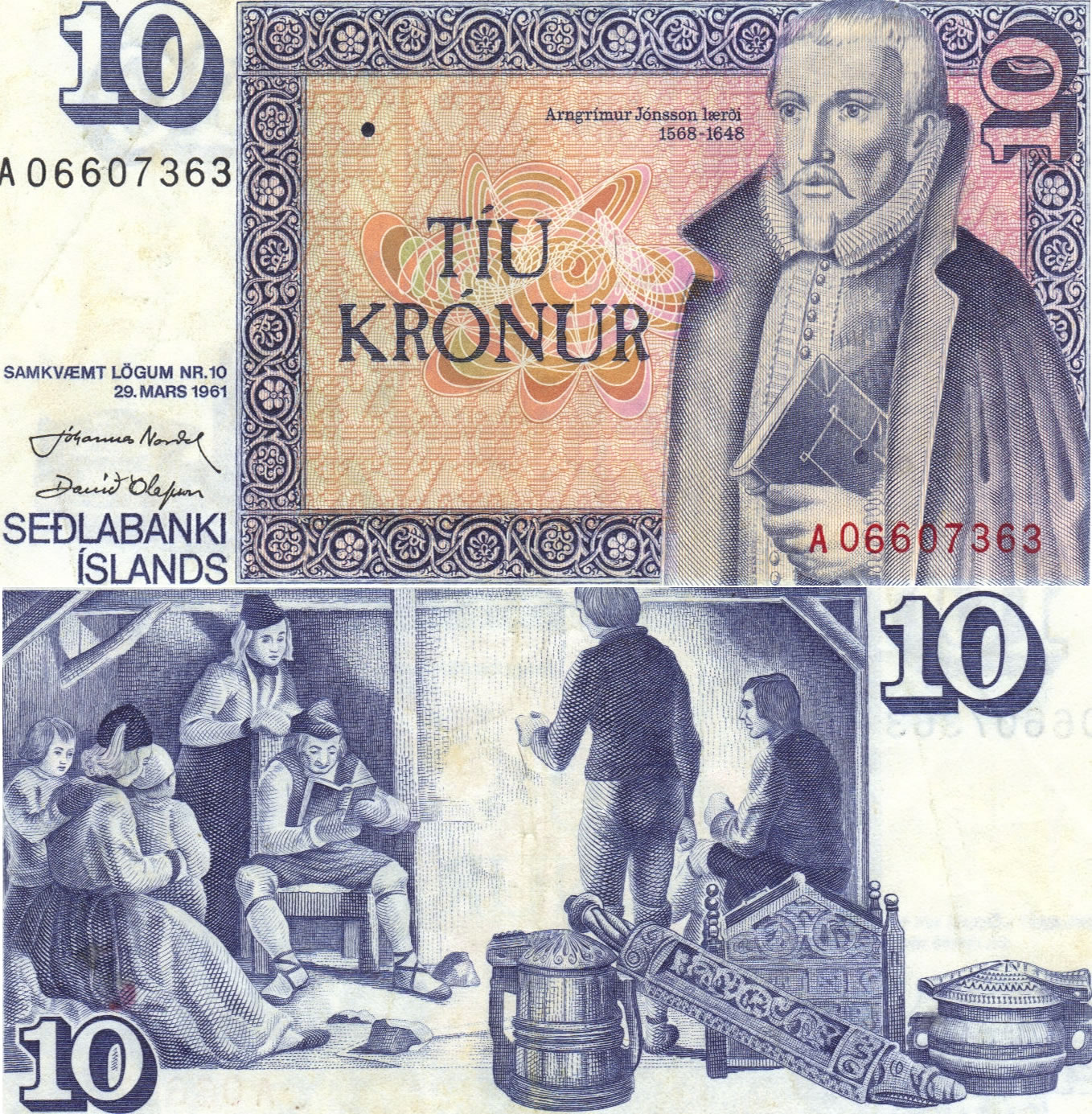
The next day we stayed close to the hotel, because we had a flight to catch. I did a little shopping at the hotel store, where I discovered, after finally figuring out how to convert kronur to dollars, that my cokes were costing me six dollars each. On the other hand, a nice wool scarf (which I still have) and a jar of caviar were dirt cheap. (I didn’t get the caviar because I was down to my last ten kronur, which didn’t buy anything. I still have it:

Finally, it was time to check out and head to the airport. Here’s my hotel tab and receipts from what little shopping I did:

And here are my souvenirs:

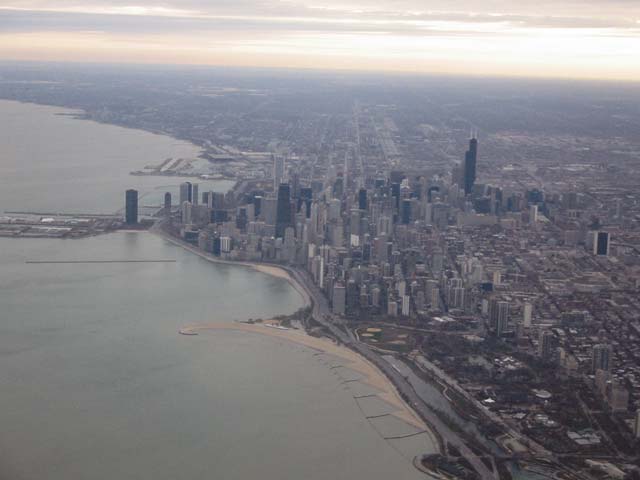
On the flight home, the ladies took the last two open seats and I got the “jump seat.” This is a fold-down seat located directly behind the cockpit. It wasn’t very comfortable, but I was happy to be on the plane at all. Another perk to being up front with the crew is that when we descending into O’Hare in Chicago, I was called into the cockpit. The pilot pointed out the window excitedly and said, “Loook. See-Ka-Go, See-Ka-Go!” As I peered curiously through the clouds, I began to see the entire city of Chicago, sitting on Lake Michigan and laid out before us. I thanked the captain for his thoughtfulness; it was a nice touch.

In Customs at O’Hare, I found the first American man and asked, “I’m from Baltimore. Have you heard about the World Series? What’s going on?” Gruffly, he said, “Yeah, I dink you guys won it.” And that was how I learned that the Orioles were World Champions. We got into Baltimore in time to see the buses from Philadelphia arrive at Memorial Stadium, where they were attacked by the throngs of fans who had been waiting all night. I was later told by coworkers that BWI had broadcast the end of the game on monitors around the terminal, and that when the last out was made, the concourses shook.

No matter. I had my memories of a very cool weekend in Ísland (take that however you want to), and I wouldn’t have traded it for the world, not even for the World Series.

My Top 20 Christmas Songs

Christmastime is here, and in honor of the season, I’m going to do a few Christmas lists. The first one out of the gate are my twenty favorite Christmas songs:

1. I Believe in Father Christmas – Greg Lake. From Christmas 1975 – Lush, gorgeous music paired with a biting, cynical message (“Hallelujah, Noel, be it heaven or hell; The Christmas you get you deserve.”) Not exactly uplifting, but awesome nonetheless.

2. Happy Xmas (War Is Over) – John & Yoko. A sentimental favorite. I’m a huge Beatles/Lennon fan, and this is typical John, reminding everyone that there’s much to be done.

3. You’re A Mean One, Mr. Grinch – Thurle Ravenscroft. If there’s a recurrent theme in this list, it’s that we carry our childhood around with us forever. I love How The Grinch Stole Christmas (the original animated version, not that sin against nature that Jim Carrey foisted upon us), and I’ve even memorized most of the Suess script. BTW, did you know the guy who sang this was the voice of Tony the Tiger, the Kellogg’s Frosted Flakes spokescharacter? Heeee’s Great!

4. Frosty the SnowmanJimmy Durante. Another throwback to my youth. This version is from the animated classic, which so impressed me in my youth that I eventually went out and got myself my own cute blonde girl and married her. How’s that for influence?

Karen

Laurie

5. 2000 Miles – The Pretenders. I’m a big fan of Chrissie Hynde and the Pretenders, and I love her contribution to the Christmas season.

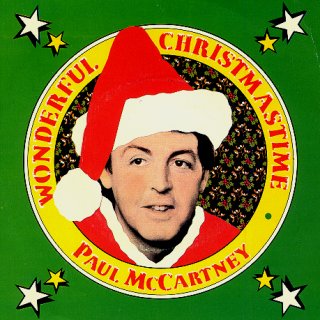
6. Wonderful Christmastime – Paul McCartney. My Beatles thing influencing me again. Bouncy, upbeat, hopelessly optimistic. In short, perfectly Paul.

7. God Rest Ye Merry Gentlemen – Barenaked Ladies & Sarah McLachlan. This is a really great folksy mashup  of God Rest Ye Merry Gentlemen and We Three Kings. I wish it was played more often on the radio.

8. Let It Snow, Let It Snow, Let It Snow – Dean Martin. The definitive version by the always smooth, slightly intoxicated Dino.

9. Have Yourself a Merry Little Christmas – Judy Garland. This is a sad song anyway, but when Judy sings it, it’s got a tragic, almost heartbreaking feel about it. If you’re a potential holiday suicide candidate, stay away from this one.

10. Sleigh Ride – Leroy Anderson. The original version, and for me the signature tune of the Christmas season.

11. Holly Jolly Christmas – Burl Ives. Another childhood memory, this time from Rudolph the Red-Nosed Reindeer. Whenever I hear this song, I don’t think of Burl Ives, I think of Sam the Snowman.

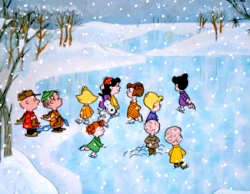
12. Christmastime Is Here – Vince Guaraldi Trio. From the opening scene of A Charlie Brown Christmas, where the Peanuts gang is skating. Whenever I hear this song, in my mind I also hear the sound effects from the cartoon. Weird.

13. The Christmas Song – Nat King Cole. The definitive version from the definitive voice. Classy, smart and timeless.

14. Do You Hear What I Hear? – Bobby Vinton. When my mom tucked me in every Christmas Eve, she let the small radio play next to my bed so that I could listen to the news bulletins tracking Santa’s movements across the globe (I always dozed off when he was up around Newfoundland). For some reason, this version of this song was always on that station, and thus became welded to my childhood Christmas memories.

15. Santa Claus Is Coming To Town – Bruce Springsteen. Proof that you can be cool and rock Santa Claus. I wonder: Did Clarence ever get that new saxophone? Good stuff.

17. The Little Drummer Boy – Harry Simeone Chorale. Another memory from the radio next to my bed on Christmas Eve.

18. Rockin’ Around The Christmas Tree – Brenda Lee. It was only very recently that I actually saw a picture of Brenda Lee for the first time. I had always imagined her looking like Sandra Dee. You cannot imagine my disappointment.

Sandra Dee


Brenda Lee

18. White Christmas – Bing Crosby. Bing’s original rendition is ancient and perfect.

19. O Holy Night – Mario Lanza. A voice from the heavens, crazy powerful and booming, almost compelling you to “fall on your knees” and ‘hear the angel voices.” Perhaps the greatest vocal performance of all Christmas songs.

20. Silver Bells – Elvis Presley. The King, doing his Christmas thing. A bit bluesy, all Elvis. Thank you, thank you very much.

21. Baby, It’s Cold Outside – Steve Lawrence and Eydie Gorme. Steve and Eydie did a few Christmas songs that I like, and I inadvertently left them off the list, until reminded by the intrepid Melissa Smith. Curiously, though, I can’t think of Steve & Eydie without being reminded of the Sinatra Group, an SNL skit that was a send up of the McLaughlin Group. Mike Myers and Victoria Jackson do a great job, with the late, great Phil Hartman as ol’ Blue Eyes.

Have a swinging Claus-Day, Jack.

Happy Thanksgiving! I Might Be OCD! (No, I’m Sure Of It Now.)

I love holidays. This is tied very closely to my love for traditions and seasons, which I think, is tied very closely to my need for order and predictability. Let me explain.

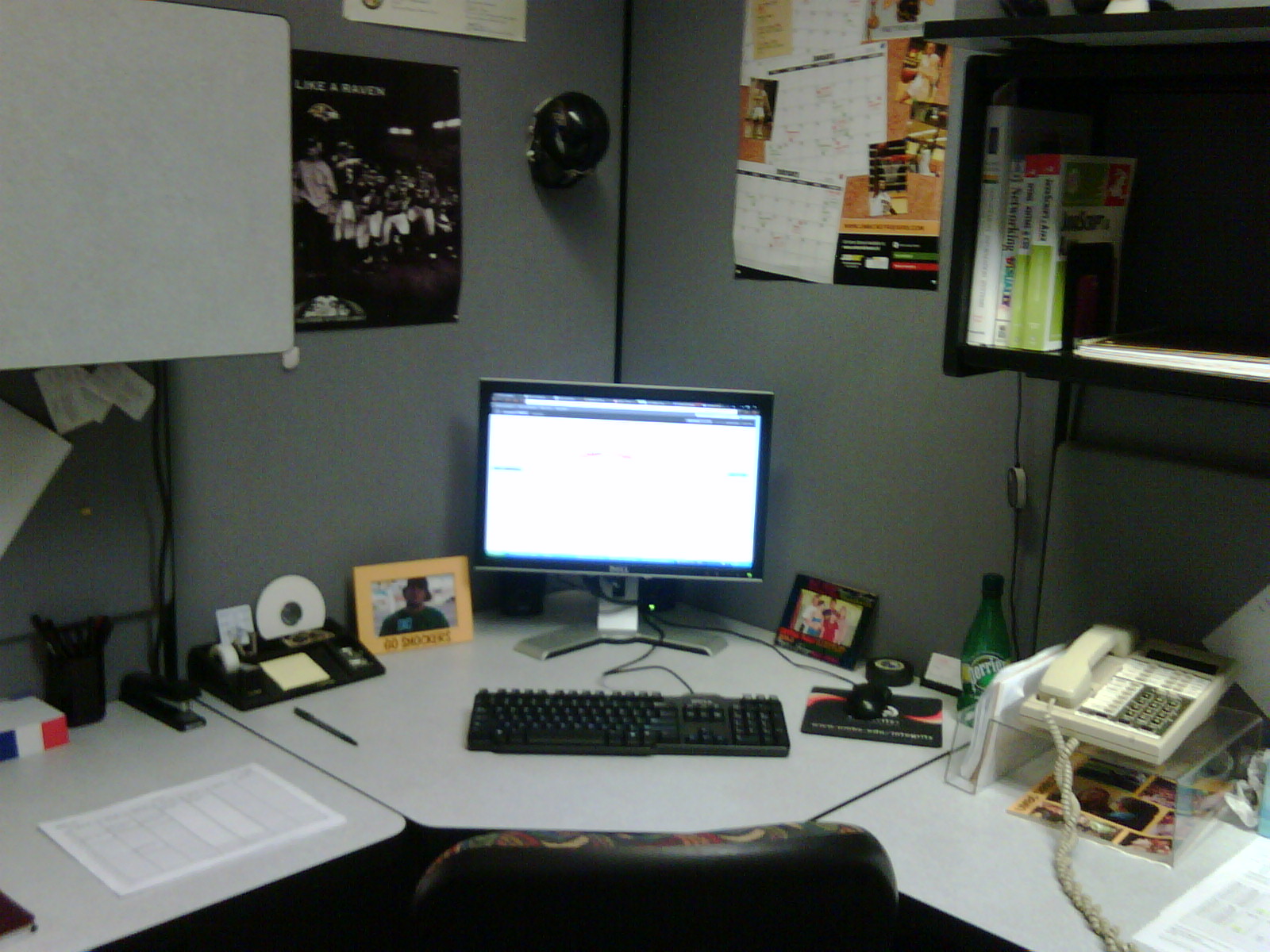
My desk is very neat and very regimented. Everything has a place, and everything is in its place – all the time. I don’t like things to be drifting into areas where they do not belong, because, well, that’s not where they belong. When something is displaced, I notice and return it immediately. There is order in my universe.

My orderly universe

I also love the seasons, especially the changing of the seasons. I like how there’s a definitive start and stop date to seasons, and I ensure that my personal routines adhere to this framework as much as possible. For example, I will not turn on the heat in the house before November 1st – period. That’s when my heating season starts. On the other side of the year, I will not turn on the air conditioning until June 1st. Every fall, I neatly fold my “summer clothes,” tee shirts, shorts, etc., and box them away in the closet until spring, replacing them in my dresser with the sweatshirts that had been stored away for the previous six months. I guess this is my way of marking the passage of the seasons, and thus the passage of time, in an orderly, disciplined manner.

Likewise, my holiday schedule is similarly regimented. Halloween decorations are to be displayed from October 1-31 only, because September isn’t Halloween season yet and November is Thanksgiving season. So, on November 1st every year, the Halloween decorations return to their boxes and the Thanksgiving decorations go up. On the day after Thanksgiving, “Black Friday,” I can’t be bothered with shopping, because that is the day when the Thanksgiving decorations must go away, being replaced by the Christmas decorations. (While we decorate, my wife and I prepare a second, smaller Thanksgiving meal, because we rarely get enough leftovers from the actual feast.) Because of the sheer number of decorative items and the degree of difficulty involved (the tree alone may take hours to adorn satisfactorily), I allow Friday and Saturday to complete this task. But be assured, by the end of the Saturday after Thanksgiving, it is done. Christmas season officially ends for me on January 1st. On that day, all the Christmas decorations will come down and be stored away for the year. This act officially ends my holiday season.

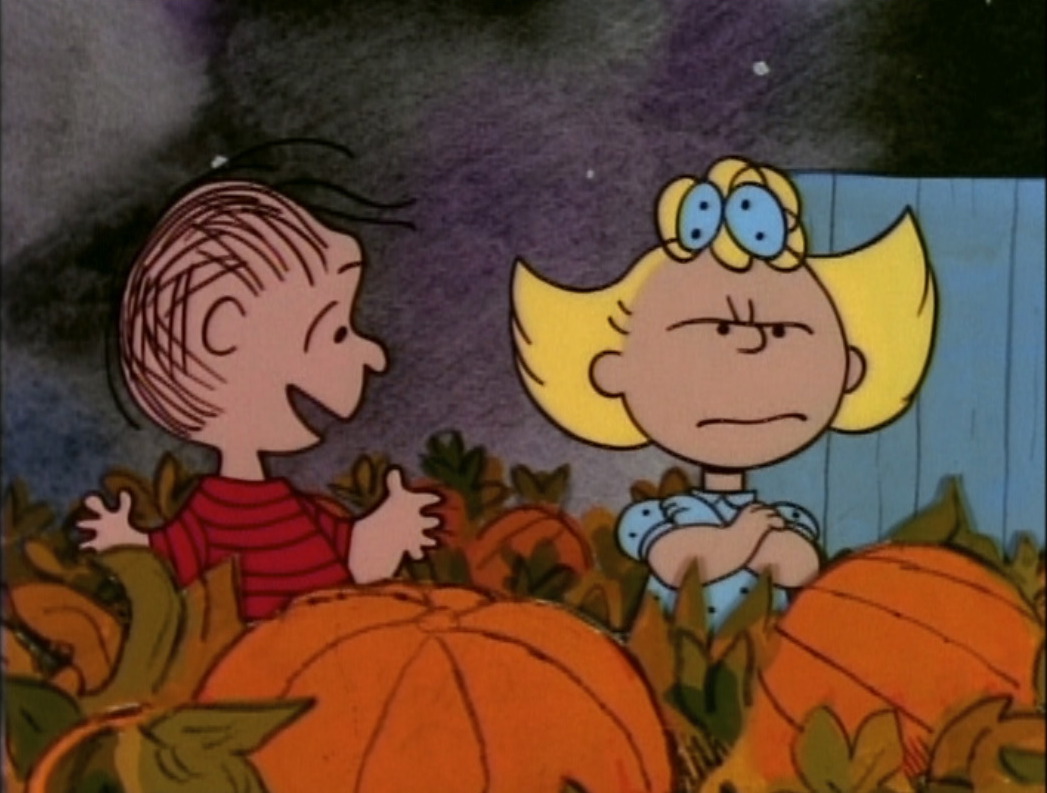
But really, it goes farther than this. During the various holiday seasons, there are certain activities that I must engage in, or else I’ll feel like I’ve missed out on a key component. For example, I must watch all of the original Charlie Brown specials in their appropriate season (The Great Pumpkin, Charlie Brown Thanksgiving & Charlie Brown Christmas).

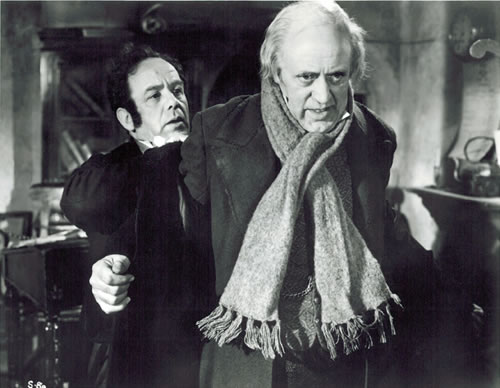
I must also see all of the other TV specials from when I was a child (The Grinch, Frosty the Snowman, Rudolph, etc.)  I must also watch Alastair Sims’ 1951 version of A Christmas Carol.

"It's not convenient - and it's not fair!"

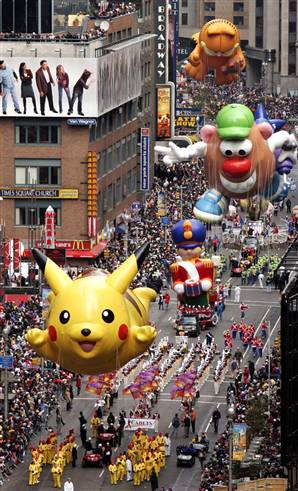
Now back to Thanksgiving. Today, I will wake up and watch the Macy’s Thanksgiving Day Parade on NBC. I will not pay much attention to the Broadway nonsense and endless interviews with actors from struggling NBC television shows, but I will become increasingly focused during the last 90 minutes as the ratio of inflatables to dancers picks up. I will attempt to interest my (now teenage) children in this and they will be less than excited (but that’s part of the tradition, too).

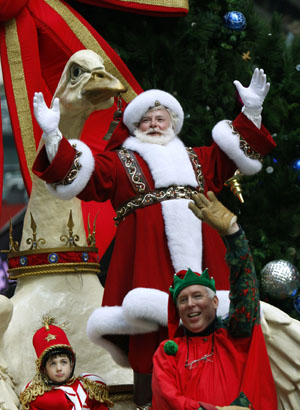
At the end of the parade, I will not take my eyes from the screen until Santa has disappeared. This may take a few minutes, as he continues to smile, wave and Ho, Ho, Ho as the credits roll for what seems like forever. But he is Santa, so I will wait.

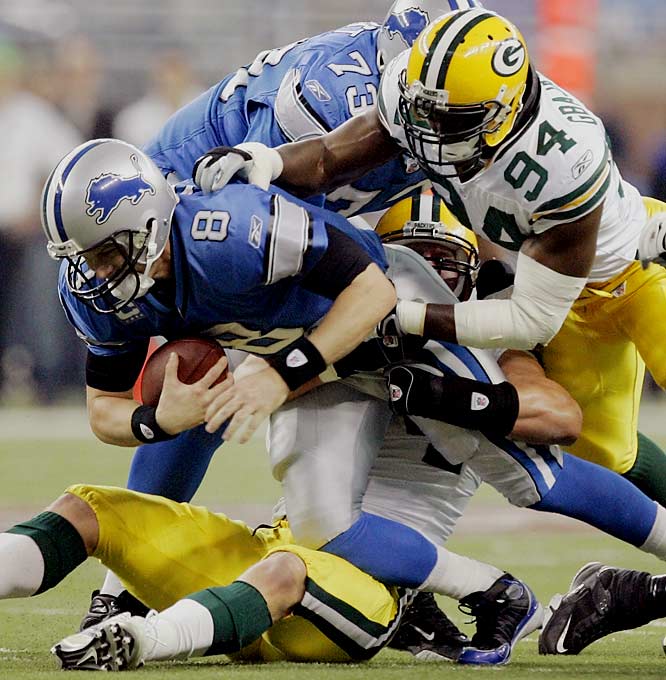
After the parade, the television goes to football, where I must watch the Detroit Lions valiantly struggle against their inevitable fate, almost as if they were the central character in a Greek tragedy. Struggle they may, but in the end, they will be vanquished by whatever team is lucky enough to be playing them (this year it’s the Packers). At halftime, my wife, our children and I will leave our home and make the short drive to her mother’s home, where the Lions game will be waiting for us. Watching the Detroit Lions lose is also an important part of my Thanksgiving routine.

About the time the Lions’ opponents are running out the clock, dinner will be served; the fare is predictable and correct to the holiday. During the meal the television will be switched over to the Cowboys game, but I feel that this game is more peripheral to the day, and so I watch it with less intensity, often times dozing off. Eventually, the “let’s get ready to go home,” noises start to be made, the children are rounded up, and we, with a few token leftovers as souvenirs, make our way home to prepare for the work ahead of us on Friday and Saturday.

With all of this having been accomplished, with each benchmark having been achieved, I will feel satisfied that one season has successfully passed into another, and I didn’t miss anything in the process. It will have been a good Thanksgiving.

I wish an equally wonderful Thanksgiving for each of you today.

Help Desk Thanksgiving Party!

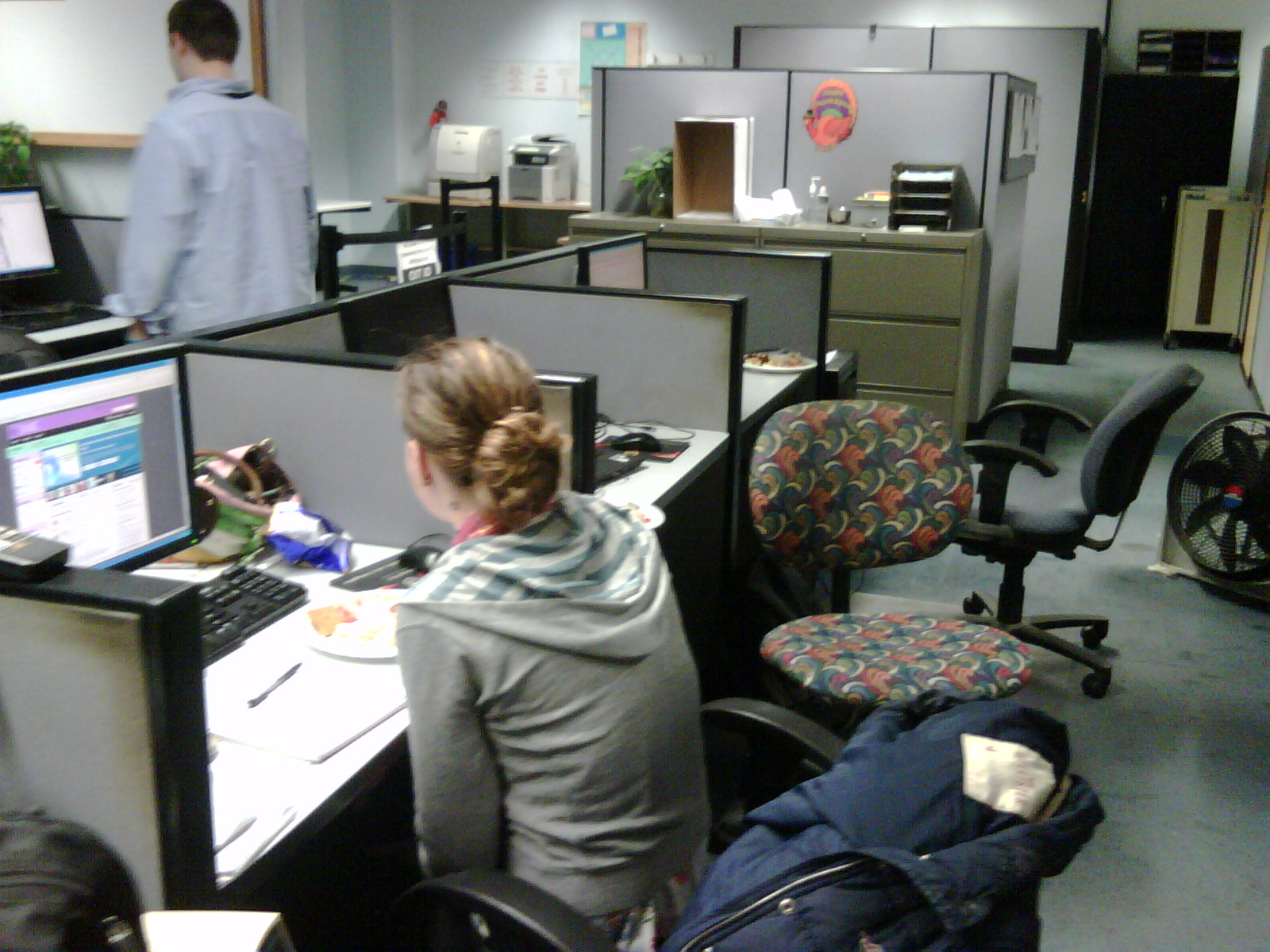
Today, the Help Desk was the scene of an all-day potluck dinner. Lots of folks brought in food, desserts and beverages. Here’s the menu (I think this is everything):

Sliced turkey, Cranberry sauce, Deviled Eggs, Apple Pie, Stuffing, Crab Dip, Chocolate cake, Pumpkin Pie, Green Bean casserole, Sweet Potato Pie, Shrimp Cocktail, vegetable platter, chips & soda.

Here are some photos:


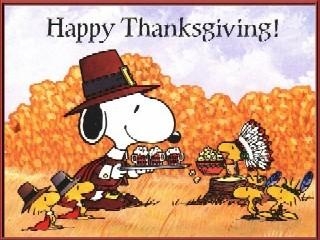
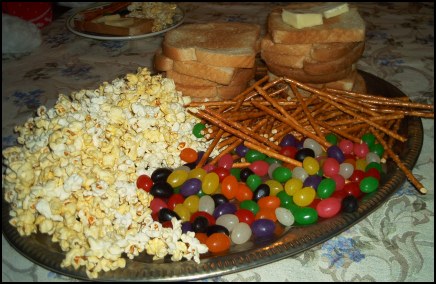
If we had been at Charlie Brown’s house, this would’ve been the fare:

Happy Thanksgiving!

Addendum: It’s only 2PM, and I’ve already consumed more calories than I would in an average day (the Belgian Chocolate cake finally got me). Not good! (And there’s still tomorrow…)


My First, Largely Wasted Semester of Grad School

This fall I entered into my first semester of graduate school. (One of the cool perks of being a UMBC staff member is that the tuition is completely remitted. Make that a very cool perk.)

My undergraduate degree is in History, but my career path has taken me to DoIT at UMBC, so continuing my history education didn’t make much sense. Also, I needed a graduate degree that I could pursue online. For these reasons, I selected the UMBC Online Information Systems program, which fit all of my needs. The folks both at UMBC’s Graduate School and at the IS Department were great, and I was quickly accepted (because of my undergrad GPA, I didn’t have to take the GRE). (Here I also need to thank Drs. Laurie, Kars & Lindenmeyer for their recommendations on my behalf, not once, but twice. But more on that later.)

With the help of my graduate advisor (and Program Manager) Shannon Keegan, I was soon enrolled in my first two classes: IS 607, Intro to Information Systems, and IS 631 Management Information Systems. My books arrived by mail a few weeks before the start of the semester; I was ready to go.

One of my first thoughts upon starting the semester was how little the degree of difficulty seemed to have changed from my undergraduate courses. I guess I was expecting the coursework to be really, really heavy, but it was actually pretty manageable, even with a full-time job. I was used to getting A’s, but had been worried that I’d get less than a B as a graduate student and be disgracefully booted from the program. A couple of weeks into the fall semester, that fear was gone. (Don’t worry, it comes back.)

In IS 607, the coursework started with basic HTML, which seemed ridiculously easy. During the first week or two, we were asked to write simple HTML webpages and then upload these to our personal userpages for viewing by the instructor. (This is around the time when I was deciding that getting a master’s degree was going to be cake.) In IS 631, the assignments were much like what I had grown used to as a history major: read, take an online quiz (as many times as you needed to get 100%), submit a chapter evaluation to the discussion board, and write a short paper every few weeks. Again, cake.

By October, IS607 had moved out of HTML and into CSS style sheets. This is when I started remembering how much I hate coding. I mean really hate coding. But it was still OK, because there were plenty of workable examples I could use as a template (in the book and online) and I could modify these and learn enough to get by – for a time.

By mid-October, the class had moved into JavaScript, and I was panicked and lost. Hours and hours were spent banging away at the keyboard, bleary-eyed and wondering why pages weren’t rendering the way they were supposed to. More hours were spent doing internet research, trying to figure out what I was doing wrong, what key element I was missing in my code. This however, just added layer upon layer of suggestions and confusion to my already messy code, and before too long, I couldn’t tell what was broken and what worked anymore. I hate coding. I really do. I began to question whether I was cut out for online learning; maybe I needed an instructor in front of me two or three times a week. Maybe I’m just stupid.

OK, now... what's not quite right with this code...

I looked at the course catalog. Was IS607 really critical? Oh, it was not just critical, it was a prerequisite for every other class in the catalog. Awesome. Just awesome.

By Halloween, I had come to the grim and deflating decision that I had been defeated by IS607. I would withdraw, not just from the course, but from the Online IS program. I had been totally and utterly defeated – by JavaScript, no less.

Fortunately, I found another online graduate program that is more in line with my strengths, the Online Master’s in Instructional Systems Development – Training Systems. This program is more about people than code, which suits me far better, but still relates to my career in IT (think online learning, Blackboard, etc.). Even though it seemed like a lateral move to me, I had to reapply to the Graduate School ($50), forcing me to get my three recommendations all over again (thanks again Drs. Laurie, Kars & Lindenmeyer). But, that’s all done now, and I’m just waiting for the official word that I’ve been accepted so that I can get my spring classes set up.

Chuck Hodell, the nice guy at the ISD program who also wrote the book on ISD - literally!

What about IS631, you say? Well, I’m still acing that, although I must admit, not knowing if the credits will be transferable has certainly lowered my motivation, making even routine assignments feel like heavy lifting. Reading and then writing about something you won’t be needing in a few weeks gets progressively more difficult. So why not just withdraw from this class, too? Because I hated the feeling of being whipped by a class, and also it seems like such a waste, especially at this late point in the semester. I figure I might as well finish, get my A, and salvage a moral victory from my experiences this fall.

So it goes.